Thank you for visiting this site. This article covers “The St. Petersburg Paradox.”
If the expected value of a game is mathematically infinite, how much would you pay to play? $100? $10,000? $1,000,000? In theory, no entry fee is too high — “in the long run you can’t lose.” Yet in practice almost everyone would pay only a few dollars. This gap between intuition and theory is the heart of a paradox that has been debated for over 300 years.
The Rules
The rules are simple.
Flip a fair coin until heads appears. The prize is determined by which flip produced the first heads.
- Heads on flip 1 → prize: $2
- Heads on flip 2 → prize: $4
- Heads on flip 3 → prize: $8
- Heads on flip 4 → prize: $16
- Heads on flip n → prize: $2ⁿ
The later the first heads, the larger the prize doubles.
Computing the Expected Value
Expected value is the average payoff over many plays.
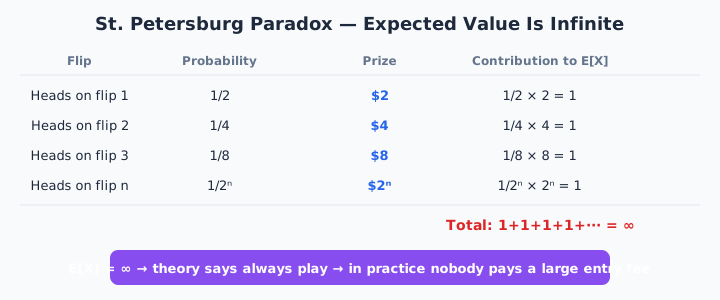
- First flip is heads (probability 1/2), prize $2 → contribution: 1/2 × 2 = $1
- Second flip is the first heads (probability 1/4), prize $4 → contribution: 1/4 × 4 = $1
- Third flip is the first heads (probability 1/8), prize $8 → contribution: 1/8 × 8 = $1
- …
Every stage contributes exactly $1 to the expected value. Since this continues infinitely, Expected value = 1 + 1 + 1 + 1 + … = infinity.
An infinite expected value means that, in theory, no entry fee — $1 million, $1 billion — is too much to pay. You should always play, because in the long run you come out ahead. Yet essentially no one would pay even $100 for a single play.
Why Intuition Says No
Thinking it through, there are several reasons.
First, the probability of a large prize is astronomically small. Getting 20 consecutive tails has probability roughly 1 in a million. To win more than $1 million, you need million-to-one luck.
In most cases — 75% of the time — the prize is $4 or less. If you pay $100 to play, you lose money on three plays out of four.
The expected value is infinite because an astronomically small probability of an astronomically large prize keeps contributing $1 per term forever. But in any realistic number of plays during a human lifetime, the outcome is almost certain to be far below infinity. The limit “works” only over a number of trials that will never be reached.
Bernoulli’s Solution: Utility Theory
The first resolution was proposed by Swiss mathematician Daniel Bernoulli in 1738 (presented at the St. Petersburg Academy of Sciences — hence the name).
Bernoulli argued that people do not evaluate outcomes in terms of money alone, but in terms of the utility (satisfaction) that money provides.
For a person who already has $1 million, receiving another $1 million is not twice as satisfying as it was to receive the first million. The utility of money increases at a diminishing rate (roughly logarithmically) as amounts grow larger.
Replacing dollar amounts with their utilities in the expected value calculation produces a finite result. This caps the reasonable entry fee at some finite amount — the paradox dissolves.
The Debate Continues
Bernoulli’s utility theory is widely accepted as one resolution, but it is not final. If you modify the game to pay out prizes that grow even faster than a person’s utility diminishes, the paradox returns.
Modern economics and decision theory analyze the St. Petersburg Paradox through multiple lenses: risk aversion, finite lifespans, diminishing marginal utility, and more.
The most lasting lesson may be that expected value alone is an insufficient guide to rational decision-making.
In a real game the expected value is finite
The expected value comes out infinite because of the assumption that the house can pay any amount. Drop that assumption and the answer changes completely.
Recompute with the house’s capital as a ceiling and the payable expected value works out as follows.
| The house’s capital | Approximate expected value |
|---|---|
| $10,000 | about $14 |
| $10 million | about $24 |
| $10 billion | about $34 |
| Equivalent to world GDP | about $47 |
Multiply the capital by a thousand and the expected value rises by about $10. It grows only logarithmically, so within any realistic range it comes to a few tens of dollars at most.
The infinite expected value, in other words, is a mathematical statement; any game that can actually be run has a finite and rather small value.
That supports an explanation of why intuition says “I would not pay that much”: it has been quietly factoring in the house’s ability to pay. The economist Karl Menger pointed this out in 1934, and it is regarded as one of the strongest resolutions.
The limits of explaining it by diminishing utility
Bernoulli’s utility-theoretic resolution has a known weakness too.
Assume logarithmic utility and the expected utility is finite — but build a game whose prizes grow faster still and the expected utility becomes infinite even under logarithmic utility.
- The original game: prizes grow as powers of two, and logarithmic utility keeps it finite
- The modified game: prizes grow as an exponential of an exponential, and it diverges even so
- The conclusion: unless the utility function is bounded, the same problem can be rebuilt
Paul Samuelson and others set this out in the 1960s, and it is known as the super St. Petersburg paradox.
Assuming utility is bounded avoids it, and then a different question appears: is there a ceiling on human satisfaction?
That is why a 300-year-old problem still appears in decision-theory textbooks. Each time it looks resolved, it comes back in a stronger form.
What people actually pay
Apart from the theory, there are experiments on what people will actually pay.
What the studies have in common is that the median offer sits somewhere in the range of a few dollars to a few tens of dollars. Explaining that the expected value is infinite does not move it much.
| Explanation given | Rough tendency in willingness to pay |
|---|---|
| Rules only | a few dollars |
| Told the expected value is infinite | rises slightly, same order of magnitude |
| After playing a few rounds | sometimes falls |
The third row is the interesting one. Play it and the prize is a handful of dollars in almost every round, so willingness to pay goes down.
- Probability the prize ends at $4 or less: roughly three quarters
- Probability the prize exceeds $1,024: under one in a thousand
- What holds the expected value up: the enormous prizes that essentially never occur
That the expected value is generated by events that will not happen in a lifetime is the source of the clash with intuition.
Situations where expected value cannot be used
The practical lesson to draw from this paradox is that expected value is not a universal measure.
Expected value is reliable when the same bet can be repeated enough times, because the law of large numbers takes hold.
In the following situations, though, expected value alone leads to bad judgements.
- You only get one attempt: there is no opportunity to converge on the average
- The tail of the distribution is extremely long: rare events dominate the expected value
- Bankruptcy is possible: run out of capital along the way and you cannot enter the remaining rounds
The third is especially important, and it is the background against which money-management ideas such as the Kelly criterion arose.
Even with a positive expected value, staking your whole capital every time eventually bankrupts you. That “profitable on average” and “profitable for me” are different things is, to my mind, the single most important point in both investing and business.
Related paradoxes of rational choice
Related paradoxes where a judgement made rationally still ends up inconsistent, or with no settled right answer.
Summary
This article covered “The St. Petersburg Paradox.”
Proposed three centuries ago, this paradox reveals the gap between mathematical probability and real human decision-making. The fact that people refuse to pay large amounts for a game with infinite expected value may actually reflect something right about human judgment — not a failure of rationality.
To return to the full list of paradoxes, follow the link below.
Thank you for reading. We hope to see you in the next article.
Also popular with readers
📚 Series: The World's Paradoxes (28/81)