Thank you for visiting this site. This article covers one of the most famous of all paradoxes: “Achilles and the Tortoise.”
This paradox was conceived by the ancient Greek philosopher Zeno in the 5th century BCE, and it has been passed down through philosophy and mathematics for nearly 2,500 years. The premise is remarkably simple: the fastest hero of Greek mythology — Achilles — can never catch a lumbering tortoise. Logic, apparently, proves it.
What Is the Achilles and the Tortoise Paradox?
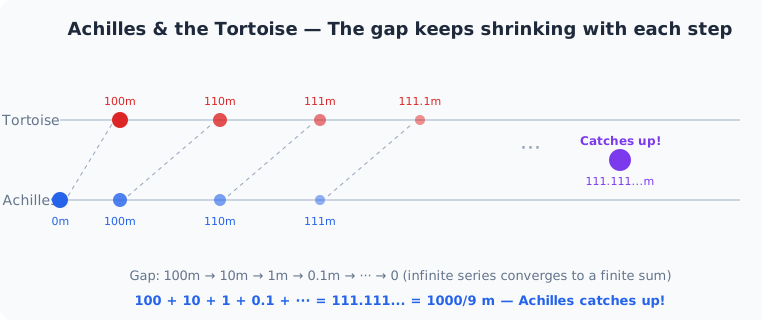
Here is the setup. Achilles races a tortoise, but the tortoise is given a head start. Say the tortoise starts 100 metres ahead.
Achilles is far faster, so he first runs to where the tortoise started — 100 metres away. But by the time Achilles reaches that point, the tortoise has moved a little further. Say the tortoise has now advanced 10 metres, putting it at the 110-metre mark.
Achilles runs to 110 metres. But again, while he was running, the tortoise inched forward — say another 1 metre, to 111 metres.
Achilles reaches 111 metres — and the tortoise is now 0.1 metres ahead…
Each time Achilles reaches “where the tortoise was,” the tortoise has always moved a little further ahead. The logic seems to conclude that Achilles can never catch the tortoise.
Why Is This a Paradox?
In the real world, there is no way Achilles can fail to catch a tortoise. Common sense tells us the swift Achilles would overtake it in moments.
Yet Zeno’s logic appears airtight. “Achilles reaches the tortoise’s last position → the tortoise moves a bit further → he chases again → it’s a bit further still…” This infinite repetition seems to keep Achilles perpetually behind.
Our intuition says “of course he catches it,” yet logically refuting the argument turns out to be surprisingly hard. That gap is the heart of the paradox.
Zeno used this paradox to challenge the very concepts of “motion” and “infinite divisibility of space.” If motion truly exists, why does logic produce this apparent contradiction?
The Modern Mathematical Resolution
This paradox troubled philosophers for over 2,000 years, but developments in mathematics from the 17th century onward provided a clear answer: the convergence of infinite series.
Yes, there are infinitely many steps before Achilles catches the tortoise. But the time for each step gets smaller and smaller.
Let’s calculate concretely. Suppose Achilles is ten times faster than the tortoise.
- Step 1: Close a 100-metre gap → 10 seconds
- Step 2: Close a 10-metre gap → 1 second
- Step 3: Close a 1-metre gap → 0.1 seconds
- Step 4: Close a 0.1-metre gap → 0.01 seconds
- …
The total time is 10 + 1 + 0.1 + 0.01 + … This is an infinite sum, yet its total converges to 11.111… seconds — roughly 11.11 seconds. An infinite number of steps can sum to a finite amount of time.
Zeno’s trick lay in the implicit assumption that “infinitely many steps = infinite time.” In reality, if each step is short enough, the total remains finite.
What Zeno Really Meant
Zeno never sincerely believed “Achilles cannot catch the tortoise.”
Zeno devised these paradoxes to defend his teacher Parmenides, who argued that “existence is one and unchanging” and that “motion” and “change” are illusions. Zeno aimed to show that the common-sense view of motion as real contains a logical contradiction — a reductio ad absurdum argument.
This Paradox’s Lasting Influence
Achilles and the Tortoise had an enormous impact on subsequent mathematics and philosophy.
Much of the rigorous formulation of infinite series and the concept of limits emerged precisely from attempts to answer this paradox. The concept of a “limit” — the foundation of calculus — can be seen as mathematics’ direct response to the question Zeno posed.
In philosophy, the paradox is still debated today. Mathematics may have “solved” it, but the philosophical question of whether we can truly understand why an infinite series of time intervals sums to something finite remains open.
Mathematics provides an answer; our intuition still struggles to fully accept it. That lingering unease is perhaps the very essence of a paradox.
Its relation to Zeno’s other paradoxes
Achilles and the tortoise is one of Zeno’s paradoxes of motion. Four have come down to us, and they are built to complement one another.
| Name | Content | What it attacks |
|---|---|---|
| The dichotomy | to reach a destination you must first cover half the way | the infinite divisibility of space |
| Achilles and the tortoise | to catch up you must reach where the other one was | the infinite divisibility of space |
| The arrow | at each instant the arrow is at rest | the indivisibility of time |
| The stadium | a contradiction derived from the relative speed of passing bodies | minimal units of time and space |
What I find interesting is that the first two and the last two attack from opposite directions.
The dichotomy and Achilles press on the difficulties that follow if space can be divided without limit. The arrow and the stadium press on the difficulties that follow if instead there are indivisible minimal units.
Zeno is closing a pincer: a contradiction appears whether you hold that things can be divided or that they cannot.
The arguments are taken to have been made in defence of his teacher Parmenides, who held that motion and change are illusions of the senses and that what is real is unchanging.
Solved in mathematics, still open in physics
That the sum of an infinite series converges to a finite value was formulated rigorously in the nineteenth century. That disposes of the mathematical problem.
The question of whether space and time really are infinitely divisible, however, is still open in physics.
- The Planck length: about 1.6 × 10⁻³⁵ metres. Whether shorter distances mean anything is unknown
- The Planck time: about 5.4 × 10⁻⁴⁴ seconds, equally unclear
- Theories of quantum gravity: several proposals treat spacetime as discrete
If spacetime does have a minimal unit, the premise of the dichotomy fails outright. Zeno’s stadium might then be the one that bites.
A question from 2,500 years ago runs continuously into a question at the front edge of physics. It is a good illustration of how long-lived a philosophical question can be.
Infinitely many additions summing to something finite
It is worth looking a little more concretely at the content of the mathematical resolution.
Suppose Achilles runs ten times as fast as the tortoise, which starts 100 metres ahead. The stages up to the moment he catches it lay out as follows.
| Stage | Distance Achilles covers | Running total |
|---|---|---|
| 1 | 100 metres | 100 |
| 2 | 10 metres | 110 |
| 3 | 1 metre | 111 |
| 4 | 0.1 metres | 111.1 |
| 5 | 0.01 metres | 111.11 |
The stages continue without end, and the total approaches 111.111… metres — that is, 111 and 1/9 metres, a finite value.
Adding infinitely many terms can still give a finite sum. This is the convergence of a geometric series, a notion not available in Zeno’s day.
The same holds for the time taken. The duration of each stage shrinks in the same ratio, so the total converges to a finite time.
In short, passing through infinitely many stages and taking an infinite amount of time were two different things. Confusing the number of stages with the time or distance required is what the paradox really consists of.
Related paradoxes involving infinite operations
Related paradoxes where the idea of dividing infinitely finely collides directly with intuition.



Summary
This article covered Zeno’s paradox, “Achilles and the Tortoise.”
Conceived 2,500 years ago, this problem still confronts us with the strangeness of infinity. Modern mathematics resolves it through the convergence of infinite series, yet the fact that infinitely many intervals can sum to something finite remains genuinely astonishing on reflection.
To return to the full list of paradoxes, follow the link below.
Thank you for reading. We hope to see you in the next article.
Also popular with readers
📚 Series: The World's Paradoxes (2/81)