
Thank you for visiting this site. This article covers “Berkson’s Paradox.”
“Handsome guys have bad personalities” or “Beautiful women aren’t very smart” — you may have heard stereotypes like these. In reality, appearance and personality shouldn’t be correlated at all, so why do these impressions arise? A statistical trap is lurking beneath the surface.
Alongside Simpson’s Paradox, Berkson’s Paradox is one of the classic pitfalls in statistics, with broad effects on data analysis and everyday judgment.
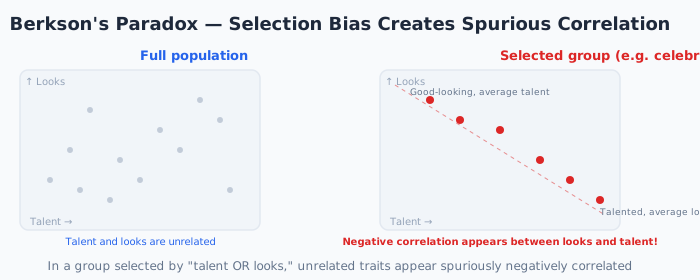
What Is Berkson’s Paradox?
First noted by American statistician Joseph Berkson in 1946, this paradox occurs when two traits that are genuinely unrelated in the full population appear negatively correlated when observed only within a particular subset.
Consider a concrete example. Suppose that in the overall population, “looks” and “personality” are completely unrelated.
Now suppose you only consider dating candidates who meet at least one of two conditions: “above-average looks” or “above-average personality.” Anyone with both below average simply never enters your consideration.
Something strange emerges within this candidate pool. Someone with exceptional looks is in the pool even without good personality (their looks alone qualify them). Conversely, someone with exceptional personality is in the pool even without great looks.
The result: within the candidate pool, people with better looks tend to seem to have worse personalities.
Understanding It with a Graph
A scatter plot makes this clearer. Put looks on the horizontal axis and personality on the vertical axis, and plot the entire population as points. If the two traits are unrelated, the points scatter uniformly over a square.
Now filter by the condition “looks + personality ≥ some threshold.” Only the upper-right triangle of the square remains. Within this triangle, higher looks (moving right) tends to correlate with lower personality (moving down), and a negative correlation appears along a diagonal line.
This is a mathematically inevitable outcome. Once you impose a lower bound on the sum (i.e., condition on it), high values of one variable can compensate for low values of the other — structurally generating negative correlation.
The Problem in Medical Research
Berkson originally raised this issue in the context of medical research.
When studying the relationship between two diseases using hospital data, a negative correlation can appear between diseases that are actually unrelated.
This happens because hospital patients are “people admitted for some reason.” Patients admitted for disease A are included regardless of disease B; patients admitted for disease B are included regardless of disease A. But healthy individuals (who have neither A nor B) are not in the hospital, so the sample is biased in a way that creates a spurious correlation. For example, if diabetes and fractures appear negatively correlated in hospital data, that may not mean diabetes protects against fractures — it may simply be an artifact of the admission bias.
What it looks like on social media
Berkson’s paradox occurs constantly on today’s social platforms.
Most of the posts you see are either interesting or generating outrage, or both. A post that is dull and provokes nobody never reaches your timeline in the first place.
The impression that follows is that the more interesting a post, the less likely it is to blow up, or that posts causing a storm are dull. There may be no real correlation between how interesting something is and how likely it is to provoke; the sample you see is skewed, and an apparent correlation appears.
Examples in Everyday Life
Berkson’s Paradox lurks in many familiar settings.
Movie reviews: You might feel that “big-budget movies tend to be boring.” But the movies you watch are ones you chose because they’re either “cheaply made but interesting” or “widely talked about.” Low-budget boring films never reach your radar; high-budget boring films do (through publicity). So within the films you watch, budget and quality appear negatively correlated.
Restaurant ratings: “Cheap places taste better” may partly follow the same logic. You choose restaurants that are either “cheap” or “well-reviewed.” Expensive and mediocre restaurants and cheap and mediocre restaurants both get filtered out, so within the restaurants you visit, price and quality appear negatively correlated.
Job market: “High-paying jobs are demanding” can be partly explained the same way. Jobs people apply for tend to be either “well-paying” or “easy,” and jobs that are both low-paying and demanding attract few applicants in the first place.
How It Differs from Simpson’s Paradox
Berkson’s Paradox is often confused with Simpson’s Paradox, but the mechanisms differ.
Simpson’s Paradox is when the direction of a correlation reverses between the aggregate and the sub-groups. It arises because of a confounding variable (a third variable).

Berkson’s Paradox, by contrast, arises from restricting (conditioning on) the sample to a specific subset. No confounding variable is needed — a spurious correlation emerges from the way the sample is selected alone.
How to Guard Against It
To avoid Berkson’s Paradox, it is crucial to always be conscious of how the group being analyzed was selected.
Drawing general conclusions from a group filtered by specific criteria — hospital patients, viral social-media posts, your pool of dating candidates — is dangerous. Verifying conclusions against data from the full original population is the basic defense against being misled by apparent correlations.
“Does this conclusion hold in the full dataset too? Or is my sample simply biased?” Keeping this question in mind is the best protection against Berkson’s Paradox.
Selection is what creates the correlation
The substance of Berkson’s paradox is that the selection criterion itself introduces a false relationship into the data collected.
Gather only the people who satisfy a condition and that condition creates a subtractive relationship between two attributes, because if one is low the other has to be high to get through the filter.
| Where the selection happens | The criterion | The false negative correlation produced |
|---|---|---|
| Students at a famous university | high academic ability or a special talent | the strongest students look unremarkable in other ways |
| Hospital inpatients | some serious symptom | disease A and disease B look negatively related even when unrelated |
| Employees who were hired | sufficient experience or raw ability | the most experienced look the least sharp |
| Candidates for a relationship | good looks or a good personality | the best-looking people seem to have the worst personalities |
The fourth is commonly voiced as the belief that attractive people have bad personalities; in all likelihood it only appears that way.
Even with no relationship between looks and personality in the population at large, people who are low on both drop out of the candidate pool, so a negative correlation appears among those who remain.
Clues for noticing it
The awkward part is that looking at the data alone will not tell you that a selection occurred. What you hold is the post-selection data, and what is missing from it is invisible.
- Check where the data came from: on what conditions were these people assembled?
- Look at the shape of the scatter plot: is the bottom-left unnaturally empty?
- Compare against population data: does the same relationship hold overall?
The second is the practical clue. Data affected by Berkson’s paradox takes on a roughly triangular shape, with the low on both region missing.
When an analysis returns an unexpected negative correlation, the first thing to ask is how this data was collected. Suspecting the way the sample was built is usually faster than interpreting the correlation.
Related paradoxes that defy probabilistic intuition
Related paradoxes where the arithmetic is correct and the answer refuses to sit with intuition.




Summary
This article covered “Berkson’s Paradox.”
A correlation observed in a biased sample is not necessarily a real-world correlation. This lesson is valuable in every situation involving data — from everyday decisions to academic research.
Knowing that “attractive people have bad personalities” is a statistical illusion may subtly change how you see the world.
To return to the full list of paradoxes, follow the link below.
Thank you for reading. We hope to see you in the next article.

Also popular with readers
📚 Series: The World's Paradoxes (77/81)