Thank you for visiting this site. This article covers “The Deterrence Paradox.”
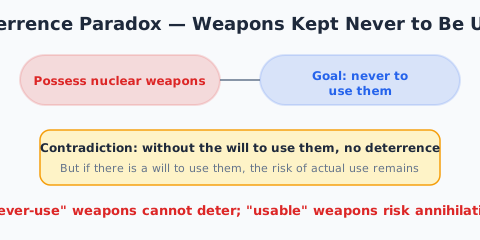
Nuclear weapons possess the destructive power to wipe out humanity many times over. Yet precisely because these terrifying weapons exist, direct war between nuclear-armed states has not occurred, or so the argument goes. The paradoxical logic of “possessing weapons in order not to use them” is the very core of deterrence — and the source of its paradox.
The Basic Logic of Deterrence
The logic of deterrence runs as follows.
Country A possesses nuclear weapons. If Country B attacks Country A, Country A will retaliate with nuclear weapons. Nuclear retaliation would devastate Country B. Therefore, Country B does not attack Country A.
In short, the “fear of retaliation” “deters” the attack. The US–Soviet relationship during the Cold War had exactly this structure, known as “Mutual Assured Destruction (MAD).”
Under MAD, a state in which both sides possess enough nuclear weapons to completely destroy the other is considered “stable.” At its peak in 1986, the US and USSR together held approximately 70,000 nuclear warheads — enough to destroy the Earth dozens of times over. The deeply paradoxical situation where possessing weapons capable of annihilating all life was “the guarantee of peace.”
The Structure of the Paradox
But here is the paradox.
For deterrence to work, the adversary must believe you will “actually retaliate with nuclear weapons if attacked.” If they conclude that “that country would never actually use nuclear weapons,” deterrence collapses.
Yet rationally considered, actually using nuclear weapons is often not rational in the very circumstances where one might.
What is the point of launching a retaliatory nuclear strike after your country has already been devastated by a first strike? Your country is already destroyed; retaliation does not improve the situation. It only raises the risk that the exchange of nuclear strikes will end all human life.
So: threatening to “retaliate” is necessary for deterrence, but actually retaliating is not rational. For the threat to work, genuine willingness to retaliate is required; but a rational actor would not actually retaliate. This contradiction is the Deterrence Paradox.
In game-theory terms, the threat to “retaliate” is a “non-credible threat.” A rational player is threatening with an option they would never actually execute — and the adversary knows it.
The Cold War’s Practical Solution
The practical Cold War solution to this problem was “automating retaliation.”
If a system can be built that automatically launches a nuclear counter-strike upon detecting a nuclear attack, then even if rational leaders try to avoid retaliation, the system carries it out regardless.
The Soviet “Dead Hand (Perimeter)” system was reported to be just such a mechanism. By building a system that would automatically retaliate even if the national leadership were wiped out, the certainty of retaliation was guaranteed.
But this is a solution that entrusts the fate of humanity to an automated system — terrifying in its own right. Stanley Kubrick’s 1964 film Dr. Strangelove satirically depicts exactly this scenario of an automated retaliation system spinning out of control.
Another approach is the “Madman Theory”: by making a leader appear to act unpredictably, the threat’s credibility is enhanced — “you never know what that person might do.” President Richard Nixon reportedly used this strategy deliberately during the Vietnam War. If rational behavior makes a threat non-credible, appearing irrational restores credibility — resolving one paradox with another.
The Prisoner’s Dilemma Connection
The Deterrence Paradox has a deep relationship with game theory’s “Prisoner’s Dilemma.” Taking nuclear disarmament as an example: if both countries disarm, both are better off — but if only one disarms, it becomes defenseless against the other. As a result, both countries end up not disarming, trapped in a Nash equilibrium that is bad for everyone.
Deterrence Logic in Everyday Life
The Deterrence Paradox is not limited to nuclear weapons.
Penalty clauses in contracts are designed to ensure the penalty is “never paid.” When a penalty is actually collected, the contract has already failed. Criminal law’s harshest penalties exist to ensure crimes are “never committed.” When an execution takes place, deterrence has already failed.
Mechanisms whose success is measured by never being triggered exist throughout society. Insurance, too, follows the structure of deterrence: it is best never to need it, but you must hold it first in order to avoid needing it.
Contemporary Challenges
The Deterrence Paradox did not disappear after the Cold War. Nuclear-armed states continue to multiply (US, Russia, UK, France, China, India, Pakistan, North Korea, Israel), and the bilateral MAD model has evolved into a complex multipolar structure.
How well the traditional logic of deterrence applies to new threats such as cyberattacks and AI-enabled weapons is an open question. Cyberattacks are often difficult to attribute, creating the fundamental problem of “not knowing who to retaliate against.”
The people who built the theory of deterrence
The theoretical work on nuclear deterrence was carried out by researchers during the Cold War.
At the centre of it was the economist Thomas Schelling, who brought game theory into international politics in his 1960 book The Strategy of Conflict.
What Schelling pointed out is that for deterrence to hold, the other side has to believe the threat might actually be carried out — and the more rational a leader is, the more readily they are seen through as somebody who will not retaliate when retaliation means their own country’s destruction.
The remedies he proposed run in several directions.
| Method | What it is | The aim |
|---|---|---|
| Automatic retaliation | strike back on detection with no human in the loop | remove the room for a decision |
| Forward deployment | place your own forces on the front line | guarantee involvement if attacked |
| Delegating authority | give launch authority to field commanders | keep central hesitation from operating |
| The madman theory | make them think you might do anything | destroy the presumption of rationality itself |
What all of them share is the idea of deliberately giving up your own freedom of choice in order to make the threat credible.
Schelling likened it to two people holding hands at the edge of a cliff and edging backwards. The counter-intuitive shape of it is that whoever first makes their own retreat impossible gains the advantage.
Schelling was awarded the Nobel Prize in Economics in 2005.
The problems carried over into the present
The theory assembled during the Cold War now faces new difficulties.
- Cyberattacks: attribution is impossible, so there is no settled target for retaliation
- Non-state actors: a threat of retaliation does not work on somebody with nothing to lose
- Autonomous weapons: decisions outpace humans, and a chain of malfunctions cannot be stopped
- Multipolarity: a balance between two states differs in character from a balance among many
The first is the serious one. Deterrence rests on the prediction that doing this will bring retaliation; if you cannot tell who did it, the prediction does not get off the ground.
More than seventy years after the idea of deterrence appeared, the premises have changed enough that the theory is at the stage of needing to be rebuilt.
When deterrence breaks down
Deterrence has the property that, while it is working, nothing happens — so its successes are invisible. Its failures, by contrast, always show.
Looking back over history, the situations in which deterrence breaks share several conditions.
- The other side is not calculating costs and benefits: deterrence premised on rational calculation does not reach somebody who is not calculating
- They have little left to lose: for a side already cornered, a threat of retaliation deters nothing
- The scope of the threat is vague: if it is unclear where the trigger lies, the other side will probe the boundary
- Small provocations can be stacked: if no single one merits retaliation, deterrence never fires
The fourth is known as salami tactics, and it is the most widely used way of defeating deterrence today. The logic is that sliced thinly enough, no single slice is a reason for war.
Deterrence and reassurance come as a pair
What often drops out of discussions of deterrence is the part about making the other side believe that they will not be attacked if they do not attack.
Strengthen only the threat and the other side may conclude that if we are going to be attacked anyway, better to move first. That raises the incentive for a pre-emptive strike, which makes things more dangerous rather than less.
For that reason the theory treats threat and reassurance as a combination. Signal the will to retaliate clearly while simultaneously conveying that you have no intention of striking first — a difficult pair to hold together.
Threatening more does not make you safer. That is the other face of the deterrence paradox.
Deterrence turns out to be less a question of how much force you hold than of how you make somebody believe you.
Related paradoxes of social dilemmas
Related paradoxes where everyone behaving rationally leaves everyone worse off.

Summary
This article covered “The Deterrence Paradox.”
“We possess them in order not to use them, but without the will to use them they are useless” — this contradiction is a fundamental problem that nuclear-armed states continue to face even after the Cold War. The irony of peace being maintained by armed force may reflect the complexity of human civilization itself.
To return to the full list of paradoxes, follow the link below.
Thank you for reading. We hope to see you in the next article.

Also popular with readers
📚 Series: The World's Paradoxes (78/81)