Thank you for visiting this site. This article covers “The Prisoner’s Dilemma.”
The most famous problem in game theory — it vividly illustrates the structure, hidden throughout society, in which individually rational choices lead to the worst collective outcome.
The Setup
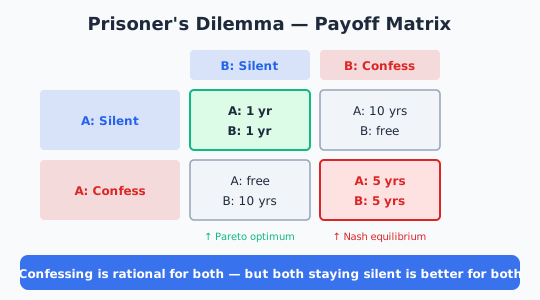
Two suspects, A and B, are held in separate rooms and cannot communicate.
The prosecutor offers each prisoner the following deal:
- Both stay silent (cooperate): insufficient evidence; both get 1 year
- Both confess (defect): both get 5 years
- Only one confesses: the confessor goes free; the silent one gets 10 years
| B stays silent | B confesses | |
|---|---|---|
| A stays silent | A: 1 yr / B: 1 yr | A: 10 yrs / B: free |
| A confesses | A: free / B: 10 yrs | A: 5 yrs / B: 5 yrs |
Why Betrayal Is “Rational”
Consider A’s position.
If B stays silent: A’s options — stay silent (1 year) or confess (go free). → Confessing is better.
If B confesses: A’s options — stay silent (10 years) or confess (5 years). → Confessing is better.
Whatever B does, confessing is the better choice for A. B faces an identical structure, so B’s rational choice is also to confess.
The result: both rational players confess and each gets 5 years.
Yet if both had stayed silent, each would have served only 1 year. Individually rational choices produce a collectively worse outcome. This is the heart of the Prisoner’s Dilemma.
The Dilemma in Everyday Life
The same structure appears everywhere.
Price wars: When two companies undercut each other, both lose profit. But if only one cuts prices, the other loses customers — so each is forced to cut anyway.
Arms races: Nations that both build up militaries spend more without gaining security. But unilateral disarmament leaves one side vulnerable.
Environmental problems: If each country avoids the cost of CO₂ cuts, no one cuts — and the whole planet suffers. The structure is identical.
All of these share the feature: “If only I cooperate, I lose.”
Repeated Games Change the Outcome
In a one-shot Prisoner’s Dilemma, defection is rational. But when the same players interact repeatedly, the calculus changes.
In a famous computer tournament organized by Robert Axelrod in the 1980s, the strategy that performed best was Tit for Tat. The rules are simple: cooperate on the first move, then mirror whatever the other player did last time. Cooperate if they cooperated; defect if they defected.
In repeated games, the threat of future retaliation makes the long-term benefits of cooperation outweigh the short-term gains from defection. This is why trust and reputation matter so much in human society.
Institutions as the Solution
In the real world, the Prisoner’s Dilemma is often resolved by institutions — laws, contracts, and regulations.
Price-fixing cartels are illegal precisely because, left alone, competing companies would fall into a dilemma that harms consumers. International treaties and environmental regulations can be understood as mechanisms designed to prevent countries from getting trapped in a collective dilemma.
Humans have long recognized the structure of the Prisoner’s Dilemma and responded by designing rules that make defection costly.
What happened in Axelrod’s tournament
The repeated game deserves a closer look. The experiment the political scientist Robert Axelrod ran in 1980 is the most famous in the field.
He invited researchers around the world to submit strategies to a computer tournament playing the prisoner’s dilemma 200 times over. The entries played a round robin against each other and were ranked on total score.
The main strategies entered
| Strategy | What it does | Result |
|---|---|---|
| Tit for tat | cooperate first, then copy the opponent’s previous move | 1st |
| Always cooperate | cooperate every time | exploited, languished |
| Always defect | defect every time | earns early, does not hold up overall |
| Suspicious tit for tat | defect first, then copy the opponent | invites chains of retaliation, underperforms |
| Random | choose at random | near the bottom |
Tit for tat, writable in about four lines, beat every complicated strategy and won.
Axelrod published the results and held a second tournament. Sixty-two strategies were submitted, by entrants who all knew what had happened the first time — conditions ideal for designing something to beat tit for tat.
Tit for tat won again.
The four properties the strong strategies shared
Axelrod picked out four features common to the strategies that scored well.
- Be nice. Never defect first. All of the top eight strategies had this property
- Retaliate. Always answer a defection. The soft-hearted get exploited
- Forgive. Return to cooperation as soon as the opponent does
- Be legible. Let the opponent read your rule quickly
The fourth is the one that gets overlooked and it matters. A strategy too complex for the opponent to read cannot build a cooperative relationship, and loses out.
That the harder you try to outwit people the worse you do strikes me as transferring straight to ordinary working life.
Cooperation arises in the animal world too
The structure is not confined to human society. Animals are found cooperating in prisoner’s-dilemma situations as well.
- Vampire bats share blood with roost-mates who failed to feed, favouring those who have shared with them before
- Cleaner wrasse eat parasites off larger fish; individuals that cheat stop being visited
- Bees and ants build cooperation on close genetic relatedness
- Pack hunters take more together than alone, and defection is conspicuous enough to be suppressed
Every case satisfies one condition: the same partners meet repeatedly. Repetition is what makes maintaining a reputation worth more than the short-term gain from defecting.
Cooperation does not require a moral sense. That was the important finding here. All it needs is meeting repeatedly, and remembering what the other party did last time.
Turn that around and cooperation is fragile in one-off transactions and anonymous relationships. Rating systems and public transaction histories work, on this reading, because they manufacture those two conditions artificially.
What plea bargaining actually does
Plea bargaining, which gave the dilemma its name, is used widely in the United States.
In federal criminal cases only a few percent go to trial; the great majority are settled by a guilty plea. As a way of keeping the courts’ workload down, it is a rational arrangement.
The structure attracts criticism, though, over one problem: innocent people confess.
If the sentence for fighting and losing at trial is set extremely high, taking the lighter sentence becomes rational even when innocent. Confession becomes the dominant strategy, exactly as the theory says.
- Weaker evidence increases the pressure to deal. The less confident the case, the greater the motive to dangle a heavy charge
- Means matter. Those who can afford a long trial are the ones able to refuse a deal
- Accomplices race each other. Whoever talks first gains, so they compete to confess
Japan introduced a plea-bargaining system in 2018, limited to economic and drug offences and requiring the defence lawyer’s agreement. The conditions were narrowed deliberately, so that the prisoner’s dilemma structure does not operate too strongly.
As an example of theory bearing directly on the fine print of an institution, it is a suggestive one.
Related paradoxes of social dilemmas
Related paradoxes where everyone behaving rationally leaves everyone worse off.


Summary
This article covered “The Prisoner’s Dilemma.”
The misalignment between individual rationality and collective rationality is a pattern woven into the fabric of human society. Simply knowing this dilemma exists changes how you see many of the problems around you.
To return to the full list of paradoxes, follow the link below.
Thank you for reading. We hope to see you in the next article.

Also popular with readers
📚 Series: The World's Paradoxes (50/81)