Thank you for visiting this site. This article covers “The Fallacy of Composition.”
“What is right for the individual becomes wrong for everyone when everyone does it” — is this a logical error, or just how the world works? This paradox appears surprisingly often in everyday life and is as important as it is familiar.
What Is the Fallacy of Composition?
The Fallacy of Composition is the logical error of assuming that what is true of a part must also be true of the whole.
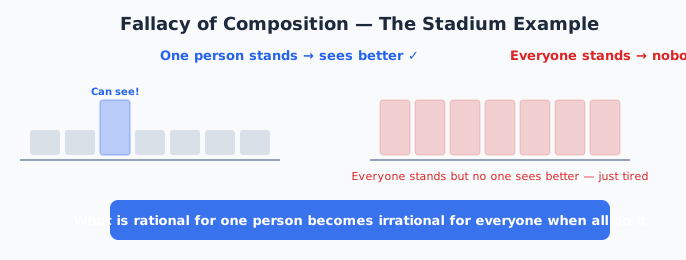
The simplest example is a stadium audience. If one person stands up, they see better than those around them. But if everyone stands, no one sees any better than when everyone was seated — they just end up standing there, tired.
Standing was a rational choice for one person, yet when everyone does it the result is irrational for everyone. This is the textbook pattern of the Fallacy of Composition.
The Classical Logic Definition
The Fallacy of Composition has been recognized since Aristotle as an informal fallacy. In formal logic, the principle that “if P(x) holds for every x, then P(whole) also holds” is not always valid — yet in everyday reasoning we fall into this trap with alarming frequency.
A classic example of flawed reasoning: “Every player on this team is excellent, therefore this team is excellent.” In both sports and business, it is well known that individually excellent members do not automatically produce an excellent team.
Economic Examples
The Fallacy of Composition manifests most seriously in economics. Keynesian economics could fairly be described as largely an attempt to grapple with this paradox.
Saving during a recession: When the economy turns bad, it is prudent for individuals to cut spending and save. But if everyone saves simultaneously, consumption collapses, corporate revenues fall, unemployment rises, and the whole economy deteriorates. This is also known as the Paradox of Thrift.

Bank runs: Withdrawing your deposits when you hear a bank is in trouble is rational for any individual. But if everyone tries to withdraw at once, the bank actually fails. In September 2007, in the early stage of the financial crisis, Britain’s Northern Rock experienced a genuine bank run — the first in about 140 years since 1866.
The credentials arms race: Earning a TOEIC score or a professional certification to stand out from the crowd is advantageous for the individual. But when everyone obtains the same credential, the differentiating effect disappears and all the time and cost invested in it is wasted. Economists sometimes call this “signaling arms races.”
Why Does This Fallacy Occur?
The root cause of the Fallacy of Composition is that individual actions affect others — that is, there are externalities.
One person saving has a negligible effect on the overall economy. But when millions save simultaneously, the impact is enormous. Because individuals cannot (or do not) account for the “effect on the whole” when making decisions, locally correct choices backfire at the aggregate level.
It Happens Every Day
The Fallacy of Composition pervades everyday life.
When more people use side streets to avoid traffic, the side streets become congested too. When everyone shifts their timing to avoid a crowd, everyone ends up arriving at the same time anyway.
Stockpiling masks during a pandemic is rational for the individual, but when everyone stockpiles, masks are unavailable to those who need them most.
“It’s fine if just I do it” collapses the moment everyone thinks the same thing.
Relation to the Tragedy of the Commons
The Fallacy of Composition is closely related to the “Tragedy of the Commons.” Each farmer rationally adding more sheep to shared pasture leads, when everyone does it, to the destruction of the pasture. This too is a clash between individual rationality and collective rationality.
The difference is that the Fallacy of Composition focuses on the logical structure of “the error in reasoning from part to whole,” while the Tragedy of the Commons focuses on the outcome of “the exhaustion of a shared resource.” The underlying structure is the same; the angle of analysis differs.
Can It Be Solved?
Because the Fallacy of Composition is difficult to resolve through individual free will alone, the usual remedy is to establish “rules for the whole.”
Deposit insurance guards against bank runs; fiscal and monetary policy counters recession-induced spending slumps; purchase limits address stockpiling. Each is a mechanism designed to prevent the Fallacy of Composition from playing out.
In game-theory terms, situations where the Fallacy of Composition arises are games where the Nash equilibrium does not coincide with the Pareto optimum. When each player’s best strategy leads to an outcome that is not best for everyone, external intervention — institutional design — is the rational solution.
There is an error running the other way
The fallacy of composition has a counterpart: the fallacy of division.
- Fallacy of composition: taking what holds of the parts to hold of the whole
- Fallacy of division: taking what holds of the whole to hold of the parts
The two errors compared
| Fallacy of composition | Fallacy of division | |
|---|---|---|
| Direction | parts to whole | whole to parts |
| Example | good players mean a good team | a player on a strong team must be good |
| Example | standing on tiptoe gives a better view | anyone at a high-average-salary firm earns a lot |
| Example | if every firm cuts prices, sales rise | this company must be growing, the industry is |
Both arise from assuming that properties pass automatically between part and whole.
The last row is the one most often seen in investment decisions. Even in a growing industry there are, naturally, companies losing ground within it. Applying the overall trend to an individual stock is this error.
The idea of emergence
The phenomenon of a property failing to carry over to the whole has been organised not only as an error but as a positive concept: emergence.
It refers to a property appearing when elements are combined that none of the elements possessed.
- The properties of water: hydrogen and oxygen are both flammable gases; combined they make a liquid that puts out fire
- An ant colony: each ant follows simple rules, and the colony builds complex structures
- Consciousness: no individual neuron is conscious, and consciousness is held to arise when they are assembled
- Traffic jams: no driver is trying to stop, and the flow stops
The fallacy of composition is a story of failure — it was expected to carry over and did not — while emergence is the positive view that something new arises precisely because it does not carry over.
It is the same phenomenon seen from the side where an expectation failed or from the side where novelty appeared.
Understanding every part does not tell you about the whole. That fact has been confirmed over and over in economics, in biology and in computer science. The fallacy of composition is the most familiar way in.
The forms it takes in argument
The fallacy is not confined to abstract logic; it turns up constantly in actual debate.
- “Every component is safe, so the product is safe”: faults arising from combinations of components are left out
- “We hired excellent people, so the team will be strong”: overlapping roles and coordination costs are not counted
- “Each item of spending is small, so the budget is fine”: nobody is looking at the accumulated total
- “We made every step as fast as possible, so the whole is fastest”: waiting time between steps is ignored
All of them assume that a property holding of the parts transfers unchanged to the whole.
Properties that transfer and properties that do not
Not every property fails to transfer. There are clues for telling them apart.
| Kind of property | Example | Does it transfer? |
|---|---|---|
| Properties of material | all parts are steel, so the whole is steel | yes |
| Properties that sum | the total of the parts’ weights is the whole’s weight | yes |
| Properties fixed by interaction | safety, speed, stability | sometimes not |
| Properties of ratio or rank | market share, ranking, proportion | no |
The more the elements interact, the less the properties of the parts transfer to the whole.
When the connective “therefore the whole is too” appears in an argument, check which side of that table the property in question falls on. That alone prevents a great many errors.
Paradoxes of the Individual and the Collective
These related paradoxes, like the fallacy of composition, deal with individual rationality producing a collective loss.
Related paradoxes of social dilemmas
Related paradoxes where everyone behaving rationally leaves everyone worse off.
Summary
This article covered “The Fallacy of Composition.”
What is true of the parts is not necessarily true of the whole. This simple yet easily overlooked principle is worth keeping in mind across every domain — from economic policy to daily life.
To return to the full list of paradoxes, follow the link below.
Thank you for reading. We hope to see you in the next article.

Also popular with readers
📚 Series: The World's Paradoxes (51/81)