Thank you for visiting this site. This article covers “The Tragedy of the Commons.”
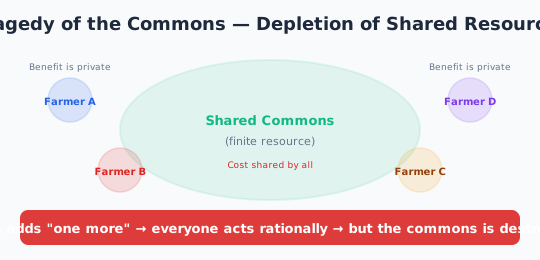
There is a shared pasture where several herders graze their livestock freely. Each herder finds it rational to add one more animal. But when all of them do so, the pasture is ruined, and everyone ends up worse off.
This is one of the most frequently cited concepts in modern society, applicable to everything from environmental problems to organizational management.
Hardin’s Paper
In 1968, ecologist Garrett Hardin published a paper titled “The Tragedy of the Commons” in the journal Science, bringing this concept to worldwide attention.
The setup is simple. Several herders graze their livestock on a shared commons.
Each herder reasons: “If I add one more animal, the benefit is entirely mine. The damage to the commons is shared by everyone, so my share of the cost is negligible.”
Let’s put numbers to it. With 10 herders, say adding one animal yields a benefit of 100 while the damage to the commons costs 50 — shared 10 ways, each herder’s share is just 5. Benefit 100 against cost 5. It would be irrational not to add more.
But everyone makes the same calculation and takes the same action. When all 10 add one animal, total degradation costs 500; each herder’s share of 50 is half their benefit of 100. Keep going and the commons is fully destroyed — ultimately no one can graze at all.
Why It Is a Paradox
What is individually rational leads to collectively catastrophic results. Every part is locally optimized yet the whole collapses — that structure is the core of the paradox.
It can be understood as a multiplayer extension of the Prisoner’s Dilemma. The dominant strategy for each individual (the best move regardless of what others do) produces the worst outcome for everyone.
What makes it particularly troubling is that unilateral restraint solves nothing. If you stop adding animals while the other nine continue, the commons still collapses — and you alone miss out on the benefits. Restraint is a “losing move” for the individual, which is why no one volunteers to go first.
Modern Examples
The tragedy of the commons appears everywhere in modern society.
Climate change: Each country finds it rational, in the short term, to prioritize economic growth over cutting CO₂ emissions. But when all countries do so, the global climate changes and all suffer. The fact that the Paris Agreement relies on voluntary targets rather than binding enforcement reflects just how difficult it is to confront the commons tragedy while respecting national sovereignty.
Fishery collapse: Each fisherman benefits from catching as many fish as possible. But when all do so, the stock collapses and fishing ceases to be viable. The Atlantic cod fishery is the classic case: in 1992, a fishery that had sustained communities on Canada’s Atlantic coast for roughly five hundred years collapsed from overfishing, costing roughly 40,000 people their livelihoods.
Traffic congestion: Each commuter prefers to drive alone for convenience. But when everyone does, gridlock makes everyone’s commute miserable.
Antibiotic overuse: Each patient feels safer taking an antibiotic. But widespread overuse breeds resistant bacteria, potentially producing a world where antibiotics no longer work.
Digital Commons
The internet age has given rise to new varieties of the tragedy.
Email spam: Sending email costs nearly nothing, but the flood of spam degrades the reliability of email as a whole. For each sender it is rational to send promotional mail; when all do, the commons of email starts to fail.
Information pollution on social media: Extreme content earns individual accounts high engagement, but when everyone chases that direction the information quality across the platform decays.
Three Approaches to Solutions
Three broad approaches address the tragedy of the commons.
Privatization
Dividing the commons into privately owned plots gives each owner an incentive to manage their resource sustainably. Land privatization is historically among the most successful remedies.
However, it cannot easily be applied to resources that cannot be divided — the atmosphere, the oceans. And privatization inevitably raises the justice question of who receives ownership rights.
Regulation
Governments impose usage limits and penalize violators. Fishing quotas and carbon-emission trading schemes are examples.
Emissions trading is a hybrid of regulation and markets. Governments set a total cap on emissions (regulation) and let firms trade permits (market), so those with the lowest abatement costs cut first.
Self-Governance
Elinor Ostrom studied many success cases in which communities managed shared resources voluntarily, work for which she was awarded the 2009 Nobel Prize in Economics.
Ostrom’s discovery was that a third path exists — neither privatization nor government regulation. Around the world, irrigation systems, fisheries, forests, and pastures have been managed sustainably for centuries by communities that developed their own rules. Ostrom identified eight conditions for successful self-governance: clearly defined boundaries, fair usage rules, collective decision-making, monitoring, graduated sanctions, and dispute resolution mechanisms, among others. Contrary to Hardin’s pessimistic conclusion, humans can cooperate to manage resources sustainably under the right conditions.
The third path Ostrom demonstrated
Hardin’s paper implied that avoiding the tragedy of the commons required either privatisation or state control. The political scientist Elinor Ostrom took issue with that dichotomy.
Surveying the management of shared resources in the field across the world, she showed that there are numerous cases where rules the participants themselves devised have sustained a resource over long periods.
Her cases include Japan’s iriai common lands, Swiss communal pastures, Spanish irrigation associations and Filipino water-user groups. Some of them have been maintained for centuries.
What successful joint management has in common
In her 1990 book Governing the Commons, Ostrom set out eight principles shared by the cases that work.
- Clear boundaries: who counts as a user and how far the resource extends are both clear
- Fitted to local conditions: the rules are made for the local situation, not imported from outside
- Participants can set the rules: the users themselves take part in changing them
- Monitoring exists: carried out by the users themselves or by people accountable to them
- Graduated sanctions: no immediate expulsion; a light penalty for a light breach
- A forum for resolving disputes: a cheap and rapid mechanism for handling conflict
- The right to organise is recognised: an external government does not deny self-governance
- Nested structure: large resources are managed by stacking smaller units
The finding was that the tragedy can be avoided by agreement among the participants alone, without either privatisation or state control.
Ostrom received the Nobel Prize in Economics for this work in 2009, the first woman to do so.
That said, self-governance does not work in every case. Where the users are too numerous, or the relationships are anonymous and faceless, neither monitoring nor sanctions operate. A scale at which people can see one another is a condition shared by most of the successes.
The difficulty of acting on global warming is precisely that this condition cannot be met. Ostrom’s finding is a source of hope and, at the same time, a statement of the limits of its own application.
Related paradoxes of social dilemmas
Related paradoxes where everyone behaving rationally leaves everyone worse off.
Summary
This article covered “The Tragedy of the Commons.”
The collision between individual rationality and collective optimality underlies the most important problems in modern society, from environmental destruction to organizational dysfunction. Solutions are not easy, but Ostrom’s work shows that the human capacity to design cooperative institutions is itself a source of hope.
To return to the full list of paradoxes, follow the link below.
Thank you for reading. We hope to see you in the next article.
Also popular with readers
📚 Series: The World's Paradoxes (55/81)