Thank you for visiting this site. This article covers “The Innovator’s Dilemma.”
An industry-leading company listens carefully to its customers, raises the quality of its products, and makes one rational investment decision after another — and yet it loses its market to a startup and declines. Doing the right things leads to defeat: this is one of the most troubling paradoxes in the business world.
Christensen’s Insight
Clayton Christensen of Harvard Business School introduced the concept in his 1997 book The Innovator’s Dilemma.
What caught Christensen’s attention was a pattern that kept repeating: a technically inferior product repeatedly defeated the market leader. And the defeated company was not incompetent — it had followed the textbook of good management.
Christensen discovered this pattern through detailed study of the hard-disk-drive industry. The theory’s persuasiveness rests on systematic analysis of decades of industry data, not mere anecdote.
Sustaining vs. Disruptive Innovation
Understanding the theory requires distinguishing two types of innovation.
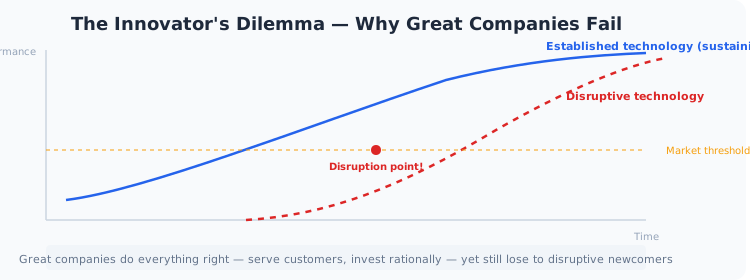
Sustaining innovation improves existing products along dimensions that current customers value: faster, higher quality, more features. Established companies excel at this kind of innovation and almost always win.
Disruptive innovation introduces a new technology that is initially inferior on mainstream metrics but cheaper, smaller, or easier to use. This is precisely where established companies struggle.
Why Large Companies Lose
Established companies have rational reasons to ignore disruptive technologies:
- Their current customers want higher-performance products
- The early market for disruptive technology is small — too small to sustain a large company’s growth targets
- Profit margins are thin; existing business lines offer far better returns on investment
- The best talent gravitates toward larger markets and higher-margin projects
Following the fundamentals of good management — listen to customers, invest where margins are high, target growth markets — leads logically to ignoring disruptive technology.
But disruptive technology improves. Eventually it reaches a level adequate for the mainstream market and enters it carrying the advantages of lower cost and greater ease of use. By the time the large company notices, it is already too late.
Here is the paradox in its sharpest form: the large company lost because it acted rationally. Had it acted irrationally — investing in a small, low-margin market — it might have won.
Historical Cases
Hard Disk Drives
The most thoroughly analyzed case in Christensen’s original book. Each transition — 14-inch to 8-inch to 5.25-inch to 3.5-inch — toppled the leader of the previous generation.
The 14-inch leader dismissed 8-inch drives as “too low capacity to be useful.” That was a correct judgment: the company’s main customers (mainframe makers) needed large capacity. But 8-inch drives created the minicomputer market, then improved and eventually entered the mainframe market too.
Kodak and Digital Photography
Kodak developed digital camera technology in-house as early as 1975, yet chose to protect its film business — which enjoyed profit margins of roughly 70%. Digital camera hardware sales were thin-margin by comparison.
Kodak’s management was not foolish. Explaining to shareholders, “We are going to shrink a 70%-margin business to invest in a 10%-margin one,” was nearly impossible. In 2012, Kodak filed for bankruptcy.
Smartphones
Nokia and BlackBerry dominated the mobile phone market, but the early iPhone (2007) was inferior on every traditional phone metric: call quality, battery life, typing speed on a physical keyboard.
Yet the iPhone redefined the category — not as a phone but as a pocket computer — using its touchscreen and app store. By the time Nokia recognized the shift, the rules of the game itself had already changed.
The Organization’s DNA Resists Change
What makes this dilemma so intractable is that sound management judgment becomes the cause of the company’s own destruction.
Even knowing that investment in disruptive technology is warranted, doing so is hard to justify to shareholders and conflicts with the values and processes of the existing organization.
Christensen decomposed a company’s capabilities into three elements: resources (people, technology, capital), processes (how work gets done), and values (the criteria used to prioritize investments). Resources can be moved relatively easily; processes and values are deeply embedded in the organization and extremely difficult to change.
The structure of the organization itself is designed to resist change.
Christensen’s Prescription
Christensen’s recommendation was to develop disruptive technology in a small organization kept deliberately separate from the parent company.
This independent unit is permitted to have different processes and values: small markets count as success, thin margins are acceptable, and it is not obligated to respond to the demands of the parent company’s existing customers.
IBM’s decision to launch its personal computer business from Florida, far from headquarters, is frequently cited as a successful example of this strategy — though many companies have tried the same approach and failed.
Those who were disrupted and those who were not
Christensen’s theory was influential enough that counterexamples have been hunted for. Look at the companies that survived and a common response emerges.
| Company | The disruption faced | The response | Outcome |
|---|---|---|---|
| Fujifilm | photographic film wiped out by digitisation | shifted into cosmetics and medical | survived |
| Kodak | the same | defended the film business | bankruptcy |
| Netflix | from DVDs by post to streaming | destroyed its own main business itself | survived |
| Blockbuster | the same | defended the store network | disappeared |
| Intel | the rise of low-cost CPUs | entered the segment itself under another brand | survived |
What the survivors have in common is that they went after their own most profitable business themselves.
Netflix moved resources into streaming while DVDs by post were still in the black. It is hard to call that a rational decision, and the share price fell heavily at the time.
The theory has its critics
There are objections to the theory as well.
- Selection after the fact: line up the companies destroyed by disruption and the theory fits, while companies that made the same response and failed are not counted
- Not usable for prediction: which technology is disruptive is only clear afterwards, which makes it weak as an instrument for management decisions
- Re-examination of the cases: studies replicating Christensen’s own cases report that a considerable number do not fit the pattern of a disruptive technology
In 2014 Jill Lepore attacked the theory itself in The New Yorker, setting off a substantial controversy.
That it looks inevitable in hindsight is a weakness shared by much of management theory. It is reasonable to read this theory not as a law but as a pattern of failure that tends to occur.
Related paradoxes of economics and happiness
Related paradoxes where an improvement measured in money or happiness fails to deliver the expected result.



Summary
This article covered “The Innovator’s Dilemma.”
Rationality becoming its own enemy — this paradox carries some of the most practical lessons the business world has to offer. What is correct today may be the cause of defeat tomorrow. The time when you feel most secure in your position may be exactly when you need the courage to disrupt yourself.
In the age of AI, this lesson has never felt more urgent.
To return to the full list of paradoxes, follow the link below.
Thank you for reading. We hope to see you in the next article.

Also popular with readers
📚 Series: The World's Paradoxes (56/81)