
Thank you for visiting this site. This article covers “The Giffen Paradox (Giffen Goods).”
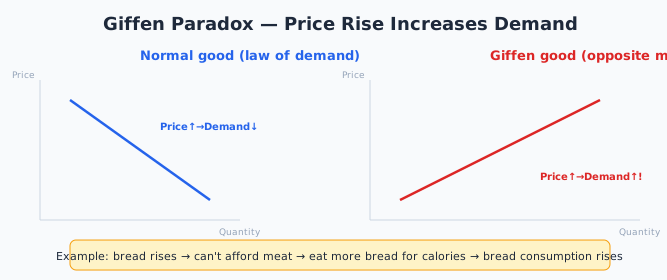
One of economics’ great principles is the law of demand: as price rises, demand falls; as price falls, demand rises. It seems so obvious it barely needs stating. Yet exceptions exist — goods whose consumption actually increases as their price rises. These are Giffen goods.
A staple of every economics textbook, yet one whose real-world existence was debated for nearly two centuries — the Giffen Paradox is one of economics’ great mysteries.
The Origin of Giffen Goods
The name comes from 19th-century Scottish economist and statistician Robert Giffen.
In his 1895 Principles of Economics, Alfred Marshall attributed to Giffen the following observation: “When the price of bread rises, poor households actually increase their consumption of bread.”
Behind this observation lies the Irish Great Famine of 1845–1852. When a blight drove up potato prices, it was reportedly observed that the poor consumed more potatoes, not fewer.
Curiously, no document exists in which Giffen himself clearly described this phenomenon. Whether Marshall’s attribution was accurate remains one of the unsolved puzzles of economic history.
The Two Forces Behind the Law of Demand
Understanding Giffen goods requires decomposing the effect of a price change into two components.
Substitution effect: When a good’s price rises, consumers try to switch to relatively cheaper alternatives. If potatoes get more expensive, it is natural to shift toward bread or rice. This effect always pushes consumption of the more expensive good down.
Income effect: When a good’s price rises, the same budget buys less — equivalent to a fall in real income. The direction of this effect depends on the nature of the good.
For a normal good, a fall in income reduces consumption, so both effects push in the same direction (less consumption). But for an inferior good (one consumed more when income is low, less when income is high), the income effect works in the opposite direction — pushing consumption up.
A Giffen good is an inferior good where the income effect is so strong it overwhelms the substitution effect.
A Concrete Example
Imagine a world with only two foods: potatoes and meat. A family has a monthly food budget of $30, with potatoes at $0.50 each and meat at $5 per pack.
The family buys 40 potatoes ($20) and 2 packs of meat ($10), barely meeting their nutritional needs.
Now suppose potatoes rise to $0.60 each. Keeping the same 40 potatoes now costs $24, leaving only $6 — enough for a single pack of meat, and the calories no longer add up.
But calories must be obtained somehow. So the family gives up meat entirely and spends the whole $30 on potatoes — 50 of them at $0.60 each. Replacing the calories from those 2 packs of meat with potatoes pushes potato consumption from 40 up to 50.
In extreme poverty, a staple food’s price rise can trigger the response of “give up luxuries entirely and concentrate on the staple,” causing the staple’s consumption to increase.
The Strict Conditions
The conditions for a Giffen good are extremely demanding:
- The good must be a necessity that takes up a large share of the consumer’s spending
- The consumer’s income must be very low
- Reasonable substitutes must be scarce or unaffordable
- The price change must significantly affect the consumer’s real purchasing power
All of these must hold simultaneously. Such conditions are genuinely rare in the real world. Consumers in developed countries almost never encounter Giffen goods.
A Long Empirical Debate
For a long time, Giffen goods appeared in every economics textbook yet had virtually no confirmed real-world examples — a “theoretical entity” that nobody could pin down.
In 2007, Robert Jensen and Nolan Miller of Harvard University reported a landmark result from an experiment with poor households in Hunan and Gansu provinces of China. By varying subsidies on rice and wheat flour to manipulate effective prices, they found that in some households rising rice prices led to increased rice consumption — behavior that matched the theoretical predictions for a Giffen good.
This study is widely cited as the strongest evidence yet for the real existence of Giffen goods, though debates about the experimental design and interpretation continue. The difficulty of controlling economic phenomena like a laboratory experiment is what has made this problem so persistent.
How Giffen Goods Differ from Veblen Goods
Another category of goods famous for “selling more at higher prices” is Veblen goods (luxury brands, etc.) — but the mechanism is entirely different.
Veblen goods derive value from being expensive: high-end watches and designer handbags become more desirable the more they cost, because ownership signals status (conspicuous consumption). Consumers eagerly pay the high price.
Giffen goods, by contrast, arise from poverty. The consumer is not happy to buy more potatoes — they are compelled to by the absence of any other option. “Price rise → demand rise” is the surface similarity; the underlying human circumstances are polar opposites.
The difference set out in detail
| Aspect | Giffen good | Veblen good |
|---|---|---|
| The goods | staples and other necessities | luxury brands, jewellery |
| The buyer | the extremely poor | the wealthy |
| Why demand rises | other things become unaffordable, so this is bought instead | being expensive is itself the value |
| The mechanism | the income effect outweighs the substitution effect | the demand function itself depends on price |
| Empirical confirmation | long disputed | widely observed |
A Giffen good is a phenomenon explicable within ordinary demand theory. It follows from the existing apparatus of income and substitution effects alone.
A Veblen good adds the premise that a high price itself generates utility. The theoretical framework is a different one.
Where a similar structure appears today
Strict Giffen goods are rare, and the structure of an income effect outweighing a substitution effect turns up in all sorts of places.
- Rising energy bills: heating costs rise, eating out and travel are cut, more time is spent at home, and consumption does not fall easily
- Rising petrol prices: where household budgets are tight and public transport is unavailable, commuting by car cannot be reduced
- Education costs: some households cut everything else to keep paying rising tuition
In each case the binding constraint is that what cannot be cut cannot be cut. The received wisdom that a price rise reduces demand fails because the less slack a household has, the narrower its range of choices.
It is a structure worth remembering when thinking about situations in which pricing policy does not work as intended.
Paradoxes of Economics
These related paradoxes, like the Giffen paradox, overturn the conventional wisdom of economics.


Related paradoxes of economics and happiness
Related paradoxes where an improvement measured in money or happiness fails to deliver the expected result.




Summary
This article covered “The Giffen Paradox.”
Even economics’ most fundamental laws can have exceptions — a lesson this paradox teaches. The tension between the elegance of theory and the messiness of reality, and the nearly two-century struggle to find empirical proof, attest that economics is a field where experiments cannot resolve questions as easily as physics can.
The simpler the law, the more interesting its exceptions.
To return to the full list of paradoxes, follow the link below.
Thank you for reading. We hope to see you in the next article.

Also popular with readers
📚 Series: The World's Paradoxes (57/81)