Thank you for visiting this site. This article covers “The Paradox of Choice.”
When you stand before 30 varieties of jam at the supermarket, do you feel excited — or overwhelmed? A free and prosperous society gives us many choices, but too many choices can actually make people less happy. That is the central claim of this paradox.
The Jam Experiment
In 2000, Sheena Iyengar of Columbia University and Mark Lepper of Stanford University ran a now-famous experiment.
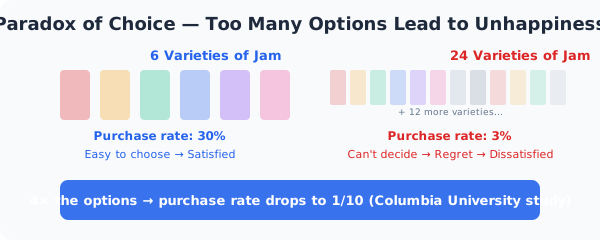
At a supermarket tasting booth, they displayed 24 varieties of jam one day and 6 varieties another day.
The 24-variety display attracted more shoppers to stop and look — but the actual purchase rates told a striking story.
- 24 varieties: 3% of tasters bought a jar
- 6 varieties: 30% of tasters bought a jar
The smaller selection produced a purchase rate ten times higher.
Why Too Many Choices Cause Problems
Psychologist Barry Schwartz systematically documented the harms of excessive choice in his 2004 book The Paradox of Choice.
Choice overload: More options require enormous mental energy to compare. Evaluating every option is impossible, so decisions tend to be half-hearted.
Decision paralysis: When there are too many options, the feeling that “something better might be out there” prevents commitment. The result can be choosing nothing at all.
Increased regret: When you pick one item out of 20, the 19 unchosen options linger. The more options there are, the stronger the nagging sense that “maybe I should have chosen differently.”
Rising expectations: With many options, people expect to find the perfect choice. When reality inevitably falls short of that expectation, disappointment follows.
Maximizers vs. Satisficers
Schwartz classified people into two types.
Maximizers: Those who always seek the best possible choice — comparing every option and pursuing the optimal outcome.
Satisficers: Those who are happy with a “good enough” choice — once a reasonable threshold is met, they stop searching.
Research found that maximizers tended to make objectively better choices, but satisficers reported significantly higher subjective satisfaction. Striving for the best actually makes you less happy — another paradox within the paradox.
The costs the chooser is paying
As options multiply, the person choosing takes on costs that do not show up anywhere. There are four kinds.
- Search cost. The effort of gathering and comparing candidates. It consumes time and attention
- Feeling the opportunity cost. The merits of the options you did not take stay visible, eroding the value of the one you did
- Raised expectations. With this much to choose from, something perfect must exist — and the standard climbs
- The weight of responsibility. With few options you can blame circumstances; with many, it becomes your own misjudgement
The second is the troublesome one. While you can still recall the merits of the candidates you passed over, nothing you pick will satisfy you easily.
Somebody who chose from thirty jams is tasting one while, somewhere in the back of their mind, the other twenty-nine possibilities remain.
Mechanisms for reducing choice are already in use
The finding is applied fairly widely in practice.
| Setting | The device | The aim |
|---|---|---|
| Restaurant menus | narrow the recommendations to three | lower the search cost |
| Insurance and financial products | provide a default product | make not choosing possible |
| Workplace pension enrolment | make enrolment the default | remove the procedural burden |
| Electronics shop floors | three price tiers, good/better/best | reduce comparison to one axis |
The third is the well-known default effect: simply making enrolment the default raises participation substantially, as confirmed in country after country.
The point is to supply a way of not choosing without taking any option away. Anyone who wants to choose still can, so nothing has been restricted.
I fix on a brand for everyday goods and stop comparing beyond that. Reducing the number of times you choose helps more than raising the quality of each choice.
Sometimes more options really are better
An abundance of options is not always harmful. Several conditions flip the effect.
| Condition | With many options | Why |
|---|---|---|
| You know your own preference | advantageous | you know what you are looking for |
| You know the field | advantageous | you can narrow candidates quickly |
| The options are organised | advantageous | axes for comparison are supplied |
| An unfamiliar field | disadvantageous | you do not know what to judge by |
| No chance to choose again | disadvantageous | the weight of regret increases |
In short, the outcome turns on whether you carry a criterion for narrowing things down.
To somebody who knows coffee, thirty varieties of bean are riches. To somebody who does not, they are a wall.
The same range, sorted by origin and roast with a note attached, becomes navigable for the non-expert too. Handing over a way to choose is a more usable remedy in practice than reducing the choices.
Relevance to Modern Life
The Paradox of Choice is deeply intertwined with today’s consumer and digital society.
Unable to decide what to watch on Netflix or Amazon Prime, people spend longer browsing than actually watching. Job boards with too many listings make it hard to apply for any. Dating apps with too many candidates make it hard to commit to one.
All of these are manifestations of the Paradox of Choice. Technology has expanded options without limit, and the result may be that we are constantly stressed by the act of choosing.
Companies like Google and Apple have in fact deliberately reduced the number of choices they present. Apple’s lean product lineup is not purely minimalist aesthetics — it is also a deliberate strategy to sidestep the Paradox of Choice.
Criticisms and Counterarguments
The Paradox of Choice has faced challenges. A 2010 meta-analysis by Scheibehenne and colleagues questioned whether the jam experiment’s effect could be reliably replicated. The harms of excessive choice do not always appear; they tend to be strongest when:
- The differences between options are small (30 jams vs. 30 cars)
- Preferences are unclear beforehand
- The decision is high-stakes and irreversible
In other words, people who know exactly what they want are less troubled by a large array of choices. The paradox hits hardest when someone faces many options without a clear sense of what they’re looking for.
The experiment itself, reconsidered
The jam experiment has been reported not to reproduce in later attempts.
The 2010 analysis pooling some fifty studies on the number of options found that, taken as a whole, the effect of more options on satisfaction averaged out to roughly zero.
The effect appears under some conditions and not others, so averaging cancels it.
Replication problems of this kind face many famous psychology experiments, and the jam study turned out not to be an exception.
That said, the part about choosing being tiring when there is more of it to do is easy to recognise from experience. Treating it as something that happens under certain conditions rather than as a law is about the right level of confidence.
Related paradoxes of economics and happiness
Related paradoxes where an improvement measured in money or happiness fails to deliver the expected result.
Summary
This article covered “The Paradox of Choice.”
Freedom and options are fundamentally good things, but too many options can produce paralysis and regret. Settling for a “good enough” choice rather than chasing the “perfect” one tends to lead to greater happiness — an important insight for anyone navigating our information-saturated age.
To return to the full list of paradoxes, follow the link below.
Thank you for reading. We hope to see you in the next article.
Also popular with readers
📚 Series: The World's Paradoxes (63/81)