Thank you for visiting this site. This article covers “The Voting Paradox (Condorcet’s Paradox).”
Many people believe majority rule is the fairest method of decision-making. But with three or more alternatives, majority voting can fail to reflect the will of the people — and not as a rare edge case, but as something that can happen fairly often.
The Paradox
This problem was identified by 18th-century French mathematician the Marquis de Condorcet.
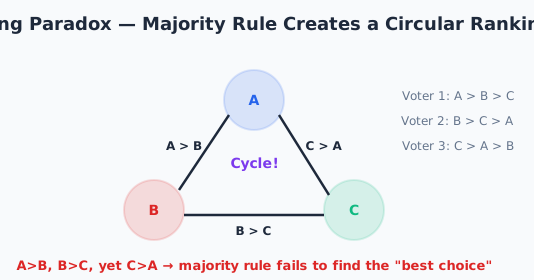
Suppose there are three voters and three candidates A, B, and C, with the following preferences:
- Voter 1: A > B > C (A first, then B, then C)
- Voter 2: B > C > A
- Voter 3: C > A > B
In a head-to-head between A and B: two voters (1 and 3) prefer A over B, so A wins. In a head-to-head between B and C: two voters (1 and 2) prefer B over C, so B wins. In a head-to-head between C and A: two voters (2 and 3) prefer C over A, so C wins.
A > B > C > A … — the ranking cycles endlessly and majority rule produces no winner.
Why This Is a Problem
What the paradox reveals is that collective preferences need not have the rational ordering that individual preferences do.
For an individual, if they prefer A over B and B over C, they must prefer A over C (transitivity). But preferences aggregated by majority vote can violate transitivity.
This is a flaw inherent in the method of majority voting: by controlling the order in which options are paired, a chairperson can engineer the outcome they want. This is called “agenda manipulation” — whoever decides the bracket decides the winner.
Condorcet himself, active during the French Revolution, proposed the “Condorcet method” in response: elect the candidate who beats every other candidate in pairwise contests (the Condorcet winner). But when a cycle occurs — as in the example above — no Condorcet winner exists, so this method alone is incomplete.
Arrow’s Impossibility Theorem
In 1951, Kenneth Arrow generalized Condorcet’s Paradox into the Impossibility Theorem.
Arrow proved that with three or more alternatives, no voting system can simultaneously satisfy all of the following — except dictatorship:
- If every voter prefers A over B, the result places A above B (unanimity / Pareto efficiency)
- The ranking of A versus B is unaffected by voters’ preferences over other candidates (independence of irrelevant alternatives)
- No single voter’s preferences alone determine the result (non-dictatorship)
In other words, a perfectly fair voting system is mathematically impossible. Arrow received the Nobel Prize in Economics in 1972 for this work.
Note: with only two alternatives, the problem does not arise. Majority rule is fully fair when the choice is binary. The problem emerges only when there are three or more alternatives.
Impact on Real Elections
In real elections, results frequently depend on the voting method used.
In single-member plurality systems, vote-splitting can allow the least popular candidate to win. For example, two candidates with similar platforms, A and B, split each other’s vote, handing victory to minority candidate C.
Proportional representation, runoff voting, ranked-choice voting — many systems have been devised, but Arrow’s theorem guarantees that every system has some flaw.
The 2000 US presidential election is a vivid real-world illustration. In Florida, George W. Bush defeated Al Gore by 537 votes, while third-party candidate Ralph Nader received about 97,000 votes. Because many Nader voters likely preferred Gore, Gore would probably have won without Nader on the ballot. An “irrelevant” candidate changed the outcome between the two main contenders — exactly the scenario Arrow’s theorem warned about.
The order of business changes the conclusion
Where Condorcet’s paradox bites hardest in practice is that whoever sets the order of the votes can set the result.
Take three proposals, A, B and C, with the majority relations running in a cycle. If they are compared two at a time in a knockout format, the winner changes with the order of the ties.
| Order of contests | First round | Final | Eventual winner |
|---|---|---|---|
| A against B first | A wins | A against C, C wins | C |
| B against C first | B wins | B against A, A wins | A |
| C against A first | C wins | C against B, B wins | B |
Nobody’s preferences have changed, and the order of business alone yields three different conclusions.
Put the proposal you want dead into an early contest and keep the one you want passed back for the final. The technique is called agenda manipulation, and it is well understood in the running of real legislatures.
The insistence that a chair be neutral makes a good deal more sense once you see this structure underneath it.
How often does the cycle actually arise?
There is research on how often the cycle turns up in real voting.
The probability rises as the number of options and the number of voters increase. Confirmed instances in actual election data, however, are not numerous.
- The theoretical probability: with three proposals, many voters and preferences distributed entirely at random, about 9 percent
- As options increase: with ten proposals it approaches 50 percent
- In real data: confirmed cases are limited
One reason for the scarcity is that voters’ preferences are often single-peaked. When the issues line up along a single axis — left to right, say — no cycle arises.
Put the other way round, the more the issues span several axes, the more readily cycles occur. Situations where economic policy, social policy and foreign policy are all tangled together are exactly this case.
It is worth knowing that majority rule is not universal, especially in any meeting with three or more options on the table.
Voting methods that try to avoid the cycle
Various voting methods have been devised to reduce cycling under majority rule. Each has its strengths and weaknesses.
| Method | How it works | Character |
|---|---|---|
| Simple plurality | write down your first choice only | easy to grasp; a split vote lets a minority win |
| Runoff | a second vote between the top two | secures a majority; discards information below third place |
| Borda count | score the ranks and total them | uses all the information; adding an irrelevant candidate moves the result |
| Condorcet method | decide the winner by round robin | no winner emerges when a cycle appears |
Every method has a weakness — which is precisely what Arrow’s impossibility theorem says.
No voting method satisfies a handful of plausible conditions at once. Since that is proved, the route of “just look for a better method” is closed off in principle.
The Borda count’s weakness is the easiest one to feel. A single additional candidate with no chance of winning can swap the order of the top two.
Why we go on voting anyway
Set out like that, majority rule looks unreliable, and in practice there is nothing to do but keep using it.
That no perfect method exists is not the same as every method being equally bad. The idea is to pick, for the purpose at hand, the one whose weakness is least likely to show.
- Two options: simple plurality raises no problem, and no cycle can occur
- Three or more options along a single axis: cycles are unlikely
- Many options across several axes: the choice of method drives the result
In the third case, part of the conclusion is effectively settled at the point where the method is chosen.
Which is why the voting method has to be fixed before the debate begins. A proposal to change the method once the result is in view is a moment to suspect agenda manipulation.
Majority rule is widely taken to be a fair way to decide. My own habit is to assume that once there are three or more options, the way of deciding is already acting on the conclusion.
Related paradoxes of collective decision-making
Related paradoxes about groups failing to reach a decision that is rational as a group.

Summary
This article covered “The Voting Paradox.”
The fact that majority rule does not always produce the right result gives us a reason to think deeply about how democratic systems are designed. Because no perfect voting system exists, understanding these limitations — and operating our institutions with them in mind — may be the most important thing we can do.
To return to the full list of paradoxes, follow the link below.
Thank you for reading. We hope to see you in the next article.
Also popular with readers
📚 Series: The World's Paradoxes (54/81)