Thank you for visiting this site. This article covers “Braess’s Paradox.”
Traffic is congested because there aren’t enough roads. Build more roads and the problem is solved — this commonsense reasoning can, in practice, make congestion significantly worse. Discovered in 1968 by German mathematician Dietrich Braess, this paradox has profound implications for urban planning and network design.
Understanding It with a Simple Example
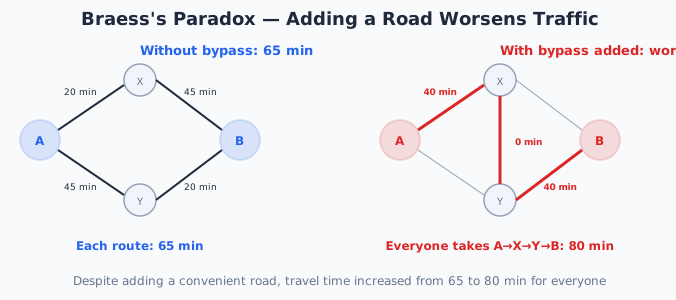
Suppose 4,000 cars need to travel from A to B. There are two routes.
Route 1: A → waypoint X → B. The A→X leg is a congested road where travel time equals (number of cars / 100) minutes. X→B is a fixed 45 minutes.
Route 2: A → waypoint Y → B. A→Y is a fixed 45 minutes. The Y→B leg is a congested road where travel time equals (number of cars / 100) minutes.
At equilibrium, 2,000 cars take each route and every driver’s journey takes 20 + 45 = 65 minutes.
Now suppose a bypass road connecting X and Y directly is built (travel time essentially 0).
Every driver now chooses A → X (congested but only 40 min with all 4,000) → Y (0 min) → B (congested but only 40 min with all 4,000). Why? Because A→X at 20 min beats A→Y at 45 min, and Y→B at 20 min beats X→B at 45 min.
With everyone on this route, the total journey time becomes 40 + 0 + 40 = 80 minutes.
“All we did was add a convenient road, yet everyone’s travel time increased from 65 minutes to 80 minutes.” That is Braess’s Paradox.
The key point is that using the bypass is each driver’s free choice. Nobody is forced. Yet the result of every individual making a rational decision is that everyone suffers.
Why Does This Happen?
The cause is that each driver choosing “the shortest route for themselves” leads to a state that is suboptimal for everyone.
Without the new road, traffic spread across two routes and reached equilibrium. But with the new road, the individually optimal route converges to one path, intensifying congestion.
This is what game theory calls a “mismatch between Nash equilibrium and Pareto optimum.” The outcome where every driver chooses their individually optimal route (Nash equilibrium) is not the best outcome for everyone collectively (Pareto optimum). It is structurally identical to the Prisoner’s Dilemma.
Crucially, not using the bypass is individually irrational. If everyone else uses it and you alone don’t, only you lose out. Even knowing that everyone would be better off if nobody used the bypass, individual rational decision-making prevents that outcome.
Real-World Cases
Braess’s Paradox is not just theoretical — it has been confirmed in reality.
In New York, closing 42nd Street in 1990 reportedly improved surrounding traffic contrary to expectations. In Seoul, South Korea, demolition of the elevated expressway that ran over Cheonggyecheon (carrying 160,000 vehicles daily) began in 2003, and the stream was restored in 2005; traffic conditions in the area likewise improved. In Stuttgart, Germany, opening a new road worsened congestion, and closing it later improved the situation.
From these cases, the paradoxical approach of “reducing roads to ease congestion” has become known in urban planning as “traffic evaporation.” When road capacity is reduced, some drivers switch to public transport or shift their departure times, and the total volume of traffic decreases.
It Applies to All Networks
Braess’s Paradox applies not just to roads but to any network.
In communications networks, adding a new link can reduce overall throughput. In power grids, adding a new transmission line can lower overall efficiency.
Adding resources to a network does not necessarily lead to improvement — this lesson is critically important for anyone involved in system design.
The same dynamic appears in sports. Adding a brilliant shooter to a basketball team can sometimes lower the team’s overall performance, because other players flood that shooter with passes and the team’s movement becomes one-dimensional. In a broad sense, this too shares the structure of Braess’s Paradox.
Closing roads that made the traffic flow better
Beyond theory, there are recorded cases where removing road capacity improved congestion.
The main documented cases
| Place | Year | What was done | Result |
|---|---|---|---|
| Stuttgart | 1969 | closed a road newly built to improve traffic | flow improved |
| 42nd Street, New York | 1990 | temporarily closed for Earth Day | the predicted chaos did not materialise |
| Cheonggyecheon, Seoul | 2005 | removed an elevated road and restored the river | traffic in the area improved |
| Boston | 2000s | closed certain sections | journey times fell |
Seoul is the best known. An elevated road carrying 160,000 vehicles a day was demolished and a culverted river was brought back to the surface.
Serious traffic chaos was predicted at the planning stage. In the event, average speeds on surrounding roads rose. The analysis attributes this to some drivers shifting to public transport once the road was gone, and the remaining traffic spreading out.
The price of anarchy
How much worse is the outcome when everyone picks their own shortest route, compared with a centrally optimised allocation?
The measure of that gap is the price of anarchy, introduced by Koutsoupias and Papadimitriou in 1999.
- Nash equilibrium: everyone chooses a route considering only their own travel time
- Social optimum: routes assigned so that total travel time is minimised
- Price of anarchy: the ratio of the former to the latter
Under the standard setting where congestion rises linearly with volume, Roughgarden and Tardos proved the ratio is at most 4/3 — a degradation of 33 percent.
Let people choose freely and, at worst, you lose a little over 30 percent. Put the other way, capturing that 30 percent requires central control.
The one premise all these cases need
Communication links, transmission lines, delivery routes, a basketball roster — the cases listed earlier look unrelated, and they all rest on a single premise: each element chooses what is best for itself.
- Routing protocols pick the fastest path available to that packet
- Electricity follows the path of least impedance, with nothing coordinating the grid
- Each driver picks their own shortest route
Where that premise fails, the paradox does not arise. A network under central allocation can simply be told not to use the new link.
So the condition for Braess’s paradox is not having many routes but having many routes with nobody minding the whole. Add options under that condition and the system can settle into a worse equilibrium.
More choice is not automatically better. Braess’s paradox is the simplest counterexample to that assumption.
Cases where adding roads made things worse
Closures alone give half the picture, so here is the other side.
What makes Braess’s paradox awkward is that it is hard to predict in advance. The intuition that a new road must shorten journey times is so strong that it is rarely doubted at the planning stage.
- Opening a bypass: traffic rises because the route avoids the town centre, and the junctions at either end become new bottlenecks
- Adding lanes: traffic collects on the widened stretch and jams at the merge beyond it
- Extending a motorway: people who used public transport switch to driving and total vehicle numbers rise
The third is induced demand, a different mechanism from Braess’s paradox with a similar-looking result. Numerous studies report that building more road capacity raises traffic until congestion returns to where it started.
Why it goes unnoticed at the planning stage
Because the evaluation tends to be confined to a part.
A new road’s benefit is measured by how much faster the vehicles using that road can travel. What Braess’s paradox degrades, though, is the average journey time across the whole network. Different things are being measured, so looking only at the part hides the problem.
The same happens when tuning a system’s performance or adding people to a team. As an instance of local optimisation making the whole worse, the structure is worth remembering.
The assumption that improving a part improves the whole deserves considerable suspicion. Roads aside, the essential thing is to match the scope you are changing to the scope you are measuring.
Related paradoxes of social dilemmas
Related paradoxes where everyone behaving rationally leaves everyone worse off.


Summary
This article covered “Braess’s Paradox.”
This paradox completely overturns the naive intuition that more roads means less congestion, teaching us that in complex systems, simple addition does not always work.
To return to the full list of paradoxes, follow the link below.
Thank you for reading. We hope to see you in the next article.

Also popular with readers
📚 Series: The World's Paradoxes (53/81)