
Thank you for visiting this site. This article covers “The Paradox of Thrift.”
“Stop wasting money and start saving” — few pieces of advice sound more sensible. Yet if every citizen follows it at once, the economy shrinks, everyone becomes poorer, and savings end up not growing at all — an ironic outcome.
This is the paradox that most clearly illustrates how what is right for the individual can be wrong for society — the gap between the micro and the macro.
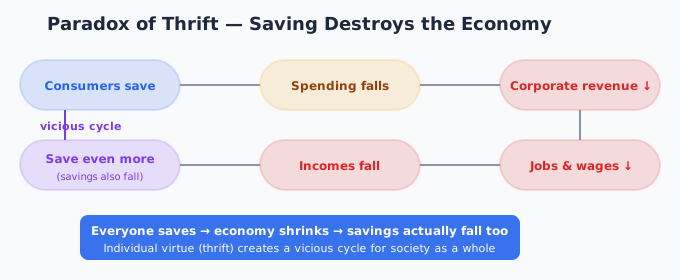
How the Paradox Works
The key is the basic economic principle that “one person’s spending is another person’s income.”
When you eat at a restaurant, your payment is the restaurant’s revenue. That revenue becomes the wages of the chef and staff, and the income of food suppliers. The supplier’s employees spend their earnings elsewhere, creating yet another person’s income. A single act of spending circulates through the economy multiple times, generating economic activity worth more than the original amount. This is the multiplier effect in Keynesian economics.
If you cut back and stop eating out, your savings increase — but the restaurant’s income falls. With just one person, the impact is negligible.
But what happens when the entire population shifts into saving mode at once?
A sharp drop in spending reduces corporate revenues. Companies cut staff or lower wages to protect profits. That reduces people’s incomes, making saving harder even if they want to. Lower incomes shrink tax revenues, reducing government services as well.
The result is a negative spiral: everyone saves → total spending falls → corporate revenues decline → employment and wages fall → spending falls further … In the worst case, the attempt to increase savings through thrift actually causes total savings to shrink because of the income collapse.
Keynes’s Insight
The economist who articulated this paradox most clearly was the British economist John Maynard Keynes.
In his 1936 work The General Theory of Employment, Interest and Money, Keynes argued for the central importance of effective demand. His insight: it is demand (consumption and investment) that drives the economy, so if everyone reduces consumption, the economy contracts.
Before Keynes, classical economics assumed that “saving is virtuous, and more saving means more investment and economic growth.” More saving → banks have more to lend → interest rates fall → firms borrow and invest. That was the logic.
Keynes showed that during a downturn, this chain breaks down. If firms are pessimistic about the future, they will not invest even if interest rates approach zero. When no one invests, savings sit idle in bank vaults rather than circulating back into the economy.
Historical Cases
The Great Depression
The Great Depression of 1929 is the most dramatic real-world instance of the paradox of thrift. The stock market crash triggered consumers to cut spending, firms to halt investment, and banks to restrict lending.
Governments of the day followed classical economics and tried to maintain balanced budgets — that is, they, too, saved. The negative spiral accelerated. Unemployment in the United States exceeded 25 percent, and recovery took more than a decade.
Japan’s “Lost Decades”
From the 1990s onward, following the collapse of the asset bubble, both households and corporations in Japan rushed to repay debt and save, depressing consumption and investment for years. Richard Koo called this a “balance-sheet recession.”
Even cutting interest rates to zero failed to revive private spending; the government had to sustain the economy through fiscal stimulus for decades. It is studied worldwide as a chronic case of the paradox of thrift.
The COVID-19 Pandemic
In 2020, lockdowns caused spending to collapse. Governments worldwide responded with large-scale fiscal measures — cash transfers, job-retention schemes — to halt the negative spiral. This was a textbook application of the Keynesian prescription.
Fiscal Policy During Downturns
The paradox of thrift is one of the main reasons governments should deploy fiscal stimulus during recessions.
If the government also cuts back while the private sector is saving, the economic contraction accelerates. By stepping in to spend more — through public works, cash transfers, or tax cuts — the government compensates for the fall in private consumption and arrests the downward spiral. That is the basic Keynesian prescription.
Of course, this approach has limits and critics. Raising government spending requires issuing bonds, increasing future liabilities. And sustaining fiscal stimulus into a boom can fuel inflation. Misjudging when to stimulate and when to tighten creates its own problems.
When the Paradox Does Not Apply
The paradox of thrift does not hold in all circumstances.
During a boom, more saving lowers interest rates, encouraging corporate investment, and the economy functions smoothly — exactly as classical economics assumed. Excessive consumption in good times can also fuel inflation and asset bubbles, so a degree of saving actually stabilizes the economy.
The paradox becomes severe primarily during downturns or when interest rates are already near zero and cannot be cut further (the liquidity trap). When the economy is cold and everyone saves simultaneously, lower interest rates fail to lift investment, and the negative spiral cannot be stopped.
Following the multiplier through with numbers
The claim that spending circulates through an economy and multiplies is worth checking against concrete figures.
Suppose somebody spends $1,000, and whoever receives it passes 80 percent of it on as further consumption, saving the remaining 20 percent.
| Stage | Amount spent | Running total |
|---|---|---|
| The initial spending | $1,000 | $1,000 |
| Second stage | $800 | $1,800 |
| Third stage | $640 | $2,440 |
| Fourth stage | $512 | $2,952 |
| Fifth stage | $410 | $3,362 |
| Total continuing indefinitely | $5,000 |
The initial $1,000 generates $5,000 of transactions across the economy. With 80 percent passed on, the multiplier works out at five.
If everybody economises instead, the chain contracts. Withholding $1,000 of spending removes $5,000 of transactions from the economy.
The lower the share passed on to consumption, the smaller the multiplier. When anxiety about the future raises the savings rate, the same fiscal stimulus has a weaker effect.
There are counterarguments
The paradox of thrift is not universally agreed within economics. The main criticisms are worth setting out.
- Saving funds investment: if it flows through banks into capital spending, the demand has not disappeared
- It does not hold in the long run: it is about a short-run shortfall in demand, while long-run growth depends on the savings rate
- Interest rates adjust: more saving lowers rates, investment rises, and the effect is offset
- An open economy leaks: with imports and exports, the domestic multiplier is smaller than the theoretical value
The third — adjustment through interest rates — was the central claim of classical economics. Keynes replied that once rates fall close to zero, the adjustment mechanism stops working.
In Japan, where rates stayed near zero for a long period, and in various countries after the financial crisis, savings were indeed observed not flowing into investment. The current understanding is close to not a law that always holds, but one that certainly bites in particular conditions.
Saving remains right for an individual, and there are phases in which everybody behaving rightly at once leaves everybody worse off. It is only in those phases that a government needs to move in the opposite direction.
Behaviour that is right for an individual can work the other way for the whole. Knowing that structure alone changes how economic news reads.
Paradoxes of Economics
These related paradoxes, like the paradox of thrift, deal with individually rational behaviour producing a loss for the whole.


Related paradoxes of social dilemmas
Related paradoxes where everyone behaving rationally leaves everyone worse off.
Summary
This article covered “The Paradox of Thrift.”
The paradox that individual virtue can become societal disaster is essential for understanding the difference between micro and macro perspectives. From the Great Depression to Japan’s prolonged stagnation to the COVID-19 crisis, humanity has confronted this paradox repeatedly.
Keeping this paradox in mind when you read economic news may help you understand the intent behind government economic policy just a little more clearly.
To return to the full list of paradoxes, follow the link below.
Thank you for reading. We hope to see you in the next article.

Also popular with readers
📚 Series: The World's Paradoxes (52/81)