Thank you for visiting this site. This article covers “The Tea Leaf Paradox.”
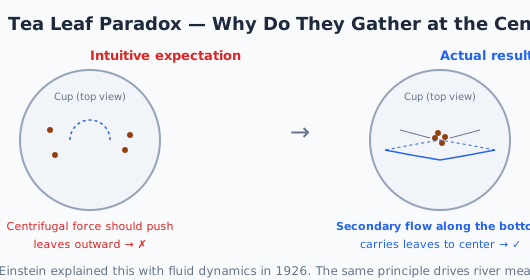
Stir tea or coffee with a spoon and the leaves or grounds that have settled on the bottom drift to the center. Centrifugal force should push them outward — yet they collect in the center instead.
This everyday phenomenon was actually the subject of a 1926 paper by Einstein. A teacup hides a surprisingly deep mechanism of fluid dynamics.
The Intuitive Prediction
Spinning liquid generates centrifugal force. A washing machine’s spin cycle presses clothes outward. On a bend in the road, your body is pulled to the outside. On a fairground ride, the faster it spins the more you are flung to the edge.
Following this intuition, tea leaves circling inside the cup should be flung outward by centrifugal force.
Yet the opposite happens. The leaves drift to the center of the cup’s bottom. The same happens if you stir sugar in a saucepan: when the rotation stops, the sugar grains form a small mound in the center.
What Is Actually Happening — The Secondary Flow Mechanism
The key is friction with the cup’s bottom surface.
When liquid rotates, centrifugal force does push it outward. But in the layer of liquid close to the bottom, friction slows the rotation. The bottom layer rotates more slowly, so it experiences less centrifugal force than the water above it.
The upper water, pushed outward by the stronger centrifugal force, spreads along the cup wall. The liquid surface becomes slightly higher at the edges and lower in the center — a slight bowl shape.
Meanwhile, near the bottom the weakened centrifugal force cannot counterbalance the inward pressure created by the higher water surface at the edges. This drives a current along the bottom, flowing inward toward the center. That inward current carries the tea leaves to the center.
The overall circulation forms a donut-shaped loop: outward near the surface → down along the wall → inward along the bottom → up at the center. This is called secondary flow. Because the tea leaves are on the bottom, they ride the inward bottom current and accumulate at the center.
In short: centrifugal force does act outward, but friction at the bottom creates a secondary flow that overwhelms it for objects on the floor of the cup. Centrifugal force has not disappeared; a separate fluid-mechanical mechanism beats it.
Einstein and Meandering Rivers
Einstein discussed this phenomenon in 1926 to explain why rivers meander.
At a bend in a river, water near the surface is flung outward by centrifugal force. Meanwhile, water near the riverbed, slowed by friction, has weaker centrifugal force and is pushed inward by the resulting pressure difference. The surface water on the outside of the bend erodes the bank; sediment accumulates on the inside of the bend.
This progressively sharpens the curve, eventually producing a meander. The same physical mechanism that moves tea leaves in a cup shapes landforms on a geological scale — a remarkable unity.
Einstein’s paper was only a few pages long but is celebrated as an elegant example of deriving a geophysical insight from an ordinary kitchen observation using consistent physics.
Baer’s Law — Northern and Southern Hemisphere Differences
River erosion has one more curious twist. The 19th-century Russian scientist Karl Ernst von Baer observed that “in the Northern Hemisphere, rivers tend to erode their right bank; in the Southern Hemisphere, the left bank.”
This is thought to result from the interaction of the Coriolis force (an apparent force caused by Earth’s rotation) with the secondary flow described above. A small flow in a teacup, connected to the rotation of the entire planet — that is a grand chain of ideas.
The Same Phenomenon Elsewhere
The secondary-flow mechanism operates in many everyday contexts.
Stirring miso soup in a pot causes the miso to gather at the center of the bottom — exactly the same principle. Debris gathering at the eye of a bathtub drain also involves secondary flow.
In industry, secondary flow affects particle separation in centrifuges in unexpected ways, and fluid engineers must account for it. In medicine, secondary flow at arterial bends and bifurcations influences the pattern of atherosclerosis. The teacup mechanism thus connects to cardiovascular disease — one of those chains of reasoning that shows why seemingly trivial physics matters.
How to stop them gathering at the centre
What if you wanted the tea leaves to move outwards instead? Once the mechanism is clear, the answer follows.
The secondary flow exists because there is friction at the bottom of the cup. The water at the bottom is slowed, the centrifugal force there alone weakens, and an inward flow arises.
- Remove the friction at the bottom: rotate the whole cup so the water turns with it, and no secondary flow appears
- Stop stirring and wait: leave it a while after stirring and the secondary flow stops too
- Use a shallow vessel: the bottom’s influence reaches the whole body of liquid more easily, and the behaviour changes
The first can be confirmed experimentally. Spin the whole container long enough that the water is turning entirely with it, and the centrifugal force balances everywhere and the leaves stay pinned to the outside.
So what decides whether they gather at the centre is not the rotation itself but the velocity difference — the fact that only the bottom is not turning.
Devices that use the same principle
The secondary flow is actively exploited in the design of industrial equipment.
| Device or setting | What is happening |
|---|---|
| Cyclone dust collectors | swirling flow separates dust; suppressing secondary flow drives the performance |
| Centrifuges | secondary flow from bottom friction degrades separation, and the geometry is designed around it |
| Brewing tanks | yeast is gathered at the centre to make it easier to collect |
| River bank protection | the mechanism eroding the outer bank of a meander is the same, and it is reflected in bank design |
The fourth is what Einstein treated in his paper. Exactly the same fluid dynamics is at work in a teacup and in a meandering river.
That a familiar phenomenon and a large-scale natural one can be described by the same equations is one of the appealing things about fluid dynamics. Knowing that stirring a cup reproduces what a river does to its banks changes how it looks.
Other flows that defy appearances
Tea leaves gathering at the centre is surprising because you are thinking only about centrifugal force. Several other phenomena mislead in the same way when only the simple balance of forces is considered.
- A vortex forms when you pull the bath plug: not the Earth’s rotation, but the slight rotation the water already had
- A river erodes its outer bank: not centrifugal force alone; secondary flow from bottom friction carries sediment inward
- An aeroplane flies: the explanation by different path lengths over and under the wing is inaccurate; the change in the direction of the flow is the substance of it
- A spoon held near a running tap is pulled in: pressure falls on the side where the flow speeds up
What they share is that the force that looks responsible is not the one doing the work, and what happens near the boundary is what counts.
Fluid dynamics is called difficult because handling this boundary layer is essential to it. Right against a wall the flow speed is zero, and a thin layer forms across which the velocity changes sharply.
The secondary flow in the teacup is produced by that boundary layer. What happens in the very narrow region at the bottom of the cup determines the flow throughout it.
Even for everyday phenomena, looking at the boundary rather than the conspicuous force gets you closer to the answer.
Related paradoxes of classical physics
Related paradoxes about familiar phenomena that stop yielding to straightforward reasoning.



Summary
This article covered “The Tea Leaf Paradox.”
Behind an apparently trivial everyday observation hides a counterintuitive mechanism of fluid dynamics. Centrifugal force acts outward, yet the secondary flow created by bottom friction carries the leaves to the center. That simple mechanism links the teacup to meandering rivers and blood vessel disease — and Einstein thought it worth writing a paper about.
Next time you stir your coffee and watch the grounds gather in the center, remember: Einstein once wrote a paper about exactly that.
To return to the full list of paradoxes, follow the link below.
Thank you for reading. We hope to see you in the next article.

Also popular with readers
📚 Series: The World's Paradoxes (49/81)