Thank you for visiting this site. This article covers “Wigner’s Friend” paradox.
Schrödinger’s Cat is famous, but there is a thought experiment that goes one step further. A friend observes the cat — and while the friend has seen a definite result, from the perspective of someone outside the lab, the friend, together with the entire system, is still in a superposition of states.
The Setup
This thought experiment was proposed in 1961 by Nobel Prize–winning physicist Eugene Wigner.
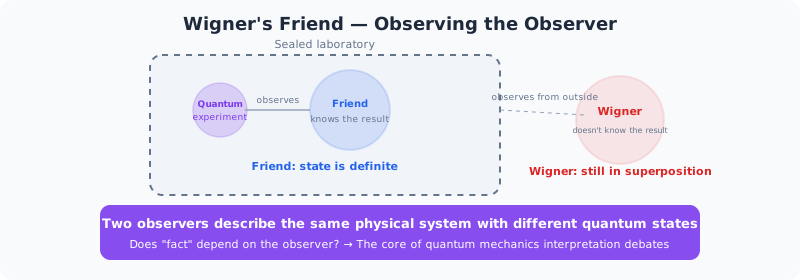
A friend conducts a quantum mechanical experiment inside a sealed laboratory — for example, observing whether a photon is detected by a detector. The friend makes the observation and sees either “detected” or “not detected.”
Wigner is outside the laboratory. He knows the friend has run the experiment, but has not been told the result.
The Core of the Paradox
According to the standard interpretation of quantum mechanics, a system remains in superposition until it is observed.
From the friend’s perspective, the quantum state collapsed at the moment of observation. The friend has a perfectly definite result.
From Wigner’s perspective, the entire laboratory — including the friend — is still in superposition. For Wigner, the state in which the friend “saw detection” and the state in which the friend “saw no detection” coexist.
When the friend opens the door and tells Wigner the result, the state collapses for Wigner — but the friend has known the outcome all along.
Is it permissible for two observers to hold different quantum descriptions of the same physical system?
Does Consciousness Play a Special Role?
Wigner himself initially concluded from this thought experiment that “consciousness collapses the wave function.” That is, the friend’s conscious observation causes the state to become definite, making Wigner’s external description incomplete.
However, many physicists reject this “collapse by consciousness” view, because granting consciousness a special physical role makes physics dependent on subjective experience.
How Wigner’s Friend Differs From Schrödinger’s Cat
Wigner’s Friend extends Schrödinger’s Cat, but with a crucial difference. Whether the cat is conscious is debatable; the friend is unambiguously a conscious observer.
In Schrödinger’s Cat, the question was “Is the cat really simultaneously alive and dead?” In Wigner’s Friend, the tension is sharper: the friend is certainly seeing one definite result, yet from the outside the system is described as being in superposition. The thought experiment more forcefully raises the question of what it means for a conscious being to be in superposition.
How Different Interpretations Handle It
Under the Copenhagen interpretation, the ambiguity of where to draw the boundary of “observation” is acknowledged, but the interpretation holds that no practical problem arises. Where exactly the state collapses — at the moment the friend observes, or at the moment Wigner learns the result — cannot be determined clearly.
Under the Many-Worlds interpretation, the world branches at the moment the friend observes, and branches again when Wigner learns the result. No contradiction arises, but the cost is an explosive proliferation of parallel worlds.
Under QBism (Quantum Bayesianism), a quantum state is understood as representing each observer’s beliefs from the outset — so two observers holding different state descriptions is simply not a problem. Quantum mechanics is not a description of an objective world; it is a tool for each agent to organize their own experience.
Recent Developments
In 2018, a paper by Frauchiger and Renner on the extended Wigner’s Friend scenario drew major attention. The scenario involves two pairs of “Wigner + friend” and runs an experiment analogous to a Bell inequality test.
The conclusion is that three assumptions cannot all hold simultaneously:
- An observation has one definite outcome (uniqueness of facts)
- Measurement settings can be freely chosen (free choice)
- Facts established in the past do not change (a locality-like assumption)
This suggests that we may need to abandon the very premise that there is a single objective fact for everyone. In 2019, Proietti and collaborators at Heriot-Watt University partially confirmed this theoretical prediction in a photon experiment.
A question about the foundations of quantum mechanics is moving from the domain of thought experiments toward experimental verification.
Whose fact is it?
What that result suggests is that objectivity in the naive sense sits badly with quantum theory.
For Wigner, the friend and the apparatus are in a superposition. For the friend, the outcome is already settled as one thing.
Both descriptions are correct from their own standpoint. The situation is one in which two contradictory descriptions of the same event hold at the same time.
- Relational interpretation: a state is defined with respect to a relation between one system and another
- QBism: a quantum state describes an agent’s own beliefs, not a shared objective entity
- Many-worlds: both happen, and no contradiction arises
Each of them weakens, somewhere, the naive premise that there is one absolute fact.
As physics the argument is unsettled, and the fact that a thought experiment has reached the stage of being testable is the largest change of the last thirty years or so.
What advanced beyond Schrödinger’s cat
The two thought experiments are often introduced as the same thing, and the questions they pose differ by one level.
In the cat story there is one human observer. What is inside the box is unknown, and there is no dispute about the point that observing settles it.
Wigner’s friend adds the step of treating the observer as a quantum system too. The person doing the observing is, for somebody else, the thing being observed — a nested structure.
| Issue | Schrödinger’s cat | Wigner’s friend |
|---|---|---|
| What is superposed | the cat (alive or dead) | the observer (what they perceived) |
| What is asked | can a large thing be superposed | whose description is correct |
| Number of observers | one | two, nested |
| The point at issue | when does collapse happen | are facts shared |
The cat problem has been largely settled in practice by the understanding of decoherence. Large objects entangle with their environment, so superposition is not maintained.
Wigner’s friend cannot be solved that way. Assume the friend is in a perfectly isolated laboratory and decoherence does not occur.
If the isolation holds, the friend’s perception ought to be in superposition along with everything else, and the friend insists they saw one outcome. That is the difficulty that remains.
Isolating a human being is impossible in practice, and as a thought experiment it presses on a question of principle. Which is exactly why the scaled-down experiments with photons matter.
Related paradoxes of quantum mechanics
Related paradoxes where quantum mechanics’ demands stop meshing with our naive picture of the world.



Summary
This article covered “Wigner’s Friend.”
At an even deeper level than Schrödinger’s Cat, this paradox confronts us with the most fundamental questions: What is an observation? Does a “fact” depend on the observer? Nearly a century after quantum mechanics was completed, the debates about its interpretation continue.
To return to the full list of paradoxes, follow the link below.
Thank you for reading. We hope to see you in the next article.

Also popular with readers
📚 Series: The World's Paradoxes (48/81)