
Thank you for visiting this site. This article covers “The Garage Paradox (the Barn-Pole Paradox).”
When a car longer than a garage approaches at near the speed of light, Lorentz contraction shrinks the car so that it fits inside the garage. But from the car’s perspective, the garage contracts — so the car should not fit. Which view is correct?
This thought experiment is one of the clearest illustrations of the “relativity of simultaneity” — a cornerstone of special relativity.
The Setup
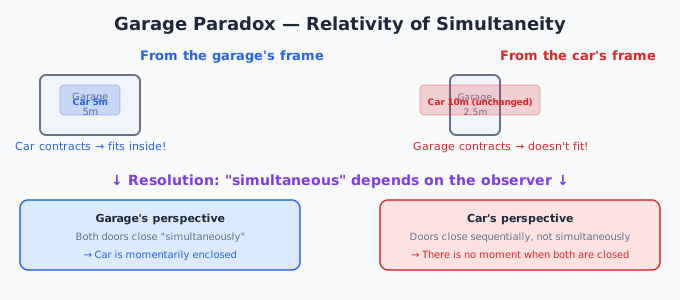
A car is 10 meters long. The garage is 5 meters long. Normally, the car cannot fit in the garage.
Now suppose the car travels toward the garage at 86.6% of the speed of light (the speed at which the Lorentz factor is exactly 2). Special relativity predicts that the car’s length “shrinks” to half — 5 meters. This is Lorentz contraction.
Lorentz contraction is not an illusion; it is a physically real effect. The observer in the garage can, in principle, observe the car contracted to 5 meters and fitting perfectly into the 5-meter garage. Closing both front and rear doors simultaneously is theoretically possible.
What the Car Sees
Now consider the perspective of the person inside the car.
In special relativity, motion is relative. From the car’s reference frame, it is the garage that is moving. Therefore, Lorentz contraction applies to the garage, shrinking it from 5 meters to 2.5 meters.
A 10-meter car clearly cannot fit in a 2.5-meter garage. From the driver’s viewpoint, the car does not fit inside the garage at all.
Fits or doesn’t fit? The same physical situation seems to yield contradictory conclusions.
The Resolution: Relativity of Simultaneity
The resolution lies in another key consequence of special relativity: the relativity of simultaneity.
Let us be precise about what “the car fits in the garage” means. It means: “the moment the car’s rear end enters the garage and the moment the car’s front end has not yet reached the garage exit exist simultaneously.”
For the garage observer, these two events are indeed simultaneous. Both doors can be closed at the same time.
But for the car’s occupants, these two events are not simultaneous. From the car’s perspective, the exit door closes first (and opens again before the front of the car reaches it), and then the entry door closes. There is no moment from the car’s perspective when both doors are closed at the same time.
Understanding via Spacetime Diagrams
The clearest way to understand this paradox is through a Minkowski spacetime diagram.
In a spacetime diagram, the horizontal axis represents space (position) and the vertical axis represents time. The garage’s front and rear doors are drawn as two vertical lines. The car’s front and rear ends are also two lines — but since the car is moving, they are slanted.
The key point is that “simultaneity” is defined differently for different observers. What is simultaneous for the garage observer corresponds to a horizontal line on the spacetime diagram. What is simultaneous for the car’s occupant corresponds to a tilted line.
This difference in tilt is why the same physical events are observed in a different time order by the two observers. Both are correct; there is no contradiction.
What Happens If You Really Close the Doors?
If the garage observer actually closes both doors simultaneously, the car traveling at 86.6% of light speed would strike physical doors — in practice this would be catastrophic.
But what physics cares about is whether the car is damaged by the act of closing the doors. If the doors snap shut and immediately open again: from the garage’s perspective, there is a moment when the car is entirely inside and both doors are closed. From the car’s perspective, the exit door closes and opens, the car’s front passes through, and then the entry door closes and opens. Neither observer sees the car crushed. Both descriptions are consistent.
If the doors close and stay closed, the car’s front hits the exit door and a shockwave propagates rearward at less than the speed of light. This, too, can be described consistently from either perspective without contradiction.
Relation to the Twin Paradox
The Garage Paradox, like the Twin Paradox, is a thought experiment born from special relativity.
The Twin Paradox concerns time dilation (effects along the time axis); the Garage Paradox focuses on length contraction and the relativity of simultaneity (effects along the space axis). Both are two sides of the same coin, derived together from the single mathematical framework of the Lorentz transformation.

Both paradoxes vividly demonstrate how profoundly special relativity contradicts our everyday intuitions about time and space.
Why We Can’t Experience This in Daily Life
In everyday life, neither Lorentz contraction nor the relativity of simultaneity is perceptible. At 100 km/h, the Lorentz contraction of a car is far smaller than an atom — utterly unmeasurable.
But inside CERN’s particle accelerators, particles traveling near the speed of light routinely experience Lorentz contraction. Short-lived particles like muons reach the ground through the atmosphere only because time dilation and Lorentz contraction extend their effective range beyond what their rest lifetime would allow. The strange world the Garage Paradox describes is everyday reality at the subatomic scale.
What it means for a length to contract
Picturing Lorentz contraction as an object being squeezed is a source of confusion. No force is acting on the matter and deforming it.
The essential point is that measuring a length is itself an operation performed at one instant. To measure a rod you have to read the positions of its front and back ends at the same moment.
What counts as the same moment, however, differs between observers. Measure using a different notion of simultaneity and you naturally get a different length.
- Measured by somebody at rest: the ends are read at that observer’s same moment
- Measured by somebody moving: the ends are read at a different same moment
- Result: both are valid measurements, and the values differ
Nor is it that the contracted rod returns to its original length once you take it away and examine it. The original length just means the value measured by somebody at rest relative to the rod.
Length is not a quantity intrinsic to an object; it is fixed only once you specify whose length it is. That is the same property that velocity and momentum have, so it is not especially strange.
Both accounts remain correct to the end
The garage paradox feels uncomfortable because the two accounts never come to agree.
| Event | As seen from the garage | As seen from the car |
|---|---|---|
| Closing the front door | simultaneous with the rear door | later than the rear door |
| The instant the car is fully inside | it exists | it does not exist |
| The interval when both doors are closed | there is one | there is none |
Everything that disagrees in that table concerns whether things are simultaneous.
There are also things that do not disagree. Whether the car struck a door gets the same answer from both. The fact of a collision having occurred or not does not vary with the observer.
What matters in physics are these quantities that are the same for everyone. Length and simultaneity change with the standpoint; whether an event happened does not.
What looked like a contradiction was really a question of distinguishing quantities that are allowed to vary from quantities that are not. The paradoxes of relativity mostly settle into this shape.
Related paradoxes of relativity
Related paradoxes where everyday intuitions about length and simultaneity stop working near the speed of light.



Summary
This article covered “The Garage Paradox.”
The apparent contradiction arising from the combination of Lorentz contraction and the relativity of simultaneity is an excellent teaching tool for understanding the essence of special relativity. The physical laws are fully consistent from both perspectives. The paradox is just an illusion that arises when we forget that “simultaneous” is not an absolute concept.
To return to the full list of paradoxes, follow the link below.
Thank you for reading. We hope to see you in the next article.

Also popular with readers
📚 Series: The World's Paradoxes (47/81)