Thank you for visiting this site. This article covers “Olbers’ Paradox.”
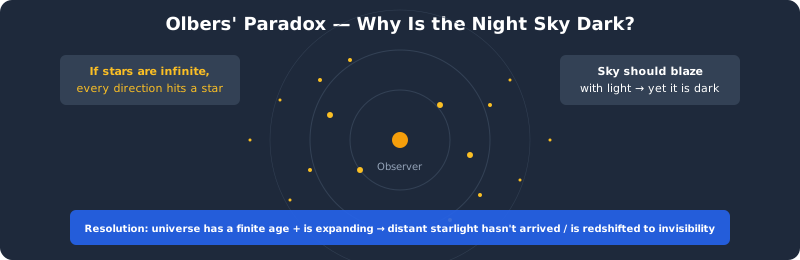
Look up at the night sky and you see a dark expanse dotted with stars. Familiar enough — yet a profound puzzle lies within it. If the universe is infinite and stars are distributed uniformly, every direction you look should eventually hit a star. The night sky should be covered in stellar light without a gap, blazing as bright as the surface of the Sun.
Why is the night sky dark? This seemingly childish question turns out to expose something fundamental about the nature of the universe.
The Logic of the Paradox
This problem is named after German astronomer Heinrich Olbers, who addressed it systematically in 1823, but the same question was raised earlier by Kepler in 1610 and by Halley in Britain and Cheseaux in Switzerland in the 1720s.
The argument runs as follows. Suppose the universe extends infinitely and stars are uniformly distributed throughout space.
Draw a thin spherical shell centered on Earth at some distance r. A star twice as far away appears only one-quarter as bright (inverse-square law). But the surface area of the shell grows with the square of the distance, so a shell of equal thickness at twice the distance contains four times as many stars. The decrease in brightness and the increase in star count cancel exactly, so every spherical shell contributes the same amount to the total brightness of the night sky.
If this goes on to infinity, the total brightness is infinite. Strictly, nearer stars block the light of more distant ones, so the actual brightness is not infinite — but every direction in the sky would still be covered by a stellar surface, making the entire sky as bright as the surface of the Sun (roughly 5,500 °C). The night sky is dark. That is the contradiction.
Early Answers That Did Not Work
Several attempts were made in Olbers’ time, but none succeeded.
Olbers himself proposed that interstellar gas and dust absorb the light of distant stars. But this fails fatally: gas and dust that absorb light warm up and eventually radiate at the same intensity as the stars. If the universe were infinitely old, the gas and dust would have long since reached stellar temperatures — no shielding effect remains.
Others suggested that the universe might be finite in size, with a limited number of stars. This points in the right direction but was psychologically unacceptable at the time. A finite universe raises the uncomfortable philosophical question: what lies beyond its edge?
The Correct Resolution — the Age and Expansion of the Universe
A clear answer emerged from 20th-century cosmology, resting on two factors.
First: the universe has a finite age. The universe began in the Big Bang about 13.8 billion years ago. Light travels at a finite speed (about 300,000 km/s), so light from more than 13.8 billion light-years away has not yet reached us.
The region of the universe from which we can receive light — the observable universe — is finite. The assumption that we can accumulate light from infinitely many shells breaks down.
Second: the universe is expanding. Distant galaxies recede faster than nearby ones. Their light is redshifted — its wavelength is stretched. Visible light shifts to infrared, infrared shifts to microwave, and so on, becoming invisible to the human eye.
Light from sufficiently distant galaxies arrives greatly diminished in energy by cosmic expansion. This further darkens the sky.
The Cosmic Microwave Background — the Sky Is Not Completely Dark
Interestingly, in one sense the night sky is not completely dark.
About 380,000 years after the Big Bang, the universe cooled enough for light to travel freely. That ancient light is detected today as the Cosmic Microwave Background (CMB). Stretched by billions of years of cosmic expansion, it now arrives as microwaves corresponding to a temperature of about 2.7 Kelvin (roughly −270 °C), uniformly from every direction.
In microwaves, the sky glows uniformly in all directions. Invisible to the naked eye, but in 1964 Penzias and Wilson accidentally discovered this radiation, providing decisive evidence for the Big Bang.
In a transformed sense, the situation Olbers’ Paradox predicted — the sky filled with light from all directions — has actually come true.
Edgar Allan Poe’s Intuition
Remarkably, a non-scientist gave an essentially correct answer before the scientists did. American writer Edgar Allan Poe, in his 1848 prose poem Eureka, stated that the night sky is dark because “the light from distant stars has not yet had time to reach us.”
He articulated the core of the modern cosmological answer — a finite-age universe — more than a century before the Big Bang theory was established, through the intuition of a literary artist.
It is one of the most unusual episodes in the history of science: a poet’s intuition anticipating the analysis of astronomers.
Implications for Cosmology
What Olbers’ Paradox teaches is that the classical picture of a static, infinite, eternal universe is wrong.
Had the paradox been taken seriously in the 19th century, scientists might have predicted a finite, expanding universe. But the assumption of an eternal, unchanging cosmos was so deeply held that the paradox was not treated as urgent. Even Einstein, in his first cosmological model based on general relativity, assumed a static universe — and is said to have later called this his “greatest blunder” after Hubble discovered cosmic expansion.
The importance of taking a simple question seriously is one lesson this paradox offers.
Who noticed it first
The paradox carries Olbers’s name, and he was not the first to pose the question.
| Person | Year | What they did |
|---|---|---|
| Thomas Digges | 1576 | posited an infinite universe and touched on why starlight does not arrive |
| Johannes Kepler | 1610 | argued from the dark night sky that the universe is finite |
| Edmond Halley | 1720 | held that distant stars are faint so there is no problem (incorrect) |
| Jean-Philippe de Chéseaux | 1744 | formulated the problem in nearly its modern form |
| Heinrich Olbers | 1823 | proposed absorption by dust; his name stuck |
The one who came closest to the right answer earliest was Kepler, who held that the darkness of the night sky is itself evidence that the universe is not infinite.
Halley’s answer was wrong. Distant stars do look fainter, and the number of stars in a shell at a given distance grows as the square of that distance, exactly cancelling the drop in brightness. That cancellation is the core of the problem, so Halley had missed the point.
Olbers’s own answer was also wrong, and his name survives for having made the problem widely known. It is one of those common cases in the history of science where the name attached is not the person who solved it but the person who made it famous.
What the dark night sky tells us
What is appealing about this paradox is that an observation anybody can make yields strong constraints on the structure of the universe.
All it takes is looking up at night. No telescope, no computer.
- The universe is not infinitely old: it has a beginning
- Stars do not shine for ever: they have lifetimes
- Or the universe is finite: the number of stars is limited
Unless at least one of these holds, the night sky would be bright. In the event, the finite age of the universe turned out to be the main reason.
Before instruments had developed, plain observation was already able to reach into cosmology. That way of framing a question still looks impressive today.
Related paradoxes of cosmic observation
Related paradoxes about the puzzles that come with observing the universe.



Summary
This article covered “Olbers’ Paradox.”
The question “why is the night sky dark?” — seemingly simple enough for a child to ask — conceals the grand answers of a finite and expanding universe. And the fact that a writer anticipated those answers by over a century is a reminder that the boundary between science and the humanities can be crossed by genuine insight.
The deepest truths about the universe may hide in the most everyday observations.
To return to the full list of paradoxes, follow the link below.
Thank you for reading. We hope to see you in the next article.
Also popular with readers
📚 Series: The World's Paradoxes (46/81)