
Thank you for visiting this site. This article covers “Maxwell’s Demon.”
Suppose an invisible demon can observe individual gas molecules and sort them one by one. Without expending any energy, it could create a temperature difference — a direct challenge to one of the most fundamental laws of thermodynamics.
The Thought Experiment
Scottish physicist James Clerk Maxwell devised this thought experiment in 1867 in a letter to his friend Peter Guthrie Tait. Maxwell called the being a “finite being,” but physicist William Thomson (Lord Kelvin) later dubbed it a “demon,” and the name stuck.
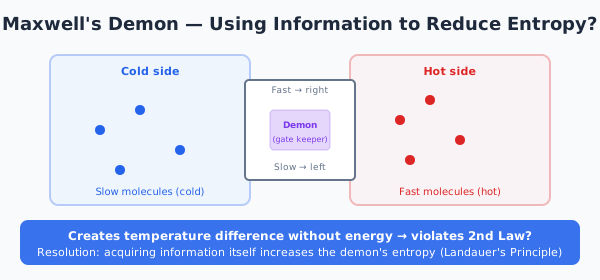
A container is divided into two chambers by a partition. Both chambers are filled with gas at the same temperature. The partition has a small door, guarded by an intelligent microscopic being — the demon.
The demon watches approaching molecules and operates the door selectively: fast-moving (hot) molecules are allowed into the right chamber, while slow-moving (cold) molecules are directed to the left.
Over time, fast molecules accumulate on the right and slow molecules on the left. A temperature difference appears from gas that started at uniform temperature — without adding any energy.
A temperature difference can be used to extract work. The demon appears to have created energy from nothing.
What Is at Stake
This thought experiment challenges the Second Law of Thermodynamics.
The Second Law states that “the entropy (disorder) of an isolated system never decreases.” Equivalently: “a temperature difference cannot arise spontaneously without an external energy input.”
Yet the demon creates a temperature difference by doing nothing more than opening and closing a door — an operation that seems to require almost no energy. Does this violate the Second Law?
Over a Century of Attempts to Resolve It
Maxwell’s Demon troubled physicists for more than a hundred years.
In 1929, Leó Szilárd suggested that the demon’s act of measuring each molecule’s speed must itself require energy. But it was later shown that ideal measurements need not consume energy, and this line of attack stalled.
The decisive resolution came from Rolf Landauer in 1961 and Charles Bennett in 1982.
Landauer showed that erasing information always requires energy — now known as Landauer’s Principle.
Bennett applied this to the demon. To sort molecules, the demon must record information about each one. But the demon’s memory is finite, so old records must eventually be erased. Erasing them generates entropy that offsets (or exceeds) the entropy reduction achieved by sorting.
The conclusion: when the cost of handling information is included, the Second Law is not violated.
Concretely, erasing one bit of information requires at minimum kT ln2 of energy (k is Boltzmann’s constant, T is temperature). At room temperature (about 300 K), this is roughly 3 × 10⁻²¹ joules — tiny but never zero. The more the demon sorts, the more it must erase, and each erasure dissipates energy and increases entropy.
The Deep Link Between Information and Physics
Resolving Maxwell’s Demon revealed that information and physics are inseparable.
Erasing information costs energy and increases entropy. In other words, information has a physical reality.
This insight runs through the frontiers of modern physics: information theory, quantum computing, and even the black-hole information paradox all connect back to it.
In 2010, a research group at Chuo University and the University of Tokyo experimentally realized a nanoscale “Maxwell’s Demon” and directly observed the conversion of information into energy. The experiment was celebrated as direct evidence of the equivalence of information and energy.
Connection to Modern Computers
Landauer’s Principle sets the theoretical minimum energy cost of computation. Today’s computers consume energy orders of magnitude above this limit, but as transistors shrink they approach the Landauer floor.
This means computation has an irreducible physical cost. Any “irreversible computation” — one that erases information — must dissipate energy. This realization has driven research into reversible computing (computation that does not erase information), which also forms one of the theoretical foundations of quantum computing.
A demon that has actually been built
Maxwell’s demon has by now been partially realised in the laboratory.
In 2010 a Japanese research team reported observing the thermal fluctuations of a microscopic particle and manipulating an electric field on the basis of that information, thereby extracting work from information.
Whenever the particle happened to move upward, a barrier was raised so it could not go back. Repeat that and the particle climbs as though going up stairs. Work was extracted without energy being supplied directly.
The second law was not broken, of course. A cost is incurred, properly, in the part where the observation is made and recorded.
| Stage | What happens | Energy balance |
|---|---|---|
| Observation | measure the particle’s position and record it | information gained, equal to the record |
| Manipulation | move the barrier according to the information | work can be extracted |
| Erasing the record | clear the memory for the next measurement | heat is dumped here |
The third row is the crux. Erasing information necessarily produces heat, and that is what boxes the demon in.
What Landauer’s principle actually says
The relation that erasure carries heat was established by Rolf Landauer in 1961 and is known as Landauer’s principle.
It fixes a minimum quantity of heat for erasing one bit, proportional to temperature. At room temperature the value is extremely small — and it is not zero.
The principle was confirmed experimentally in 2012. A single bit was erased using a microscopic particle, and the heat released matched the theoretical value.
- Computation itself can in principle run without producing heat (reversible computing)
- Erasing information always carries heat. This alone cannot be avoided
- Real computers operate orders of magnitude above the theoretical floor, so there is room left
The power current semiconductors consume is far above the Landauer limit, but as feature sizes shrink the limit has begun to register as a practical constraint.
A demon born as a thought experiment turned, over 150 years, into the principle that information carries a physical price. As the moment physics and information came to stand on the same ground, it is a satisfying piece of history.
Why the demon survived so long
The reason this thought experiment went unresolved from 1867 for more than a century is that every time it was boxed in, another way out was found.
Line the rebuttals up and you can see where the issue kept moving.
- Early objections: opening and closing the door takes work. Dodged by positing a frictionless door
- Szilard’s formulation (1929): the information gained in measurement corresponds to the decrease in entropy
- Brillouin and others (1950s): seeing a molecule requires shining light on it, and that produces heat
- Landauer (1961): identified the unavoidable cost as lying in erasing the record, not in measuring
- Bennett (1982): measurement can be made reversible, so erasure alone is essential
The location of the problem migrated from the door to the light, and from the light to the memory.
The fourth and fifth matter most: the measurement stage, suspected all along, turned out to be free in principle. What stops the demon is the single fact that a finite memory must eventually be cleared.
A demon with infinite memory could run without ever erasing. In that case it produces no heat and instead accumulates entropy inside itself without limit. The books balance somewhere either way.
Information became a physical quantity
What the conclusion delivered was the view that information is not an abstract notion but has physical substance.
If erasing one bit produces heat, then information has a place inside the framework of thermodynamics. Landauer’s line, “information is physical,” became the slogan of the field.
The idea now extends into quantum information theory and into arguments about the efficiency of biological molecules. Experimental technique grew capable of following the behaviour of single molecules, and what had been armchair argument became measurable one piece at a time.
That a thought experiment spawned a branch of experimental science over 150 years is, to me, the most enjoyable part.
Related paradoxes of classical physics
Related paradoxes about familiar phenomena that stop yielding to straightforward reasoning.




Summary
This article covered “Maxwell’s Demon.”
What looked like a thought experiment that could defeat thermodynamics led to the profound discovery that “information has a physical cost.” The fact that a 160-year-old thought experiment connects directly to the cutting edge of modern physics is a remarkable testament to the power of deep questions.
To return to the full list of paradoxes, follow the link below.
Thank you for reading. We hope to see you in the next article.

Also popular with readers
📚 Series: The World's Paradoxes (45/81)