Thank you for visiting this site. This article covers “The EPR Paradox.”
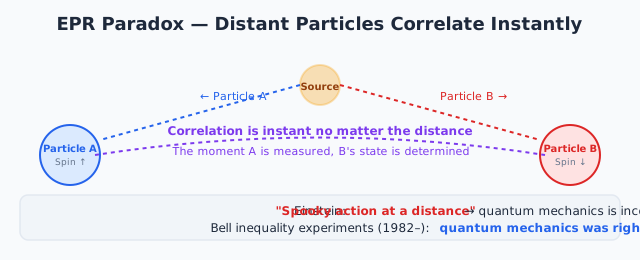
Take two particles quantum-mechanically linked and send one to Tokyo, the other to New York. The moment you measure the Tokyo particle, the state of the New York particle is determined instantly — regardless of distance, unconstrained by the speed of light. Einstein called this “spooky action at a distance” and strongly objected to it.
What Is the EPR Paradox?
The name comes from a 1935 paper by Einstein, Podolsky, and Rosen published in Physical Review, titled “Can Quantum-Mechanical Description of Physical Reality Be Considered Complete?” (EPR = the three authors’ initials). As the title suggests, the paper’s goal was to demonstrate the incompleteness of quantum mechanics.
In quantum mechanics, two particles in a state of “quantum entanglement” are correlated no matter how far apart they are.
For example, suppose two electrons have entangled spins. In this state, if one spin is up, the other must be down. But which one is up is not determined until measured — that is the claim of quantum mechanics.
The moment you measure the Tokyo particle’s spin and find it is “up,” the New York particle’s spin is instantly confirmed as “down.” This confirmation happens instantaneously, apparently unconstrained by the speed of light.
Einstein’s Objection
Einstein argued that this picture painted by quantum mechanics was wrong. His objection rested on two principles.
Locality: An event at one location cannot affect a distant location faster than light.
Realism: Physical quantities have definite values before they are measured.
Einstein reasoned that if merely observing the Tokyo particle instantly changes the state of the New York particle, this violates locality.
Einstein’s position was that the spin of a particle was fixed from the beginning — it wasn’t determined by the act of measurement. He compared it to placing a left glove and a right glove in separate boxes: opening one box and finding a left glove tells you the other box contains a right glove, but that doesn’t mean the measurement “caused” anything.
In other words, quantum mechanics is incomplete, and there must be undiscovered “hidden variables” that pre-determine the outcomes.
Summarized as a syllogism: “If quantum mechanics is right, locality is violated. Locality must be right. Therefore quantum mechanics is incomplete.” Most of the physics community at the time supported Niels Bohr’s Copenhagen interpretation, making Einstein’s criticism a minority position. Bohr immediately published a rebuttal, arguing that the EPR paper’s definition of “physical reality” was itself flawed. For the next 30 years this debate was regarded as an irresolvable philosophical dispute — until 1964.
Bell’s Theorem and the Experiments
In 1964, Irish physicist John Bell proved a landmark theorem: if “hidden variables” exist, certain experimental results must satisfy a specific inequality (Bell’s inequality).
In 1972, John Clauser and Stuart Freedman performed the first experiment and found signs that Bell’s inequality is violated. In 1982, Alain Aspect conducted more rigorous experiments and confirmed that Bell’s inequality is definitively violated. In 1998, Anton Zeilinger closed the remaining loopholes, and the result became conclusive.
The “local hidden variables” Einstein had hoped for do not exist. The astonishing conclusion: nature must give up either locality, realism, or both.
In 2022, Aspect, Clauser, and Zeilinger shared the Nobel Prize in Physics for their experimental contributions. Eighty-seven years after the EPR paper and fifty-eight years after Bell’s theorem, the paradox transformed from a philosophical dispute into a triumph of experimental science.
Faster-than-Light Communication Is Impossible
If quantum entanglement transmits correlations instantly, can it be used for faster-than-light communication? No, it cannot.
The Tokyo observer obtains only a random result — “up” or “down” — and cannot control that result to encode a message. The New York observer also sees only a random spin on their particle and cannot know what happened in Tokyo until informed through conventional communication channels.
Entanglement creates “correlation” instantaneously, but it cannot transmit “information” instantaneously. This subtle but crucial distinction preserves consistency with relativity.
Applications in Quantum Technology
The quantum entanglement properties revealed by the EPR Paradox now form the foundation of transformative technologies.
Quantum cryptography uses entanglement to achieve theoretically unbreakable communication. In 2017, China used the satellite “Micius” to successfully demonstrate quantum cryptographic communication over a distance of 1,200 km.
Quantum teleportation transfers the quantum state of a particle to a distant location using entanglement. Matter itself does not teleport, but this is regarded as an essential technology for networking quantum computers.
The irony that the phenomenon Einstein called “spooky” now underpins cutting-edge 21st-century technology is hard to miss.
What Einstein was trying to defend
Einstein’s position in the EPR paper is often misunderstood. He was not saying that the calculations of quantum mechanics were wrong.
What he wanted to defend were the two premises set out earlier — realism and locality. Taken together they are called local realism, and both had been tacit assumptions of physics for centuries.
The argument of the EPR paper was that if you accept these two, quantum mechanics must be incomplete. The claim was not that quantum mechanics is wrong but that something is still missing from it.
What was posited as missing were hidden variables — the idea that the particles carry their answers in advance and quantum mechanics simply fails to describe them.
What Bell’s inequality forced
What made John Bell’s 1964 work decisive is that it moved the argument from philosophy to experiment.
Bell showed that if local realism is correct, the correlations between measurement results cannot exceed a certain bound. The predictions of quantum mechanics exceed that bound, so an actual measurement decides which is right.
| Year | Experiment | Result |
|---|---|---|
| 1972 | Clauser and colleagues’ early experiment | supported quantum mechanics |
| 1982 | Aspect and colleagues’ experiment | reconfirmed with fewer loopholes |
| 2015 | loophole-free experiments (several institutions) | decisive confirmation |
| 2022 | Nobel Prize in Physics | Aspect, Clauser and Zeilinger |
The result was a win for quantum mechanics. One or both of the premises — that distant places are independent of one another and that values are fixed in advance — does not hold.
What is worth noting is that the experiments do not determine which one fails. Positions that give up locality and positions that give up realism both remain in play.
Einstein is often said to have lost, and the fact that the question he posed became one that experiment could settle was itself a major advance for physics.
Related paradoxes of quantum mechanics
Related paradoxes where quantum mechanics’ demands stop meshing with our naive picture of the world.




Summary
This article covered “The EPR Paradox.”
The paradox Einstein introduced in order to criticize quantum mechanics as incomplete ironically became the catalyst for proving quantum mechanics correct. The fundamental workings of nature appear to operate by mechanisms far stranger than our everyday intuition would suggest.
To return to the full list of paradoxes, follow the link below.
Thank you for reading. We hope to see you in the next article.
Also popular with readers
📚 Series: The World's Paradoxes (44/81)