Thank you for visiting this site. This article covers “The Fermi Paradox.”
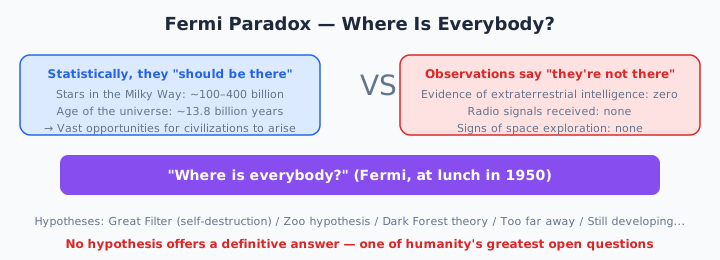
The universe contains hundreds of billions of galaxies, each with hundreds of billions of stars. Surely some of those stars host Earth-like planets, and surely some of those planets have evolved intelligent life. Yet we have found not a single piece of evidence for the existence of extraterrestrials. “Where is everybody?” — this simple question, asked by Italian physicist Enrico Fermi over lunch in 1950, is the beginning of the paradox.
Fermi’s Question
In the summer of 1950, Fermi was having lunch with fellow physicists at Los Alamos National Laboratory. UFO sightings were in the news, and the conversation turned to extraterrestrials.
After the topic drifted elsewhere, Fermi suddenly asked, “Where is everybody?” The other physicists immediately understood what he was referring to — and reportedly laughed.
Fermi’s back-of-the-envelope reasoning was this: given the scale and age of the universe, the time needed for an intelligent civilization to spread across the galaxy should be minuscule compared to the age of the universe. Yet there is no evidence. The contradiction was simple yet extraordinarily deep.
The Numbers
The observable universe is estimated to contain approximately 200 billion galaxies, each with hundreds of billions of stars. The total number of stars in the universe is on the order of 10²² to 10²⁴.
Some fraction of those stars have planets; some fraction of those planets sit in habitable zones; some fraction of those have actually given rise to life; some fraction of those have evolved intelligence. Apply however harsh a filter you like at each stage, and the statistical expectation that intelligent civilizations exist somewhere other than Earth remains overwhelming.
Then there is the age of the universe: about 13.8 billion years. Our solar system formed only 4.6 billion years ago, so there are star systems billions of years older. If intelligence evolved there, those civilizations might be millions or billions of years ahead of us.
Such an advanced civilization might well have spread across the galaxy. Even at the modest speed of 1% of light speed, colonizing the entire Milky Way would take only a few million years — a blink of the cosmic eye. Yet no radio signals, no spacecraft, no megastructures — nothing has been found.
The Drake Equation
In 1961, Frank Drake proposed an equation for estimating the number of communicating civilizations in the Milky Way.
The equation multiplies: the rate of star formation, the fraction with planets, the fraction with habitable planets, the fraction where life actually arises, the fraction where intelligence evolves, the fraction that develops radio technology, and the average lifespan of such civilizations.
Estimates for each parameter vary enormously between researchers, so answers range from “thousands of civilizations in the Milky Way” to “Earth is the only one.” Recent exoplanet discoveries have sharpened the early parameters (fraction of stars with planets, fraction in habitable zones), but the probability of life arising and beyond remains pure speculation.
Proposed Hypotheses
Many hypotheses have been offered in response to the Fermi Paradox. They broadly divide into two camps: “they don’t exist” and “they exist but can’t be seen.”
The Great Filter Hypothesis
Somewhere on the path from primitive chemistry to galaxy-spanning civilization there is a “nearly impassable barrier” — the Great Filter. Life’s origin, the leap to multicellular life, the development of intelligence, the long-term survival of civilization — at some stage the probability is so low that almost no civilization makes it through.
The terrifying question is whether this filter lies in our past or our future. If it is behind us, we are a lucky exception that has already survived. If it lies ahead, civilizations are destined to self-destruct once they reach a certain level.
From this perspective, the discovery of fossils of even microbial life on Mars would be “bad news.” The easier life is to start, the less likely the Great Filter is the origin of life — and the more likely it awaits us in the future.
The Zoo Hypothesis
Advanced civilizations know we exist but choose not to interfere, simply observing us — much as humans observe wildlife in a nature reserve. A non-interference principle, like Star Trek’s Prime Directive, may be observed by all advanced civilizations.
The Dark Forest Theory
Made famous by Liu Cixin’s science fiction trilogy The Three-Body Problem: civilizations in the universe maintain silence because they fear each other. Resources are finite; any other civilization is a potential threat. Since confirming whether a stranger is friendly takes time you may not have, every civilization makes “not being found” its top priority.
Other Hypotheses
Some suggest that sufficiently advanced civilizations retreat into simulations. Once virtual worlds can be built at will, exploring physical space may seem pointlessly inefficient, and civilizations lose interest in the cosmos beyond.
What This Means for Us
The Fermi Paradox raises the most fundamental questions about humanity’s place in the universe.
If the universe truly harbors no other intelligence, we may be alone — a loneliness of cosmic proportions, but also an enormous responsibility. If the only intelligence in the universe destroys itself, the universe’s own attempt to understand itself is lost forever.
On the other hand, if the universe is full of civilizations and we simply cannot detect them, that may reflect our own technological and cognitive limits. Humanity has explored only the tiniest corner of space; reaching conclusions now would be premature.
How to classify the hypotheses
Many hypotheses have been put forward, and sorted out they fall into three positions — a classification by where the story breaks off.
| Position | The claim | Representative hypotheses |
|---|---|---|
| There is nobody | the emergence of civilisation is extremely rare | rare Earth, a great filter in the past |
| They exist but we cannot meet | the gulfs of distance and time are too great | the distance argument, short civilisational lifespans |
| They exist but we cannot see | they avoid us, or we cannot detect them | the zoo hypothesis, the dark forest, technology we cannot recognise |
What makes the argument difficult is that whichever of the three is true, the observation available now — that we see nothing — is the same.
Since the observation is identical, data alone cannot narrow it down. That is why so many hypotheses remain standing side by side.
The time problem bites harder than expected
Distance is the part usually discussed, and there is a case that the mismatch in time is the more severe constraint.
The universe is 13.8 billion years old, the Earth 4.6 billion, and humanity has been emitting radio for about a century. If a technological civilisation lasts, say, ten thousand years, that is less than one millionth of cosmic history.
- The chance of civilisations being contemporaneous: the shorter the lifespan, the more likely they miss each other
- The window in which a signal is receivable: radio keeps travelling after a civilisation ends, and it spreads and weakens
- Detectable range: current technology can detect only within a fairly close radius
In the Drake equation too, the term for the lifetime of a civilisation is the most uncertain and among the most influential on the result.
The Fermi paradox is therefore, as much as it is the question where is everybody, also the question how long does a civilisation last.
That it can be read as material for thinking about our own future is part of why the problem keeps being discussed.
Related paradoxes of cosmic observation
Related paradoxes about the puzzles that come with observing the universe.




Summary
This article covered “The Fermi Paradox.”
More than 70 years after it was first asked, “Where is everybody?” still has no definitive answer. The complete absence of evidence for extraterrestrial intelligence — when the universe’s scale makes their existence seem almost certain — grows more unsettling the more deeply you think about it.
Perhaps the absence of an answer is itself the most important message.
To return to the full list of paradoxes, follow the link below.
Thank you for reading. We hope to see you in the next article.

Also popular with readers
📚 Series: The World's Paradoxes (43/81)