Thank you for visiting this site. This article covers “Tocqueville’s Paradox (the Paradox of Revolution).”
People endure the harshest conditions in silence, then suddenly explode in anger once things begin to improve a little — a strange phenomenon observed repeatedly throughout history. The paradox that improvement breeds discontent was identified by the 19th-century French political thinker Alexis de Tocqueville.
Applicable not only to politics but also to business and everyday relationships, this counterintuitive principle exposes a deep feature of human psychology.
Tocqueville’s Observation
In his 1856 work The Old Régime and the Revolution, Tocqueville analyzed in detail the state of France on the eve of the French Revolution.
Eighteenth-century France was among the wealthiest and most reform-minded nations in Europe. Under Louis XVI, tax reforms were advancing and serfdom was being eased. Scarcely any region within the old order had flourished as rapidly as France.
Yet, paradoxically, it was France that had its revolution. The more oppressive and poorer nations of Eastern Europe did not. Russia’s serfs lived far harsher lives than French peasants, yet their uprising would come more than half a century later.
Tocqueville noticed this contradiction and reached the following insight: “It is not when conditions are worst that people feel most discontented — it is when conditions begin to improve.” This was not merely an observation but a discovery about the essence of human psychology.
Why Improvement Generates Discontent
Several psychological mechanisms combine to produce this paradox.
Rising Expectations
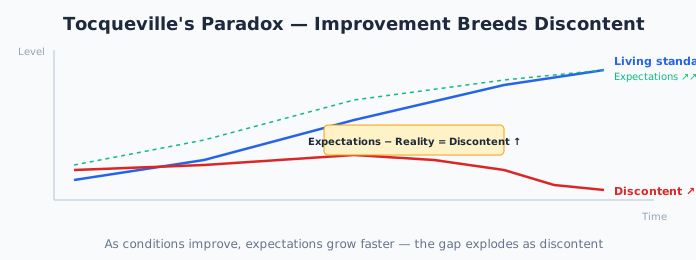
When conditions improve, people come to expect “things should get even better.” Those expectations inflate faster than the actual pace of improvement.
A small gain can actually make the remaining injustices or inconveniences stand out more sharply. What was accepted as “unavoidable” at the worst of times becomes, once improvement begins, a source of frustration: “Why does this still remain?” Psychologists sometimes call this the law of rising expectations.
Shifting Comparison Points
Under oppression, expectations are low and even small benefits are appreciated. But as conditions improve, people begin to focus on the gap between the current situation and how things ought to be.
A laborer who worked seven days a week might be grateful to work six. But once five-day weeks arrive, he starts asking: “Why not four?” The more things improve, the more intolerable what remains unimproved becomes. Because the reference point (the anchor) shifts upward continuously, subjective discontent does not diminish — it grows.
Gaining the Space and Means to Speak Up
In the most oppressed conditions, even resisting is a matter of life and death. Where voicing discontent means imprisonment and holding a meeting means execution, people have no choice but to stay silent.
When a little freedom is granted, space to speak up emerges. Improvement simultaneously provides the resources and means for resistance. The spread of education gives people an awareness of their rights; economic breathing room provides the time and funds needed to act.
On the eve of the French Revolution in Paris, the flourishing salon culture and the proliferation of pamphlets spread Enlightenment ideas, and criticism of the old order penetrated not just the intellectual class but the bourgeoisie. Ironically, the old regime’s own tolerance nurtured its critics.
A Pattern Repeated Through History
Tocqueville’s Paradox is not confined to the French Revolution. The same pattern has been observed repeatedly throughout history.
The American Civil Rights Movement of the 20th century surged precisely as Black Americans’ legal rights were improving incrementally. Black soldiers who had served in the Second World War returned home unable to bear the contradiction of “fighting for freedom abroad while having none at home.”
The collapse of the Soviet Union followed the same pattern. Gorbachev’s perestroika (reform) and glasnost (openness) were intended to stabilize Soviet governance — but as reforms progressed, pent-up grievances erupted, ultimately leading to the dissolution of the USSR.
The Arab Spring of the 2010s also began in countries that had experienced relatively stable economic growth and rising educational levels — not in the most repressive states like North Korea, but in nations that had undergone a degree of modernization.
Contemporary Examples
Tocqueville’s Paradox is visible not only in history but widely in modern daily life.
Gender equality: In countries where women’s rights have improved dramatically, criticism of remaining inequalities tends to be loudest. The fact that feminist debates are most active in the Nordic countries — those with the greatest gender equality — can be explained by this paradox.
Dissatisfaction with technology: Smartphones today are vastly more capable than a decade ago, yet user dissatisfaction has not diminished. If anything, expectations keep pace with capability: “Why doesn’t this feature exist yet?” and “Why hasn’t this bug been fixed?”
Workplace improvements: Companies that introduce remote work or flexible hours often face increased demands for “more flexibility” and “more leave.” Ironically, companies that do nothing are criticized less, while those that work hard to improve face the most criticism — a textbook case of Tocqueville’s Paradox.
The Reformer’s Dilemma
This paradox poses a serious dilemma for those leading reform.
Not improving leaves problems unsolved, but improving breeds discontent. Stopping improvements only reverts things to the previous state. What is required is the difficult balance of continuing to improve while managing the risk of a discontent explosion.
Successful reformers throughout history have carefully controlled the pace of reform and the timing of public communication. Reform that is too rapid triggers runaway expectations; too slow, and people doubt whether reform is genuinely intended. This tightrope walk is not just a challenge for politicians — it is equally relevant to corporate executives and managers.
Handling the gap between expectation and reality
What the Tocqueville effect shows is that satisfaction is decided not by the level but by the distance from expectation.
However much reality improves, if expectation climbs faster the gap keeps widening. The rate of improvement is not the problem; the growth of expectation is.
- Reality rises, expectation rises faster: discontent grows. Typical of a period of reform
- Reality rises, expectation rises at the same rate: satisfaction is flat
- Reality stalls, expectation keeps rising: the most dangerous case. Discontent mounts rapidly
- Reality falls and expectation falls with it: discontent is surprisingly small
The third is the shape often observed just before a revolution. When a long run of improvement suddenly stops, expectation alone carries on rising and the gap is at its widest.
What the people doing the improving can do
Knowing this structure changes how anybody driving reform or improvement behaves.
First, set out concretely in advance what will improve and how far. That reduces the room for expectation to inflate on its own.
Second, do not stop. The most dangerous thing in Tocqueville’s analysis was not improvement itself but improvement stopping partway.
Third, do not mistake rising discontent for a sign of failure. People may be speaking up because things improved enough to give them the room to speak.
The same happens with improvement programmes at work. The more the arrangements are put right, the more complaints appear, and whoever is responsible tends to feel it would have been better not to bother — when it is also evidence that the improvement reached people. It is not something to judge on the numbers alone.
Related paradoxes of economics and happiness
Related paradoxes where an improvement measured in money or happiness fails to deliver the expected result.



Summary
This article covered “Tocqueville’s Paradox.”
The fact that improving conditions can breed greater discontent is a paradox that can arise in politics, business, and personal relationships alike. From the French Revolution to the collapse of the Soviet Union to the debates of social media today, humanity keeps experiencing the same pattern.
It is painful when improvement is met with discontent — but one can also take comfort in the thought that discontent is itself evidence that improvement is underway.
To return to the full list of paradoxes, follow the link below.
Thank you for reading. We hope to see you in the next article.

Also popular with readers
📚 Series: The World's Paradoxes (79/81)