
Thank you for visiting this site. This article covers “The French Paradox.”
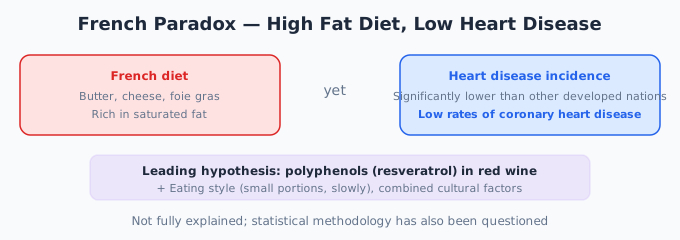
French cuisine makes lavish use of butter, cream, and cheese. A high intake of saturated fat should raise the risk of heart disease. Yet France’s death rate from heart disease is clearly lower than that of other Western nations.
This contradiction challenged nutritional orthodoxy head-on, sparked a global wine boom, and fundamentally changed how scientists think about the relationship between diet and health.
The Discovery
In the 1980s, French epidemiologist Serge Renaud noted that the French rate of coronary heart disease (CHD) mortality was dramatically lower than would be predicted from their saturated fat consumption.
Nutritional science at the time had largely accepted the causal chain: “saturated fat → elevated cholesterol → atherosclerosis → heart disease.” Data from American and Scandinavian studies underpinned this view, and saturated fat was a primary target of public health campaigns.
France’s data contradicted this picture head-on. French consumption of butter and animal fats equaled or exceeded that of the US and UK, yet France’s heart disease mortality was only about one-third that of the United States.
The TV Program That Changed the World
In 1991, the American CBS news program 60 Minutes aired a feature on the paradox. Dr. Renaud appeared and discussed the link between France’s low heart disease rates and red wine consumption.
The program caused a sensation: the following week, US red wine sales jumped 44%. The idea that red wine was “good for you” spread rapidly, and the program is credited with sparking the global wine boom of the 1990s.
As an example of a single television program reshaping food culture, the French Paradox is noteworthy in its own right.
The Red Wine Hypothesis
The most famous explanation centers on red wine. The French drink red wine regularly with meals.
Polyphenols in red wine — particularly resveratrol — were said to protect vascular endothelium, prevent LDL cholesterol oxidation, and inhibit platelet aggregation. Animal experiments reported that resveratrol extended lifespan, and it attracted enormous attention as a potential “longevity elixir.”
However, the hypothesis has a critical limitation: some estimates suggest that obtaining the amount of resveratrol shown to be effective in animal studies would require drinking more than 100 bottles of wine per day. Whether realistic drinking quantities produce the same benefits is highly questionable.
There is also the other side of the ledger. While moderate alcohol consumption has been associated with cardiac benefits in some studies, alcohol simultaneously increases the risk of cancer and liver disease. Current medical opinion does not support the simple recommendation to “drink wine for your health.”
Other Leading Hypotheses
Several factors beyond red wine have been proposed to explain the French Paradox.
Eating patterns and portion size
French food culture emphasizes leisurely, unhurried meals. Lingering over lunch for an hour or more is common, and courses are served in small portions to be savored slowly.
Comparative research by Richard Wrangham and Paul Rozin found that portion sizes at comparable French and American restaurants differ by 25–30%, with French portions smaller. Fast food portions are also noticeably smaller in France.
Even with a higher proportion of saturated fat, lower total caloric intake may contribute to the lower risk of heart disease.
The overall balance of the diet
French cuisine incorporates not only butter and cream but also plentiful fresh vegetables, fruit, fish, olive oil, and herbs. It shares many features with the Mediterranean diet.
Looking only at saturated fat misses the dietary pattern as a whole. Eating cheese with red wine, having a salad, and finishing with fresh fruit — this entire eating pattern may have a protective effect.
Snacking culture
Traditionally, the French eat relatively little between meals. Three proper meals a day, with nothing in between, is a deeply rooted cultural norm.
By contrast, constant grazing is common in the United States and is cited as a contributor to higher total caloric intake.
Statistical issues
Some researchers have noted that French heart disease statistics may be compiled under different criteria than those of other countries. When cause-of-death classification differs between nations, direct comparisons can be misleading.
It has also been argued that there is a time lag of several decades between increased saturated fat consumption and the onset of heart disease, and that France’s shift to a high-fat diet is relatively recent — its cardiovascular impact may not yet be fully reflected in the statistics.
A Paradigm Shift in Nutrition
The French Paradox became a catalyst for questioning the very premise that saturated fat directly causes heart disease.
From the 2000s onward, the “fat is bad” consensus was substantially revised. Multiple large-scale meta-analyses reported that reducing saturated fat does not necessarily lower heart disease risk, sending shockwaves through the nutrition community.
Modern nutritional science has broadly recognized the limits of predicting health from a single nutrient. Overall dietary patterns, lifestyle factors (exercise, stress, sleep), social factors (eating alone vs. with others), and genetics all require consideration. The idea that food and health interact in far greater complexity than previously imagined has become mainstream — and the French Paradox was a key spark.
The pitfall of confounding
The argument over the French paradox is often used as teaching material for the difficulty of reading causation out of statistics.
The problem is confounding. When a third factor affects both a supposed cause and the outcome, an apparent relationship appears between them.
- Wine drinkers tend to have higher incomes: better access to healthcare
- Wine drinkers have different eating habits: they drink slowly, with food
- Smoking rates and exercise habits differ: the whole pattern of life is different
- The never-drinking group contains people who quit because of illness: which makes non-drinkers look unhealthy
The fourth is known as the sick quitter effect, and it is thought to explain part of the finding that moderate drinking is good for health.
When people who gave up alcohol are counted as non-drinkers, the mortality rate of the non-drinking group comes out high.
Where the assessment stands now
Recent research increasingly reports that there is no safe lower bound for alcohol consumption. Reanalyses using only lifelong abstainers as the control group find the protective effect of light drinking much reduced or absent.
The large 2018 analysis in The Lancet, and the revisions to national drinking guidelines that followed, run in the same direction.
That French mortality from heart disease was low remains a fact, all the same. The mainstream view now explains it not by red wine alone but by the whole manner of eating.
It is an accumulation of factors: taking time over meals, snacking little, keeping portions modest.
Stop the moment you think a single component has explained everything. That is how the thirty years of the French paradox read.
Related paradoxes of economics and happiness
Related paradoxes where an improvement measured in money or happiness fails to deliver the expected result.




Summary
This article covered “The French Paradox.”
Health mysteries that cannot be explained by simple cause and effect reveal how complex nutritional science truly is. The magical effects of red wine were probably overstated, but the impact of an entire food culture on health is undeniably real.
There is something delightful about the fact that a table of butter and wine continues to challenge scientific orthodoxy.
To return to the full list of paradoxes, follow the link below.
Thank you for reading. We hope to see you in the next article.

Also popular with readers
📚 Series: The World's Paradoxes (80/81)