Thank you for visiting this site. This article covers “The Paradox of Tolerance.”
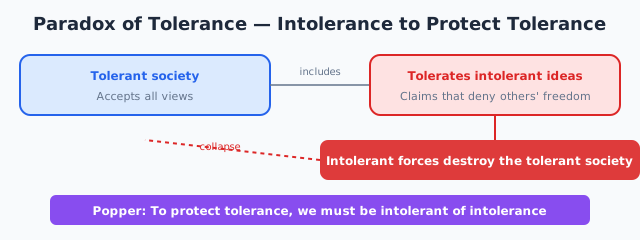
A tolerant society accepts all kinds of ideas and arguments. But if it also accepts the intolerant claim that “others’ freedom should not be recognized,” the tolerant society itself may be destroyed from within.
Should intolerance then be excluded? But is the act of exclusion not itself intolerant? This circular question touches the foundations of democratic society.
Popper’s Warning
In 1945, philosopher Karl Popper addressed this paradox explicitly in his book The Open Society and Its Enemies.
Popper’s argument runs as follows. If tolerance is extended without limit — if even the intolerant are treated with tolerance — the intolerant will ultimately eliminate the tolerant. Therefore, to maintain a tolerant society, one must be intolerant toward intolerance.
At first glance, this seems contradictory: to be a “tolerant society,” one must practice “intolerance.”
Behind Popper’s argument lay the memory of Nazism and fascism. Written in 1945, immediately after the Second World War, the book was also a response to the agonizing question: “How did democratic societies fall to totalitarianism?”
Historical Lessons
The Tragedy of Weimar Germany
History demonstrates that this paradox is no mere theoretical exercise.
The Weimar Republic — Germany after the First World War — had one of the most democratic and tolerant constitutions in Europe at the time. Freedom of speech, freedom of assembly, and universal suffrage were broadly recognized.
Yet within that tolerance, the Nazi Party expanded legally. Hitler gained power through elections and used the institutions of democracy to abolish democracy itself. The Enabling Act of 1933 passed by a parliamentary majority, and democracy committed suicide through democratic procedure.
A Recurring Pattern
Similar patterns have been observed elsewhere. In 20th-century Algeria, an Islamist party won a democratic election, making the prospect of abolishing democracy through elections a real possibility.
During the Cold War, the treatment of communist parties in Western democracies was fiercely debated. Should a party that aims to overthrow democracy be allowed to participate in elections? Allowing it hands the tools of destruction to its enemies; refusing violates democratic principles. This was the paradox of tolerance in action.
Popper and Rawls — Two Approaches
Different philosophers have proposed different responses to the paradox of tolerance.
Popper himself did not argue for a blanket ban on intolerant ideas. His position is that limiting tolerance is justified only against those who refuse rational argument, or who seek to impose their views through violence. The critical distinction, in other words, is not the content of a claim but its method.
American philosopher John Rawls took a different angle in A Theory of Justice. Rawls’s position is that even intolerant groups should be treated with tolerance, as long as they do not directly threaten the safety of society. However, when the institutions of a tolerant society are in peril, restricting intolerance can be justified as an act of self-defense.
Where Popper drew the line at method, Rawls drew it at degree of threat.
Contemporary Debates
Platform Content Moderation
The spread of the internet and social media has made this paradox increasingly urgent.
Major platforms — social networks, video sites, forums — confront the paradox of tolerance daily. Leave hate speech and extremist content unaddressed, and targeted people are effectively driven from the platform. Remove it, and the platform faces charges of censorship.
Each platform’s content moderation policies are in practice a practical answer to this paradox. Setting a fully neutral standard is impossible, and the very act of deciding what to permit and what to remove is a political act.
Legal Approaches by Country
Regulation of hate speech varies widely across nations. Germany, drawing on its Nazi history, maintains strict laws including incitement of the population (Volksverhetzung) and Holocaust denial. The United States, grounded in the First Amendment, extends maximum protection to free expression and legally protects even hate speech, except for direct incitement to violence.
Japan enacted a hate speech elimination law in 2016, but it is a statement of principle without criminal penalties. Countries are each seeking a different balance, and no complete solution has been found.
Tolerance as Value or Social Contract?
One approach to resolving this paradox is to treat tolerance not as a moral value but as a social contract.
If tolerance is a value, an obligation arises to be tolerant in all circumstances — and the paradox follows. But if tolerance is a social contract, the picture changes: “Those who participate in the contract to respect each other’s freedom are protected by it. Those who break the contract forfeit its protection.”
Under this view, being intolerant toward the intolerant is no paradox. It is simply the natural consequence of “not extending the contract’s benefits to those who violate it.”
Where to draw the line
The practical difficulty of the paradox of tolerance comes down to who decides where intolerance begins, and how.
There are broadly three directions for setting the criterion.
| Criterion | What is restricted | The difficulty |
|---|---|---|
| Judge by content | particular ideas or claims themselves | whoever holds power can apply it arbitrarily |
| Judge by method | violence, intimidation, refusal to argue | subtle incitement is hard to catch |
| Judge by consequence | cases where concrete harm is foreseeable | foreseeability is hard to establish |
Popper himself took the second. The position is to draw the line by whether somebody will engage in rational argument, not by the content of what they claim.
The advantage of that criterion is that it is hard for those in power to abuse, since the judgement is about conduct rather than about what was said.
Its weakness is that it does little against movements that deepen social division without resorting to violence. Much of the recent debate is aimed at how to close that gap.
Framing it as a limit on rights
Another strong view treats tolerance not as an unlimited virtue but as a mutual undertaking.
Only those who accept being treated tolerantly are subjects of tolerance. The logic is that a side that does not keep the undertaking cannot demand its protection.
- Seen as a virtue: one ought to be tolerant whatever the other side is, which risks self-destruction
- Seen as an undertaking: there is an explicable reason not to apply it to a side that has broken it
- The practical upshot: a restriction is positioned as exclusion from the agreement rather than as a punishment
This framing closely resembles the reasoning behind platform terms of service, where the explanation is that applying a previously stated agreement is not an infringement of free expression.
The question of who writes the terms remains, of course. No position removes the problem of who holds the authority to draw the line.
There is no complete answer, and one thing at least is clear: the position that tolerance means restricting nothing does not actually hold together.
Related paradoxes of philosophy and democracy
Related paradoxes where exercising freedom or power turns against itself.
Summary
This article covered “The Paradox of Tolerance.”
The need for intolerance in order to protect tolerance is a fundamental problem democratic societies must permanently confront. Unlimited tolerance is self-destructive; unlimited intolerance is oppression itself.
From Weimar Germany to social media moderation, our societies are constantly swinging between those poles. Continuing to ask where along that spectrum to stand may be the inescapable vocation of an open society.
To return to the full list of paradoxes, follow the link below.
Thank you for reading. We hope to see you in the next article.
Also popular with readers
📚 Series: The World's Paradoxes (81/81)