Thank you for visiting this site. This article covers the “Birthday Paradox.”
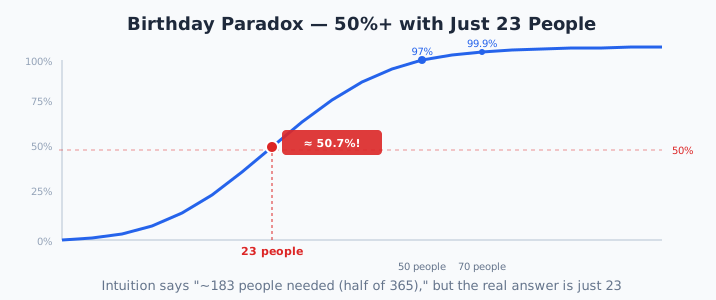
A year has 365 days, so sharing a birthday with someone seems like it should be quite rare. Yet in practice, in a group of just 23 people, the probability that at least one pair shares a birthday exceeds 50%. With 70 people, it surpasses 99.9%.
Doesn’t that seem like too few? That feeling of disbelief is the very heart of this paradox.
Why 23 People Give More Than 50%
Most people get tripped up by confusing “the probability that someone shares your birthday” with “the probability that any two people in the group share a birthday.”
The probability that someone among 23 people shares your specific birthday is indeed low (about 6%). But the question asks for “the probability that at least one pair of any two people — regardless of who — shares a birthday.”
In a group of 23 people, the number of two-person combinations is 23 × 22 ÷ 2 = 253 pairs. We’re asking whether at least one of those 253 pairs shares a birthday — and suddenly exceeding 50% doesn’t seem so surprising.
The Calculation
Rather than computing the probability of a shared birthday directly, it’s easier to compute the probability that “everyone has a different birthday” and subtract from 1.
Person 1 can be born on any day: 365/365.
Person 2 must be born on a different day: 364/365.
Person 3 must differ from both: 363/365.
Continue to person 23…
Probability all birthdays differ = 365/365 × 364/365 × 363/365 × … × 343/365 ≈ 0.4927
So the probability that all 23 birthdays are different is about 49.3%. That means the probability that at least one pair matches is 1 − 0.4927 = about 50.7%.
With 50 people the probability rises to 97%; with 70 people it exceeds 99.9%.
Real birthdays are not evenly spread
The calculation so far has assumed that births are spread evenly over 365 days. They are not.
In every country, birth numbers vary by season and by day of the week.
- Seasonal variation: more births from summer into autumn, fewer from winter into spring
- Day-of-week variation: scheduled deliveries make weekend births less common than weekday ones
- Particular dates: numbers move around dates considered auspicious or unlucky
- 29 February: it comes round once in four years, so it is extremely rare
Does that unevenness break the 50 percent at 23 people?
The answer runs the other way: the more uneven the distribution, the higher the probability of a match. People born on the popular dates are more likely to coincide with one another.
It is a proved mathematical result that the probability of a match is minimised under a uniform distribution. So 50 percent at 23 people is the figure under the conditions least favourable to a match, and any real distribution gives more.
The actual unevenness is not large, so the number required shifts only from 23 to about 22. What matters is the confirmation that making the assumptions realistic does not disturb the conclusion.
Why Intuition Fails
Humans systematically underestimate how quickly the number of “pairs” grows.
Each time one more person joins, the number of new pairs equals the total number of people already present. When person 23 joins, 22 new pairs are created. Because the number of pairs grows roughly with the square of the group size, the probability shoots up much faster than intuition suggests.
The same dynamic applies in everyday life. In a meeting of 10 people, it is hardly unusual for two attendees to share a hobby — because those 10 people form 45 distinct pairs.
Verified by Real Data
The Birthday Paradox has been confirmed not just theoretically but in actual data.
For instance, examining the rosters of teams at the FIFA World Cup (23 players per team), roughly half of all teams contain at least one pair of players sharing a birthday — exactly as theory predicts.
A school class of 30–40 students has a 70–90% chance of containing at least one shared birthday pair. Looking back at your own school days, you may well remember classmates who shared a birthday.
How the numbers change with group size
The figure of 23 tends to travel on its own, and seeing the values either side of it gives a better feel for the shape.
Probability by group size
| People | Probability that some pair shares a birthday |
|---|---|
| 10 | about 11.7% |
| 20 | about 41.1% |
| 23 | about 50.7% |
| 30 | about 70.6% |
| 41 | about 90.3% |
| 57 | about 99.0% |
| 70 | about 99.9% |
In a class of about forty, a shared birthday is there nine times out of ten. Try it in a school class and you will usually find one.
Past seventy it is effectively certain, and 100 percent is only reached at 366. The climb over that last stretch is very slow.
Looking for “somebody with my birthday” is a different question
There is a way of asking what looks like the same question that produces an entirely different number.
How many people are needed for a 50 percent chance that somebody in the room shares your birthday? The answer is 253. That is an order of magnitude away from 23.
- Any pair among the group: 23 people give 253 possible pairs
- A pair involving you: 23 people give only 22 pairs that include you
The number of comparisons differs by more than tenfold, so the number of people required differs enormously. Whether “somebody has the same birthday” is measured from you or across everyone changes the answer by a factor of ten.
That is usually where the intuition goes wrong. Hearing “23 people”, you picture 23 comparisons; the number actually being checked is 253. What is being counted is not people but pairs — grasp that one point and most of the surprise subsides.
Applications in Cryptography
The Birthday Paradox plays an important role in cryptography and security. An attack method called a “birthday attack” exploits this principle.
If a hash function produces an n-bit output, intuition suggests that generating a collision (two different inputs with the same hash) would require approximately 2^n attempts. In reality, however, roughly 2^(n/2) attempts suffice — the same mathematics as the Birthday Paradox. This is a critical factor in evaluating the security of cryptographic systems and cannot be ignored.
If you try it in a classroom
Run the demonstration with a real class and it may not go as smoothly as expected. There are a few reasons.
- Not enough people: 23 gives 50 percent, so half the time nothing is found
- Twins in the room: a shared birthday is then guaranteed, and it stops being about probability
- Everybody the same age: within one school year the birth months are skewed, which makes matches more likely
- Nobody notices: unless everyone says their date aloud, the pair themselves never find out
To be sure of success, try it with a group of around forty. A match turns up nine times out of ten.
Looking for “somebody with my birthday” is best avoided. That needs 253 people, so even a whole year group assembly is barely a coin flip.
Failing to find one is the better teaching moment. Fifty percent at 23 people means coming up empty every other time is exactly what should happen.
Counting pairs rather than people is what makes it click, and I think of this problem as the clearest example of intuition underestimating how many combinations there are.
Related paradoxes that defy probabilistic intuition
Related paradoxes where the arithmetic is correct and the answer refuses to sit with intuition.



Summary
This article covered the “Birthday Paradox.”
Strictly speaking, this is not a contradiction but a superb example of how inaccurate human probabilistic intuition can be. Intuitively grasping the explosive growth of combinations is genuinely difficult for the human mind.
To return to the full list of paradoxes, follow the link below.
Thank you for reading. We hope to see you in the next article.

Also popular with readers
📚 Series: The World's Paradoxes (25/81)