Thank you for visiting this site. This article covers “The Missing Dollar Paradox.”
Three guests check into a hotel and pay a total of $30. Later the hotel realizes the room should have been $25 and sends $5 with an employee to refund them. Since $5 cannot be split evenly three ways, the employee pockets $2 and returns $1 to each guest. Each guest has now paid $9, so the total paid is $27. Add the employee’s $2, and you get $29. Where did the missing dollar go?
This famous trick, told around the world for decades, is an illusion created by language, not mathematics.
Following the Story Carefully
Let’s trace the situation step by step.
Three guests book a room for $30. Each pays $10, totaling $30.
The hotel owner then realizes the correct price is $25 and instructs an employee to return $5.
The employee thinks: $5 can’t be divided evenly among three people, so I’ll keep $2 and give each guest $1.
Each guest has now paid $10 − $1 = $9. Three guests × $9 = $27 total paid.
Here comes the trick. Add the employee’s $2: 27 + 2 = $29. That’s $1 short of the original $30.
The Trick Revealed
The answer is clear: adding the $2 to the $27 is the wrong operation.
Let’s track the money correctly.
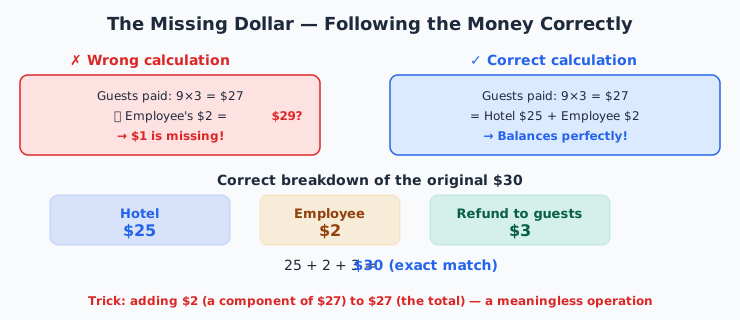
The three guests paid a total of $27. That $27 went to: the hotel ($25) + the employee ($2). 25 + 2 = 27. The arithmetic balances perfectly.
The puzzle’s trap is prompting you to add the guests’ total payment ($27) to the employee’s cut ($2). But the employee’s $2 is already inside the $27. Adding something that is already included will of course produce a wrong result.
The correct accounting: guests paid $27 = hotel $25 + employee $2.
Full breakdown of the original $30: hotel $25 + employee $2 + refund to guests $3 = $30.
Nothing is missing.
The Accounts at Each Stage
A table makes the picture perfectly clear.
| Stage | Guests | Hotel | Employee | Total |
|---|---|---|---|---|
| Before payment | $30 | $0 | $0 | $30 |
| After payment | $0 | $30 | $0 | $30 |
| After refund | $3 | $25 | $2 | $30 |
At every stage, the total is exactly $30. Not a dollar is missing. The puzzle simply combines the final numbers in an arbitrary way to make the accounts look like they don’t balance.
Why We Are Fooled
What makes this paradox interesting is that even when you know the trick, you still feel a momentary “wait, what?” reaction.
Mixing Expenditure and Holdings
Our brains expect that adding something back should return us to the original number. The puzzle cleverly blends numbers from different categories — total spent versus a component of what was spent — and makes us add things that should not be added.
Adding $27 (a total expenditure figure) to $2 (a component of that same expenditure) is meaningless. It’s like saying “3 apples + 2 oranges = 5 fruit” — numerically tidy but conceptually wrong.
An Accounting Perspective
In accounting terms, this is a debit-credit confusion. Double-entry bookkeeping always separates where money came from and where it went. This puzzle naturally leads you to mix origin and destination figures — an operation that would be immediately rejected by any accountant.
Similar sleight-of-hand — mixing numbers from different categories to make the books look balanced, or unbalanced — appears in fraudulent accounting and certain cons.
The Anchoring Effect
In cognitive psychology, people are drawn to the first number presented — the anchoring effect. In this puzzle, $30 functions as a powerful anchor. Seeing $29, we instinctively hunt for the $1 gap.
But the number $29 itself is meaningless in this context. Comparing it to $30 is the error.
Similar Tricks
The Missing Dollar shares its structure with other mathematical illusions.
The “proof that 12 = 11” type of puzzle hides a division by zero somewhere in a chain of seemingly valid algebraic steps. Each step looks fine; only the conclusion is obviously wrong.
What all these tricks have in common is that each individual step looks reasonable, making the logical leap in the overall argument hard to spot. They underscore the importance of checking every step in a mathematical or logical argument.
Tricks of the same type
The missing dollar is built by mixing a direction of addition with a direction of subtraction. Other tricks are built the same way.
- The triangle area puzzle: rearrange the same pieces and a one-square gap appears. The hypotenuse is very slightly bent
- Stacked discounts: 30 percent off then 20 percent off feels like 50 percent off. It is actually 44 percent
- The average of averages: at 40 km/h out and 60 km/h back, the average speed is 48 km/h, not 50
- Asymmetry of rises and falls: a share price that falls 50 percent and then rises 50 percent does not return to where it started
Each of them exploits a failure to distinguish the situations where you may simply add or average and the situations where you may not.
The third is a harmonic-mean problem. The distances are equal, and the slow leg takes longer, so weighting by time pulls the result toward the slow speed.
What these tricks have in common is that they are set up so an answer can be produced. The arithmetic is easy and the numbers line up neatly, so you carry straight on.
Get into the habit of checking
The ways to avoid being caught by problems like this are surprisingly simple.
| Checking step | What it reveals |
|---|---|
| Keep a separate ledger per party | who paid and who received stays unmixed |
| See whether the totals agree | money out and money in should balance |
| Try an extreme value | the shape of a discount or averaging formula shows up at once |
The third is quick and effective. For stacked discounts, thinking of 50 percent off twice makes it immediately clear that it does not come to 100 percent off.
Testing the shape of a formula with an extreme value is usually faster than following the arithmetic through. It is the first thing I reach for when checking an estimate.
The wording steers you toward the answer
What is clever about this problem is that the arithmetic error is planted in the wording rather than in the reader.
The final sentence takes the form “$27 plus the bellhop’s $2 makes $29. Where did the dollar go?” The moment the word “plus” appears, thinking is locked into the direction of addition.
- The calculation you are steered into: 27 + 2 = 29, one short of 30
- The correct calculation: 27 − 2 = 25, which matches the room charge
- The role of the wording: it specifies the direction and removes the chance to check
The bellhop’s $2 is already inside the $27, so adding it again is double counting.
- The $27 the guests paid = the $25 room charge plus the bellhop’s $2
- The $3 in the guests’ hands = what was refunded
- Total = 27 + 3 = $30, with nothing missing
Every figure balances, and the vanished money never existed. The answer is that the addition you were asked to perform had no meaning in the first place.
How to approach problems of this kind
There are a few effective stances for when you meet a trick of the same shape.
First, do not simply carry out the calculation the wording specifies. Here, being told to add is already grounds for suspicion.
Second, rebuild the table yourself, one row per party. Write down who handed how much to whom and the double counting shows up immediately.
Third, check whether that total means anything at all. The number 29, obtained by adding 27 and 2, corresponds to nothing in the world.
The last point is the most important. Numbers can always be added, so a meaningless addition still produces an answer. If you cannot say what the number represents, it is worth stopping before you calculate.
Related paradoxes that defy probabilistic intuition
Related paradoxes where the arithmetic is correct and the answer refuses to sit with intuition.


Summary
This article covered “The Missing Dollar Paradox.”
No dollar was ever missing. By subtly switching the accounting framework, the puzzle manufactures a mystery that does not exist. Strictly speaking it is not a paradox but a sophism — yet it is one of the most famous math puzzles ever devised, and it shows how easily human cognition can be led astray by the way numbers are presented.
The lesson: in everyday arithmetic, being clear about what you are actually adding is the first step to getting the right answer.
To return to the full list of paradoxes, follow the link below.
Thank you for reading. We hope to see you in the next article.
Also popular with readers
📚 Series: The World's Paradoxes (21/81)