
Thank you for visiting this site. This article covers “Thomson’s Lamp” paradox.
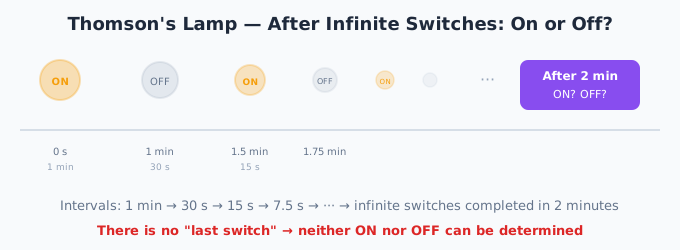
Press a lamp’s switch once — on. Press again — off. Repeat infinitely many times. When you are done, is the lamp on or off? It turns out this question has no answer.
The Setup
British philosopher James F. Thomson introduced this thought experiment in his 1954 paper “Tasks and Super-Tasks.” His goal was to expose problems inherent in the concept of a supertask — completing infinitely many operations in a finite time.
The switch is pressed at the following moments:
- 0 seconds: switch pressed (on)
- 0.5 seconds: switch pressed (off)
- 0.75 seconds: switch pressed (on)
- 0.875 seconds: switch pressed (off)
- …
Each interval is half the previous one. Therefore, infinitely many switch operations are completed within exactly 1 second.
After exactly 1 second, is the lamp on or off?
Why There Is No Answer
Suppose the lamp is on at t = 1 second. Then the last operation was pressing it on. But every “on” press is followed by an “off” press, so there is no “last on.” Contradiction.
Suppose the lamp is off. Then the last operation was pressing it off. But every “off” press is followed by an “on” press, so there is no “last off.” Contradiction.
In other words, the concept of a “last operation” does not exist. Because the infinite sequence of presses has no final element, nothing in the setup determines the lamp’s state at t = 1 second.
Note: the claim is not that the lamp is “neither on nor off” — it must be one or the other. The point is that nothing in the setup provides any logical basis for determining which.
Difference From Zeno’s Paradox
At first glance this resembles the Achilles and the Tortoise paradox, but there is an important difference.
In Zeno’s paradox, the infinite sequence of steps converges to a finite total time, and at that moment Achilles reaches the tortoise — a well-defined outcome in a new state.
In Thomson’s Lamp, the infinite sequence also converges to 1 second, but no information in the setup determines the state at t = 1 second. The infinite operations are all completed within 1 second — but their “result” is simply undefined.
The Mathematical View
Mathematically, the function describing the lamp’s state oscillates between 0 and 1 infinitely rapidly as t approaches 1 second from below. The limit as t → 1 does not exist — the function does not converge to any single value.
This is different from Zeno’s case, where an infinite geometric series converges cleanly to a finite limit. Thomson’s Lamp produces oscillation without convergence, so no limit exists.
Therefore, “what is the lamp’s state at 1 second?” has no mathematically well-defined answer. This means the question is not so much a paradox as an ill-posed question — one the problem’s setup simply does not answer.
Benacerraf’s Reply
In 1962, philosopher Paul Benacerraf offered an influential response. His argument: the fact that the lamp’s state at t = 1 is indeterminate is not a paradox but simply a feature of the problem’s constraints.
The lamp’s state is perfectly well defined at every moment before t = 1 second. Nothing in the setup says anything about the state at t = 1 exactly. Therefore, the lamp could be on at t = 1 without contradiction, or off at t = 1 without contradiction. The fact that both are consistent with the setup is itself the answer — the problem just underdetermines the outcome.
Other Supertask Puzzles
Related supertask thought experiments exist.
The Ross–Littlewood paradox: begin with an empty vase. At each step, put 10 balls in and remove 1. Repeat infinitely. How many balls are in the vase at the end? The answer depends on which ball is removed at each step — under different removal rules the answer can be 0 or infinity.
Physically Impossible
In the real world, Thomson’s Lamp cannot be built. As the interval between presses shrinks without bound, it eventually drops below the Planck time (~5.4 × 10⁻⁴⁴ seconds), at which point the notion of a time interval loses physical meaning. The switch would also need to move faster than light.
Thomson’s Lamp is a purely mathematical and philosophical thought experiment, illustrating what happens when the concept of “infinity” is forced into a finite physical scenario.
How the argument over supertasks widened
The setup Thomson introduced — completing infinitely many operations in a finite time — has since been examined in a variety of forms.
The best-known supertasks
| Name | The setup | The result |
|---|---|---|
| Thomson’s lamp | press the switch infinitely often, halving the interval each time | the final state cannot be defined |
| The Ross–Littlewood paradox | put in ten balls and take one out, infinitely often | the answer is 0 or infinite depending on which you remove |
| Zeno’s dichotomy | cover half the remaining distance each time | arrives in finite time, no contradiction |
| Benacerraf’s objection | every instant is defined, the final instant is not | a constraint of the setup, not a paradox |
What matters is that only the third resolves straightforwardly. For a quantity that varies continuously, such as position, the limit simply is the final state.
The state of the lamp, however, takes only the values 0 and 1 — a discrete quantity, for which no limit exists. Whether a supertask has a meaning turns on whether the quantity is continuous or discrete.
The Ross–Littlewood case in the second row is more extreme still. Number the balls and change only the rule for which one to remove, and the number left at the end comes out as zero or as infinite. The same “ten in, one out” is being repeated in both cases.
Seen from modern physics
The physical impossibility was covered earlier in this article, and there is also work in theoretical physics that takes setups of this kind seriously.
- Malament–Hogarth spacetime: a spacetime structure, within general relativity, in which an infinite computation can be observed in finite time
- Hypercomputation: theoretical work on the problems that would become solvable if supertasks could be carried out
Neither is anywhere near realisation, and investigating what would be possible if supertasks were does clarify where the limits of computation come from.
A problem Thomson offered as a philosophical thought experiment sits at the junction of computation theory and the structure of spacetime, which is a rather interesting place for it to have ended up.
What Thomson himself concluded
It is worth saying what James Thomson, who devised it, actually wanted to claim.
His aim was not to guess the state of the lamp. It was to show that the concept of a supertask is itself contradictory.
For infinitely many operations to have been completed, there must be a last operation. Infinity has no last member. Therefore, he argued, the phrase “completing infinitely many operations” makes no sense at all.
If that were right, Zeno’s paradoxes would be dismissed for the same reason, since the setup of passing through infinitely many intervals would never get started.
The claim was weakened, however, by the objections of Benacerraf and others, who pointed out that the final state being undefined and the operations being uncompletable are two different things.
The mainstream understanding now is that the concept of a supertask is not contradictory, and the lamp example simply fails to define a final state. Thomson’s conclusion was rejected and the question he introduced remained.
It is not undecided; it was never defined. That way of putting it is the tidiest.
Related paradoxes involving infinite operations
Related paradoxes where the idea of dividing infinitely finely collides directly with intuition.




Summary
This article covered “Thomson’s Lamp.”
Infinitely many operations are completed, yet the “result” has no definition. Perhaps demanding a “result” from an infinite process is the conceptual error itself. A deceptively simple setup that opens a window onto the abyss of infinity.
To return to the full list of paradoxes, follow the link below.
Thank you for reading. We hope to see you in the next article.
Also popular with readers
📚 Series: The World's Paradoxes (20/81)