Thank you for visiting this site. This article covers “The Simulation Argument.”
What if the universe we live in is, in fact, a vast computer simulation run by a far more advanced civilization? What if you, and I, the Sun and the galaxies, are all just data being computed inside someone’s machine?
At first it sounds like a science-fiction film or an occult tale. Yet the argument is backed by a surprisingly tough piece of probabilistic reasoning, and first-rate philosophers, physicists, and even entrepreneurs like Elon Musk discuss it in earnest. This article explains the argument, its core “trilemma,” the objections raised, and why it captivates so many.
What Is the Simulation Argument?
The simulation argument was systematically formulated in 2003 by the Swedish-born philosopher Nick Bostrom, in his paper “Are You Living in a Computer Simulation?”
The idea itself belongs to the lineage of “brain in a vat” and “Descartes’ evil demon” covered elsewhere in this series — the old epistemological question “is the reality I experience real?” What made Bostrom’s version novel was that it brought a new weapon to bear: “probability.” It reworked the vague suspicion that “reality may be fake” into the quantitative claim that “the chance we are inside a fake is in fact quite high.”
The starting point is this outlook. If a civilization does not destroy itself and keeps advancing, it may one day possess computers powerful enough to reproduce entire worlds — including conscious beings — at a level its inhabitants cannot tell apart from reality. And if such a civilization ran even one “ancestor simulation” (a re-creation of its own past history), an enormous number of conscious beings would be born inside it. A single advanced civilization could even run thousands of civilizations in parallel.
Bostrom’s Trilemma
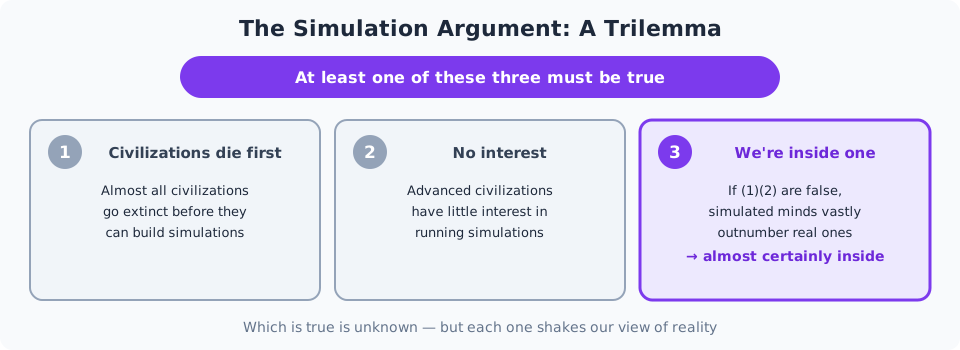
The heart of Bostrom’s argument is the claim that “at least one of the following three options must be true.” This is the “trilemma.”
- Almost all civilizations go extinct before reaching the technological stage where they could build simulations.
- Even civilizations that reach that stage have almost no interest in running ancestor simulations.
- We are almost certainly living inside a simulation.
Why must at least one be true? Follow the logic.
Suppose both (1) and (2) are false. That is, “many civilizations safely reach advanced technology, and run simulations enthusiastically.”
In that case, what happens? Since one advanced civilization runs countless simulations, each populated by many conscious beings, the number of conscious beings living inside simulations vastly exceeds the number living in true reality, on an astronomical scale. Imagine there are only a handful of “real humans” in the whole cosmos, but trillions of “simulated humans.”
Now think about yourself. With fake consciousnesses so overwhelmingly in the majority, the chance that a randomly chosen consciousness — say, “you, reading this now” — happens to belong to the rare “real” group approaches zero. It is far more likely you are a resident inside a simulation. Hence “you are almost certainly inside a simulation” — option (3).
In short, denying (1) and (2) forces (3). That is why at least one of the three must be true — the backbone of the trilemma.
The Point Is That It’s a “Three-Way Choice,” Not an Assertion
The cleverness of the trilemma is that it does not assert “we are inside a simulation.” Bostrom claims only that “one of the three is true,” without saying which.
Yet on reflection, whichever option you pick carries heavy implications:
- If (1) is true, civilizations are nearly doomed to self-destruct before reaching advanced technology (a dark future).
- If (2) is true, every advanced civilization is, oddly and universally, uninterested in running simulations.
- If (3) is true, we are right now inside a simulation.
However much you want to think “surely we just live in the real world,” to do so you must actively endorse either (1) or (2) — that is the structure.
Debate and Objections
The argument became a topic well beyond academia. In particular, the entrepreneur Elon Musk made it world-famous by stating publicly that “the odds we are in base reality (the genuine, non-simulated reality) are billions to one.”
There are also many strong objections.
First, the problem of computational resources. To simulate an entire universe down to elementary particles, including the consciousness of its inhabitants, would require staggering computing power. Perhaps it is simply impossible. (A counter holds that “computing in detail only the parts the inhabitants observe” could save vast resources — and the debate continues.)
Second, the problem of verifiability. Is there any way, from inside a simulation, to confirm that it is a simulation? Some researchers look for telltale signs in physical law — “if the universe is computation, there should be a smallest unit, like pixels” — but no decisive evidence has been found.
Third, the problem of infinite regress. The civilization simulating us may itself be inside a simulation run by a yet higher civilization. Then the nesting goes on forever — “a simulation within a simulation within a simulation…” — and it becomes unclear where the true “base reality” lies.
And a fundamental criticism: because the hypothesis is extremely hard to falsify in principle, one may ask “is it even a scientific hypothesis at all?” If any observation can be dismissed as “also part of the simulation,” the claim becomes neither testable nor refutable.
Why It Captivates Us
The simulation argument deals with the very same classic question as “brain in a vat” and the “evil demon”: “is reality real?” So why does it grip people so strongly now?
Because in an age when computers are everywhere, the question has gained a reality it never had before. Descartes’ “demon” was a creature of imagination. But “computer simulation” lies on the extension of technology we experience daily in games and VR.
Watching game graphics grow indistinguishable from reality year by year, and VR become ever more immersive, it is no longer a wild fantasy to think “someday we really could compute a world indistinguishable from reality.” The ancient epistemological question of “what is reality?” has been revived, in an entirely new guise, on the back of technological progress.
Related Thought Experiments
These thought experiments in epistemology ask “what is reality?” You can see how the same question has evolved over time.
Summary
This article covered “The Simulation Argument.”
Bostrom’s trilemma reassembled the vague unease that “we may be in a fake world” into an inescapable logic: “one of three options must be true.” Its novelty lies in wielding the weapon of probability.
Still, even if this world were a simulation, the joy and pain we feel, and our care for others, would be no less real. What makes the argument truly interesting is less the answer to “are we in a virtual world?” than the way it makes us rethink “what reality is in the first place.”
Thank you for reading. We hope to see you in the next article.
Also popular with readers
📚 Series: Famous Thought Experiments (21/60)