Thank you for visiting this site. This article covers “The Omnipotence Paradox.”
“Can an omniscient, omnipotent God create a stone so heavy that even God cannot lift it?” — This deceptively simple question has troubled theologians and philosophers for over 2,000 years. Whether the answer is yes or no, a contradiction arises. This is the omnipotence paradox.
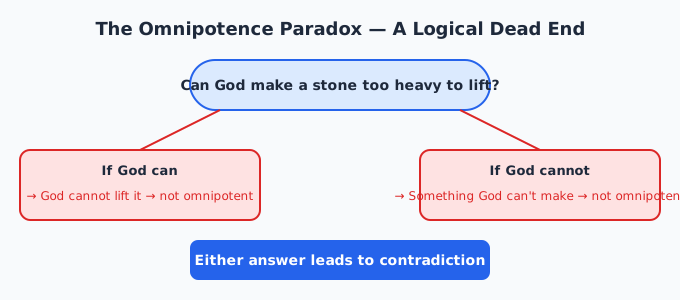
The Structure of the Paradox
Let’s lay out the argument clearly.
We ask an omnipotent God: “Can you create a stone that you cannot lift?”
Case 1: God can create such a stone. God creates the stone — and then cannot lift it. There is now something God cannot do. The moment something exists that God cannot lift, God is not omnipotent.
Case 2: God cannot create such a stone. There is something God cannot do — namely, create that particular stone. The moment there is something God cannot make, God is not omnipotent.
Either way, the concept of “omnipotence” collapses into self-contradiction. This is the heart of the omnipotence paradox.
Historical Background
The paradox in various forms goes back at least to the 12th century, when Islamic philosopher Ibn Rushd (Averroes) and later the medieval Christian philosopher Thomas Aquinas engaged with it. But the underlying question — what does “omnipotence” really mean — reaches back further still: the Epicurean philosopher Epicurus raised related challenges to divine omnipotence in the 3rd century BC.
In Christian theology the problem is especially pressing, because the God of the Abrahamic religions is held to be literally omniscient and omnipotent. If the paradox cannot be resolved, the very concept of divine omnipotence would be logically untenable.
The Theologians’ Responses
Several responses have been offered.
Thomas Aquinas argued that omnipotence means “the ability to do everything that is logically possible.” A stone “too heavy for an omnipotent being to lift” is a logically incoherent concept — the question is meaningless to begin with, like asking whether God can make a round square.
On this view, omnipotence is not the power to do what is logically impossible; it is the power to do everything that is logically possible. The paradox dissolves because it asks a nonsense question.
Descartes took a bolder position: God can transcend even the laws of logic. That is, God can realize even what is self-contradictory. This claim, however, creates other philosophical difficulties — if God can override logic, then “God is omnipotent” and “God is not omnipotent” can both be true simultaneously, making all reasoning about God vacuous.
The Problem of Defining Omnipotence
What the paradox exposes is that the word “omnipotence” is inherently ambiguous.
In ordinary speech it means “can do anything,” but once you probe that carefully, problems multiply. Can God change the past? Can God annihilate itself? Can God violate the laws of logic? The meaning of omnipotence shifts dramatically depending on how these questions are answered.
Contemporary analytic philosophy typically distinguishes several levels:
- Absolute omnipotence: can do everything, including logical contradictions
- Logical omnipotence: can do everything that is logically possible
- Physical omnipotence: can do everything within the laws of physics
Whether the paradox holds depends on which definition is adopted. That fact itself speaks to the depth of the concept of omnipotence.
Variants of the same trap
The omnipotence paradox has many variants. “Can an omniscient, omnipotent God change tomorrow’s weather?” — if it can, the foreknowledge was wrong, so it is not omniscient; if it cannot, it is not omnipotent. “Can God abolish its own existence?” — if it can, the omnipotent being is gone; if it cannot, it is not omnipotent.
All of them are self-referential contradictions produced by turning omnipotence back on itself. They share their structure with the liar paradox and with Russell’s paradox: self-reference generating a contradiction.
The answer changes with the definition of omnipotence
Responses to the paradox come down, in the end, to how the word omnipotence is fixed. The main positions:
Four definitions and where each lands
| Position | Omnipotence means | Can the stone be made? | The cost |
|---|---|---|---|
| Logical constraint | able to do whatever is logically possible | no — the object is self-contradictory | omnipotence is narrowed |
| Universal possibility | able to transcend even the laws of logic | yes, and can lift it too | argument itself stops working |
| Temporary self-limitation | able to limit its own powers | yes — and gives up omnipotence in doing so | omnipotence stops being permanent |
| Predicate denial | a stone that cannot be lifted is not an object at all | the question is meaningless | arguably it only sidesteps the problem |
The first was Thomas Aquinas’s position in the thirteenth century. His point was that God cannot do the contradictory, and this is not a limit on God’s power — the contradictory simply does not fall on the side of things that can be done.
Being unable to make a square circle is not a shortfall in ability; there is no such thing as a square circle. This remains the mainstream position.
The second was René Descartes’s. He held that God freely laid down even the laws of logic, and so could bring about a contradiction.
Adopt that and argument itself collapses, though, because if contradictions are permitted, every claim can be true and false at once.
The same problem arises well outside theology
The structure is not confined to theology. Posit anything subject to no constraint and a similar problem always appears.
- Absolute sovereignty. Can the sovereign make a law binding itself? If so, it is no longer absolute afterwards
- Constitutional amendment. Can the amendment procedure itself be amended? If so, no clause is permanent
- An all-powerful program. Can a program that solves every problem decide whether it halts?
- Self-modifying AI. Can an agent able to rewrite its goals keep its goals?
Each arrives at the same question: what happens when the capacity is turned on itself.
The omnipotence paradox has been argued over for more than a thousand years, I think, because it is a theological question and at the same time a general difficulty about authority that applies to itself.
When the question first arose
The version known as the paradox of the stone appears in the literature around the twelfth century.
The underlying concern is older. Medieval scholastic philosophy debated at length how far the attributes of God could be made logically consistent.
- Augustine (4th–5th c.) held that God cannot do evil, and that this is not weakness but an expression of perfection
- Anselm (11th c.) reasoned that being unable to lie is not a power but a species of inability
- Thomas Aquinas (13th c.) formulated the contradictory as not being an object of action at all
- William of Ockham (14th c.) distinguished God’s absolute power from God’s ordained power
All of them grant that there are things that cannot be done, and then explain why that is not a defect.
From the modern period the question left theology and became a problem in logic. Twentieth-century analytic philosophy accumulated technical arguments about how omnipotence might be formalised without contradiction.
Over about a thousand years, “can God do anything?” shifted into “what would being able to do anything even mean?” Watching the framing of a question change over time is the interesting part.
For me that shift in how the question is posed is more interesting than the theology it started in.
Related paradoxes of self-reference
Related paradoxes where meaning collapses the moment something tries to speak about itself.
Summary
This article covered “The Omnipotence Paradox.”
The question may sound like a child’s game, but it touches on the foundations of philosophy — the nature of omnipotence, the limits of logic, and the precision of language. The fact that it remains unresolved after 2,000 years of serious thought is entirely fitting.
To return to the full list of paradoxes, follow the link below.
Thank you for reading. We hope to see you in the next article.
Also popular with readers
📚 Series: The World's Paradoxes (4/81)