Thank you for visiting this site. This article covers “Meno’s Paradox (the Paradox of Inquiry).”
Looking something up when you want to know it is the most everyday of activities. Yet there is a strange problem lurking here: when we investigate something we do not know, do we actually know what we are looking for?
The Paradox
This paradox appears in Plato’s dialogue Meno, where the character Meno poses the following challenge to Socrates:
“Socrates, how will you look for something when you don’t know at all what it is? Which of all the things you don’t know will you set up as the target of your search? And if you do chance upon it, how will you know that this is the thing you didn’t know?”
Restated precisely:
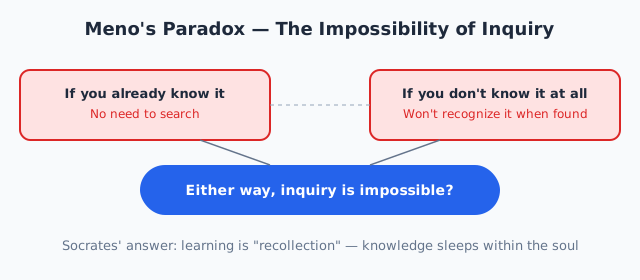
- If you already know something, there is no need to search for it (you already have it).
- If you don’t know it at all, you cannot search for it (you don’t know what to look for, and wouldn’t recognize it if you found it).
- Therefore, inquiry is impossible.
At first glance this sounds like sophistry, but the more carefully you think about it, the more stubborn the problem becomes.
A Concrete Example
Suppose a beginner cook wants to know “how to make great pasta.”
This person does not yet know how to make great pasta. So how do they find the “correct recipe”? Even if they open a cookbook, they cannot know — before trying it — whether that recipe will actually taste good. They have never made it before.
Conversely, if they already knew perfectly how to make great pasta, they wouldn’t need to look for a recipe.
The temptation is to invoke “partial knowledge” as a middle ground — and Meno’s Paradox is precisely a challenge to that notion. What exactly does it mean to partially know something? And where did that partial knowledge come from?
Socrates’ Answer: The Theory of Recollection
In Plato’s dialogue, Socrates responds with a distinctive theory known as anamnesis (recollection).
Socrates’ claim: the human soul possesses all knowledge before birth and forgets it upon entering this world. Therefore “learning” is not the acquisition of new knowledge but the recollection of what was forgotten.
On this view, we already “know” everything in some sense, and inquiry is simply the process of drawing out knowledge that already lies within us. The paradox dissolves: we are not searching for something unknown; we are remembering something forgotten.
In the dialogue, Socrates demonstrates this by posing questions to an uneducated slave boy and guiding him to produce a geometric theorem — presented as evidence for the recollection theory.
Almost no modern philosopher takes the recollection theory literally. But Socrates had identified the core of the problem with precision: the insight that knowledge requires some kind of prior foundation has carried forward into modern epistemology.
The Same Structure in Science
Meno’s Paradox is not confined to philosophy classrooms. Scientific discovery has the same structure.
When physicists search for a new subatomic particle, how do they know the properties of the particle they have not yet found? The answer is: they use theoretical predictions as a guide. The Higgs boson was theoretically predicted in 1964 and discovered at CERN in 2012. The partial knowledge provided by the theory pointed the search in the right direction.
Similarly, how does an archaeologist search for an undiscovered site? From geological and historical knowledge they infer “it should be here” and dig accordingly. Neither fully ignorant nor fully knowledgeable — operating in exactly the state of partial knowledge that the paradox questions.
The Modern View
Modern epistemology generally locates the flaw in Meno’s Paradox in its binary premise: treating knowledge as either complete or entirely absent.
Real human knowledge is a continuum. From total ignorance, through a vague impression, through partial understanding, to thorough expertise — knowledge admits of degrees.
When we inquire into something, we never start from absolute zero. Someone who wants to know “how to make great pasta” at least knows what pasta is and what “great” means. Inquiry consists of using existing knowledge as a foothold to step into the unknown.
The paradox’s hidden error was the all-or-nothing assumption about what it means to know.
The conditions under which inquiry works
Meno’s paradox strains because it forces the matter into knowing or not knowing. Real inquiry starts from the states in between.
| State of knowledge | Can you inquire? | Example |
|---|---|---|
| Knowing it completely | no need to | the answer to a times-table question |
| Knowing what you are looking for | yes | trying to recall a name |
| Able to recognise it on finding it | yes | the solution to an equation, a lost key |
| Not even knowing what to look for | difficult | a question in a field you know nothing of |
The third covers most of what inquiry actually is. The shape of it is that you do not know the answer itself, and you do hold a criterion for judging whether something is the answer.
Solving a mathematics problem, you can check a value by substituting it back in without knowing the solution in advance. Searching for something you have lost, you know it the moment you see it.
Meno’s claim that you would not recognise it even if you found it does not match how inquiry works. What it misses is that holding knowledge and holding a criterion for judging are two different things.
The same structure appears in computation
Interestingly, that distinction lines up with a central concept in computer science.
- Problems where finding the answer is hard: brute force does not finish
- Checking whether an answer is right is easy: substitute it and you know at once
- Whether that gap is essential: still unresolved
Factorisation into primes is the standard example. Finding the prime factors of a large number is arduous; verifying that a proposed factor is correct takes one multiplication.
The asymmetry between hard to find and easy to check is also the ground on which modern cryptography stands.
A question Meno raised 2,400 years ago survives in changed form. As an example of a philosophical question being translated into the language of mathematics and engineering, it is rather a good one.
How the theory of recollection has been received
As an answer to the paradox, Socrates’s theory of recollection is forced in places. It requires the premise that the soul knew everything before birth.
The theory has nonetheless been discussed for a long time, and there are reasons for that.
- It describes the experience of learning: it captures the click of recognition when you hear the right answer
- It places mathematics: it accounts for knowledge derivable by thought alone, without experience
- It shaped a view of education: it is the source of the idea that teaching is drawing out rather than pouring in
The third is the largest influence on later thinking. The view that a teacher’s role is not to hand over knowledge but to draw it out of the other person by questioning still occupies a corner of educational theory.
The scene in which Socrates has a slave boy solve a geometry problem is a demonstration of that method. He teaches no answer and leads the boy to the right one with questions alone.
The connection to modern learning theory
Few people now believe the theory of recollection itself, and the part about learning something new by using what you already know as a foothold overlaps with modern learning theory.
Nobody learns from a blank slate. New information sticks only when it can be attached to existing knowledge.
- The effect of prior knowledge: the more you know about a field, the more easily new facts about it are retained
- Scaffolding: set a task slightly beyond the learner and support them through it
- Leading by question: walking somebody through the steps of thinking sticks better than giving them the answer
Because starting from complete ignorance is not possible, the premise of Meno’s paradox collapses.
We are always in a state of partly knowing something, and inquiry is the work of filling in the gaps. Seen that way, a 2,400-year-old puzzle becomes a good deal easier to handle.
Related paradoxes of induction
Related paradoxes about the pitfalls of reasoning from what has been observed so far.
Summary
This article covered “Meno’s Paradox.”
This question from 2,400 years ago invites us to think at the most fundamental level about what it means to know. Modern epistemology has reached a workable answer, yet the paradox remains a rich invitation to reflect on the relationship between inquiry and knowledge — and it has lost none of its depth.
To return to the full list of paradoxes, follow the link below.
Thank you for reading. We hope to see you in the next article.
Also popular with readers
📚 Series: The World's Paradoxes (7/81)