Thank you for visiting this site. This article covers “The Swampman” thought experiment.
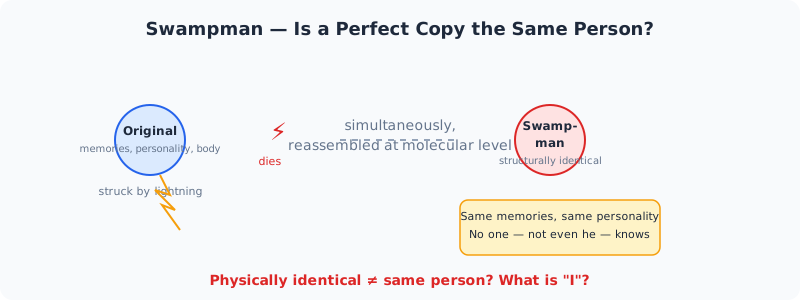
Imagine that one day you are struck by lightning near a swamp and killed. At the same moment, a second bolt of lightning strikes the swamp and, by a freak coincidence, assembles a being from the swamp’s organic matter that is atomically identical to you. Is that being you?
The Thought Experiment
The Swampman was introduced by American philosopher Donald Davidson in 1987.
The scenario: A philosopher is walking near a swamp when he is suddenly killed by a lightning strike. At the same instant, another bolt hits the swamp and — by pure chance — assembles an entity from the swamp’s organic material that is molecularly identical to the dead philosopher.
This Swampman has the same body structure, the same brain state, the same memories, the same personality, the same knowledge. He looks identical in every way.
The Swampman walks out of the swamp, returns to the philosopher’s home, lives with his family, and continues his work. No one notices the substitution. Not even the Swampman himself knows what he is.
What Is the Problem?
Is the Swampman the “same person” as the original philosopher?
Physically: identical. Memories: identical. Behavior: identical. Everyone around him thinks he is the same person. He thinks so too.
But there is one decisive difference. The Swampman has no history.
When the original philosopher “remembers being born in New York,” that memory is grounded in the actual experience of being born there. When the Swampman “remembers being born in New York,” that brain state was assembled by chance — he never actually had the experience.
When the original philosopher recognizes a friend as a friend, it is because of years of shared experience. When the Swampman recognizes the same person as a friend, he has simply been assembled with that brain state — the shared time between them is zero.
The Problem of Meaning and Causation
What Davidson wanted to probe with this thought experiment was the question: what determines the meaning of words and thoughts?
When the original philosopher says “water,” that word is backed by a long causal history of encounters with water — drinking it, seeing it, learning about it. When the Swampman says “water,” he produces exactly the same utterance — but has no causal connection to water whatsoever.
Davidson’s own conclusion: “The Swampman’s words have no meaning.” Meaning is not determined by the brain state alone; it is determined by the causal history connecting a mind to the world.
This view has met strong objections. The Swampman behaves in every way identically to the original, speaks identically, lives identically — claiming that “his words have no meaning” strikes many as deeply counterintuitive.
What Davidson was actually getting at
The outlandish setting is what made this thought experiment famous, and it was originally built for an argument in semantics.
When Davidson presented it in a 1987 lecture, the aim was to make the case that the meaning of a word depends on the causal relation between that word and the past of the person using it.
The Swampman can utter the word “tree”, though he has never seen one. The brain state is physically identical; even so, Davidson’s position is that the word cannot be said to refer to anything.
- Meaning is not settled inside the head alone: a causal connection to the world outside is required
- The memories do not point at any experience of his: they are a state that happens to coincide
- The upshot: the Swampman appears to be thinking, and yet is not thinking about anything
Davidson himself acknowledged how strange the conclusion sounds. He put it roughly as “I want to say that the Swampman means nothing at all” — pressing the claim while fully aware that it runs against intuition.
The lines the objections take
The conclusion has, unsurprisingly, drawn strong objections.
| Position | The Swampman | The grounds |
|---|---|---|
| Internalism | has the same mind as the original | same physical state, same mind |
| Causal semantics | means nothing at all | meaning is fixed by history |
| Functionalism | has a mind | performing the same function suffices |
| Biological naturalism | verdict withheld | the biological history is what matters |
From internalism and functionalism, denying a mind on the grounds of a missing past goes too far.
The argument carries over directly into how we treat artificial intelligence. Can a system that has learned to respond exactly as a human does be said to mean anything? On Davidson’s position, lacking a history of experience, it cannot.
A story about a man born out of a swamp has become an instrument in arguments about real technology. For a thought experiment from forty years ago, that is fairly good staying power.
Identity once a copy exists
The Swampman problem has almost the same structure as the arguments around a transporter.
Take somebody apart, send only the information, and rebuild them elsewhere from different material. Is the person who steps out the same person?
| Case | Physical identity | Continuity of memory | Continuity in space and time |
|---|---|---|---|
| Living ordinarily | replaced gradually | present | present |
| The Swampman | different atoms | apparently present | absent |
| A transporter | different atoms | present | interrupted |
| Two copies produced | different atoms | present in both | interrupted in both |
The fourth is the awkward one. If the original is not destroyed and a copy is made, there is no criterion for deciding which one is the person.
Judge by continuity of memory and both are. Judge by physical identity and neither is.
From examples of this kind Derek Parfit drew the conclusion that “identity is not what matters”. What matters is not whether the two are identical but whether the psychological connections are preserved.
- The traditional picture: first settle whether it is the same person, and derive responsibility and concern from that
- Parfit’s picture: there are only degrees of connection, and whether it is the same person need not be settled
On that view the question about the Swampman is not a question with no answer but a question there is no need to raise.
It is tidy, and it also feels a little too willing to cut the knot. Still, rather than staying tied to a question that yields no answer, the move of rebuilding the question itself is worth keeping in mind.
Connection to Teleportation
The Swampman problem connects directly to the teleportation scenarios common in science fiction.
A typical teleportation device works by scanning and disassembling the person at the departure point and reassembling an identical person at the destination. But this can be interpreted as killing a person at origin and creating a copy at destination.
If a teleporter were built that did not disassemble the original, two beings would exist simultaneously — the original and the teleported copy. That is exactly the Swampman problem.
What Determines Our Identity?
The fundamental question this paradox poses is: what does it mean to be “me”?
- Is it determined by material composition? (If so, it changes daily.)
- Is it determined by memories? (If so, the copy is the same person.)
- Is it determined by causal continuity? (If so, the Swampman is someone else.)
- Is it determined by the continuity of consciousness? (If so, what happens during deep anesthesia?)
Every criterion produces counterintuitive consequences. That is the deep difficulty the Swampman poses.
Related paradoxes of identity
Related paradoxes asking what it takes for something to remain the same thing.
Summary
This article covered “The Swampman” thought experiment.
As technology advances and AI, digital copies, and brain emulation come closer to reality, the Swampman’s question becomes more pressing than ever. When perfect copying is possible, how do we distinguish the “original” from the “copy”? That question still has no agreed answer.
To return to the full list of paradoxes, follow the link below.
Thank you for reading. We hope to see you in the next article.
Also popular with readers
📚 Series: The World's Paradoxes (8/81)