
Thank you for visiting this site. This article covers “Hempel’s Raven Paradox (the Paradox of Confirmation).”
If you want to verify that “all ravens are black,” you look for black ravens — that seems obvious. Yet according to formal logic, finding a red apple or a white sock also counts as evidence that all ravens are black. It may sound absurd, but the logic is sound.
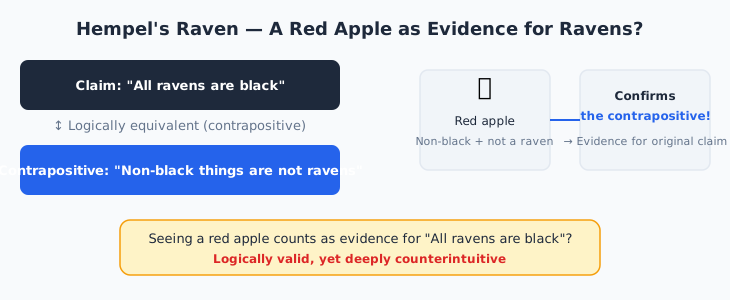
The Structure of the Paradox
Proposed in the 1940s by German-born philosopher Carl Hempel, the paradox rests on three steps.
Step 1: The Principle of Confirmation Finding a positive instance of a hypothesis is evidence for that hypothesis. Each black raven you observe raises your confidence in “all ravens are black” a little. This is the basic methodology of science.
Step 2: Logical Equivalence The statement “all ravens are black” is logically equivalent to its contrapositive: “everything that is not black is not a raven.” Just as “all dogs are animals” and “non-animals are not dogs” say the same thing.
Step 3: The Problem What is a positive instance of “everything that is not black is not a raven”? A red apple is not black, and it is not a raven — so it confirms the contrapositive.
By Step 1, that confirmation counts as evidence. By Step 2, the contrapositive is equivalent to the original claim. Therefore a red apple is evidence that all ravens are black.
Why This Feels Wrong
The idea that looking at a red apple tells you something about the color of ravens is deeply counterintuitive.
Yet the argument above appears to have no flaw: both the principle of confirmation and the logical equivalence of contrapositives are individually sound. Their combination alone produces the strange conclusion.
If this logic holds, you could sit in your room, scan the blue book, white wall, and brown desk around you, and accumulate evidence for “all ravens are black” without ever going outside to observe a raven. Worse, the same red apple would simultaneously confirm “all swans are white,” “all emeralds are green,” and every other universal generalization — all at once.
What Goes Wrong?
Several responses have been proposed.
The Bayesian Solution
The most widely accepted response: a red apple is technically evidence, but its evidential weight is effectively zero.
Bayesian probability theory explains why. The world contains an astronomically large number of non-raven objects (apples, cars, buildings…) compared to ravens. Finding one black raven is strong evidence because it confirms the hypothesis within the small reference class of ravens. Finding one red apple is vanishingly weak evidence because it is a single confirmation in the colossal reference class of non-black things — it barely moves the probability.
In other words, a red apple is not “not evidence” but rather “evidence so weak it is imperceptible.” Our intuition that it is no evidence at all reflects the near-zero magnitude, not a logical error.
Restricting the Principle of Confirmation
Some argue that the principle of confirmation itself needs refinement: only observations that are relevant to a hypothesis should count as confirming it. Adding such a relevance condition would block the red-apple inference without rejecting either contrapositives or confirmation as such.
Denying Epistemic Equivalence of Contrapositives
A third position accepts that the two statements are logically equivalent while denying that they must be confirmed in the same way. “All ravens are black” and its contrapositive say the same thing, but the appropriate method of confirmation need not be identical.
Connection to the Grue Paradox
Hempel’s Raven and Goodman’s Grue Paradox both attack the foundations of induction, though from different angles.

Hempel’s Raven asks “what counts as evidence for a hypothesis?”; the Grue Paradox asks “to which hypotheses should induction be applied?” Both reveal that induction is far less straightforward than we normally assume.
Implications for Scientific Method
What Hempel’s Raven teaches is that the question “what is evidence?” is far deeper than it looks.
Science advances by confirming hypotheses through observation and experiment. Yet there is still no fully satisfying, agreed-upon answer to the basic question of what makes an observation count as confirmation. The logical foundations of the everyday scientific activity of “testing a hypothesis” turn out to be more complex and fragile than they appear.
Can ravens be studied from an armchair?
Hempel’s paradox is often told as a joke because of the phrase “indoor ornithology”.
Without going out to look for a raven, you could confirm a hypothesis about the colour of ravens by checking one non-black object after another around the room. Surely not — that intuition is the starting point.
From a Bayesian position, though, the intuition can be given a proper account.
| Observation | How far it narrows the candidates | Degree of confirmation |
|---|---|---|
| One black raven | there are some tens of millions of ravens | reasonably large |
| One white shoe | non-black things run to astronomical numbers | almost zero, but positive |
The answer is that the white shoe does confirm the hypothesis, by an amount small enough to ignore.
Correct as logic, meaningless in quantity. The diagnosis is that it looked like a paradox because confirmation was being treated as all or nothing.
A counterexample is far stronger
The other point worth holding on to is the asymmetry between confirmation and refutation.
Find one non-black raven and the hypothesis is dead on the spot. Observe tens of thousands of black ravens and the hypothesis is still never established.
- Confirmation: each instance is small, and stacking them never reaches certainty
- Refutation: one case settles it
- Consequence: if you want to test a hypothesis, going looking for counterexamples is more efficient
So collecting nothing but instances that support your hypothesis makes almost no progress as testing.
That connects directly to confirmation bias. People naturally go looking for supporting cases, so hunting counterexamples has to be deliberate. Karl Popper’s emphasis on falsifiability rests on this same asymmetry.
From something as simple as the colour of a bird to a central issue in scientific method — it is a well-built thought experiment.
It applies to more than ravens
The paradox is not confined to the colour of ravens; it applies to every universal statement.
Any claim of the form “all A are B” is logically identical to “anything that is not B is not A”, so the same problem arises.
| Hypothesis | Contrapositive | An odd confirming instance |
|---|---|---|
| All metals conduct electricity | non-conductors are not metals | one piece of wood |
| All medicines have side effects | anything with no side effects is not a medicine | tap water |
| All staff completed the training | anyone untrained is not staff | a passer-by |
Each is logically a confirmation, and as an investigation none of them makes any progress.
The practical lesson is that the value of an observation is decided by which of the two sets is smaller.
With a hundred staff and eight billion untrained people in the world, working through the staff list is faster. Obvious enough — and the interesting part is that the obvious thing cannot be derived from the logic alone.
With a finite population the story changes
What is interesting is that when the number of objects is small, observation on the contrapositive side does acquire real meaning.
Take the hypothesis “every ball in this box is red”, with only ten balls in the box.
- Finding one red ball: the possibilities among the other nine shrink, and confirmation advances
- Finding a non-red thing outside the box: unrelated to the contents, nothing advances
- Searching the box for something non-red and finding none: strong confirmation
The third is an effective investigation using the contrapositive. Restrict the search to the hypothesis’s own domain and confirmation from the contrapositive becomes perfectly strong.
The problem was never the use of the contrapositive; it was using it without restricting the range. Hempel’s paradox is easier to accept once you read it as being about the design of an investigation rather than the use of logic.
Related paradoxes of induction
Related paradoxes about the pitfalls of reasoning from what has been observed so far.



Summary
This article covered “Hempel’s Raven Paradox.”
The conclusion that a red apple is evidence about the color of ravens sounds ridiculous, but behind it lies a deep problem at the heart of scientific reasoning. This paradox invites us to rethink the concept of “evidence” that we take for granted — and to notice just how subtle the idea really is.
To return to the full list of paradoxes, follow the link below.
Thank you for reading. We hope to see you in the next article.

Also popular with readers
📚 Series: The World's Paradoxes (9/81)