Thank you for visiting this site. This article covers “The Grue Paradox (The New Riddle of Induction).”
Every emerald we have ever seen has been green. So the next emerald we find will surely be green too — that reasoning sounds perfectly sensible. Yet when American philosopher Nelson Goodman introduced the bizarre concept of “grue” in 1955, the foundations of that reasoning began to shake.
This paradox, which challenges the very reliability of induction — the method on which science depends — is one of the problems that changed the history of the philosophy of science.
What Is “Grue”?
In his 1955 book Fact, Fiction, and Forecast, Goodman defined a new color concept called “grue.”
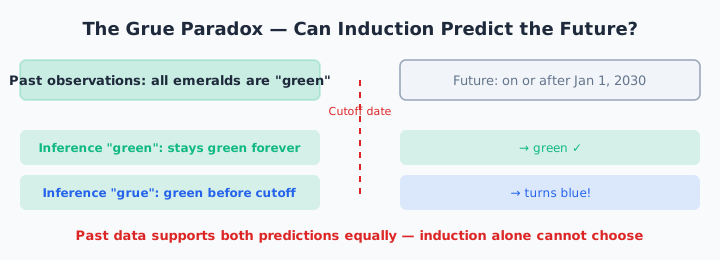
Grue = green if observed before January 1, 2030; blue if observed on or after that date.
So anything you look at today that is grue appears green. But if you look at the same thing after 2030, it will appear blue.
Now, every emerald we have observed so far has been green. But every one of those emeralds was also “grue” — because we observed them before 2030, and being green before that date is exactly what being grue means.
The word “grue” is a blend of “green” and “blue.” Goodman also defined “bleen” — blue before 2030, green after — by the same logic.
The Core of the Paradox
Applying induction:
Inference A: “Every emerald observed so far has been green. Therefore the next emerald will be green.”
Inference B: “Every emerald observed so far has been grue. Therefore the next emerald will be grue.”
Inferences A and B have exactly the same logical structure. Yet when a new emerald is observed after 2030, Inference A predicts green and Inference B predicts blue.
The same evidence, the same form of reasoning — and yet opposite conclusions.
The problem is not confined to emeralds and colors. The same move can be applied to any inductive argument, producing a contradictory alternative. For example: “The sun has risen in the east every morning, so it will rise in the east tomorrow” can be countered with: “The sun has always ‘eastrised’ (risen in the east before 2030, in the west afterward), so tomorrow it will ‘eastrise’” — which predicts the sun rises in the west.
Why Do We Choose “Green”?
We naturally feel that “green” is the correct prediction. But explaining logically why “green” is a better concept than “grue” is surprisingly difficult.
”It’s Unnatural” Doesn’t Settle It
The temptation is to say, “Grue is an unnatural concept.” But from the perspective of someone who takes grue as primitive, green is the unnatural concept — because “green = grue before 2030, bleen after 2030.” Which concept is “natural” depends entirely on your starting point.
One might object that a time-dependent definition is illegitimate. But in a system that treats grue as the primitive notion, green becomes the time-dependent concept (it switches from grue to bleen around 2030). Which concept is time-dependent depends on which one you treat as primitive — a circle.
Goodman’s Answer: Projectibility
Goodman himself responded with the concept of “projectibility.” Predicates that have been successfully and repeatedly used in the past (green, black, round…) are “projectible” — safe to extend inductively — whereas newly coined predicates (grue…) are not.
In Goodman’s view, the reliability of induction depends on the track record of the predicate. This moves the question from “why is induction justified?” to “what are the conditions under which induction works well?” — a deliberate reframing rather than a full justification.
Critics point out, however, that this does not explain why a proven track record makes a predicate reliable. Trusting predicates because they worked before is itself an inductive inference — which seems circular.
Relation to Hume’s Problem of Induction
The Grue Paradox is a new variation on the problem of induction posed by 18th-century Scottish philosopher David Hume.
Hume argued that there is no logical guarantee that past experience will hold in the future. The sun has risen every day, but there is no deductive proof it will rise tomorrow.
Goodman took Hume’s problem one step further. If Hume’s question is “why does induction work?”, Goodman’s question is “for which predicates does induction work?” Even if induction were fully justified, the grue problem would remain.
Implications for Science
What the Grue Paradox reveals is that justifying induction is a far harder problem than it appears.
Science discovers laws by induction. But it is logically possible to derive infinitely many different laws from the same data. An infinite number of curves can be drawn through any finite set of data points; scientists customarily choose the simplest one.
The principle of simplicity (Occam’s Razor) is a powerful guide in science, but there is no logical proof that simpler theories are more likely to be correct. Our judgement that a particular law is “right” depends not on logic alone but on additional criteria: simplicity, naturalness, and established precedent.
In machine learning, this connects directly to the problem of overfitting. Infinitely many models can fit training data perfectly, but only some generalize well to unseen data. The same underlying tension between fitting the known and predicting the unknown runs through both.
Natural and unnatural predicates
The sticking point in the grue argument is the feeling that grue is an artificial word and can therefore be dismissed.
That is less straightforward than it seems. Consider a language with grue and bleen as its basic terms, and it is green and blue that become the compound words.
| Our language | The hypothetical language |
|---|---|
| Green: a basic term | Green: grue until time T, bleen thereafter |
| Blue: a basic term | Blue: bleen until time T, grue thereafter |
| Grue: its definition needs time T | Grue: a basic term |
| Bleen: its definition needs time T | Bleen: a basic term |
Which is basic is a matter of convenience on the side of the language, not a fact on the side of the world.
Goodman pressed exactly this point. The criterion “it is simple, therefore it is right” depends on which words you take as your starting point, and so cannot by itself serve as grounds.
Projectibility as an answer
Goodman’s own answer was the concept of entrenchment.
A predicate that has been used in prediction many times and has worked is projectible. A predicate with no track record of use is not. That is the distinction.
- Green: used in countless predictions over many years without failing
- Grue: has no history of being used in prediction
- Basis for the verdict: not the meaning of the word but the usage history of the linguistic community
The answer can be described as grounding the justification of induction in custom rather than in logic.
For that reason the charge of circularity has been made repeatedly, since arguing that what has worked before will work again is itself an inductive argument.
Goodman did not think a complete justification was available either. What he wanted to show was that the problem of induction runs much deeper than Hume had supposed.
To the question on what grounds may we generalise, there is still no decisive answer.
Related paradoxes of induction
Related paradoxes about the pitfalls of reasoning from what has been observed so far.
Summary
This article covered “The Grue Paradox.”
A seemingly absurd definition of a color lays bare a deep problem lurking at the foundations of inductive reasoning. The induction that science takes for granted rests on surprisingly delicate assumptions.
The discovery that the boundary between “legitimate” and “strange” concepts cannot be drawn by logic alone forces a fundamental re-examination of how human knowledge is built.
To return to the full list of paradoxes, follow the link below.
Thank you for reading. We hope to see you in the next article.
Also popular with readers
📚 Series: The World's Paradoxes (11/81)