Thank you for visiting this site. This article covers “The Surprise Exam Paradox (Unexpected Hanging Paradox).”
A teacher announces: “I will give a surprise exam sometime next week. You will not know which day it will be held in advance.” A clever student reasons logically and concludes that this exam is impossible to hold. Yet the exam is given on Wednesday and the student is genuinely surprised — a curious situation.
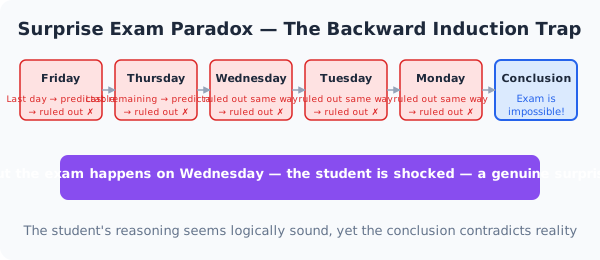
The Student’s Reasoning
The student argues as follows.
“If no exam has been given by the end of Thursday, it must be held on Friday — the only day left. But then, on Thursday night we would know the exam is Friday. That violates the condition that we cannot know in advance. Therefore, Friday is ruled out.”
Friday is eliminated.
“With Friday gone, if Thursday arrives without an exam, the remaining day must be Thursday itself. By the same logic, Thursday is also ruled out.”
Thursday is eliminated. Repeating the argument eliminates Wednesday, Tuesday, and Monday in turn.
Conclusion: the exam cannot be held on any day, so no exam will take place.
Reassured, the student stops studying. But on Wednesday the teacher gives the exam, and the student is caught completely off guard. The teacher’s announcement was correct after all.
Where Is the Error?
The student’s reasoning looks logically airtight — yet the conclusion is obviously wrong: the exam happened and the student was surprised.
What makes this paradox particularly tricky is that it is very hard to pinpoint exactly where the student goes wrong.
One analysis: the student’s reasoning is self-defeating. The moment the student concludes “no exam will happen,” any exam that does happen is by definition unexpected. In other words, it is precisely believing “there will be no exam” that makes the exam a surprise.
Put differently: the student’s reasoning assumes “the exam cannot be predicted” to conclude “the exam can be predicted (and so won’t happen)” — the conclusion contradicts the premise, causing the chain of reasoning to collapse in on itself.
The Original Form: The Unexpected Hanging
The original version of this paradox is known as the Unexpected Hanging.
A prisoner is told by a judge: “You will be hanged on one day next week. You will not know which day until the morning of that day.” The prisoner uses the same reasoning to conclude that the execution is logically impossible, and relaxes — only to be hanged unexpectedly on Wednesday.
This version is said to have circulated in Sweden in the 1940s, possibly originating in a Swedish radio announcement during the Second World War that a civil-defense exercise would be conducted at an unspecified time the following week. Martin Gardner later introduced it to a wide audience in his 1963 Scientific American column, after which many logicians and philosophers took it up.
Why It Resists Solution
This paradox has been debated for nearly 80 years without a fully agreed-upon resolution.
The root of the difficulty lies in the ambiguity of the word “unexpected.” “Derivable by logical reasoning” is not the same as “actually anticipated in practice.” On top of that, the student’s reasoning involves a circular structure in which the conclusion of the reasoning is used as a premise within the reasoning itself — this circularity is where much of the trouble lies.
Proposed Resolutions
Epistemic approach: The student’s first step (ruling out Friday) is correct. But after eliminating Friday, the student’s state of knowledge has changed, so the same premise cannot be used to rule out Thursday. The chain of backward induction breaks down partway through.
Logical approach: Formalizing the teacher’s statement “the exam will happen and cannot be predicted” reveals a self-referential structure. By an argument analogous to Gödel’s incompleteness theorem, the truth of that statement cannot be proved within the system itself.
Pragmatic approach: The student’s mistake is not the reasoning itself but believing and acting on the conclusion. Once the student believes “no exam will happen,” any exam that follows is necessarily unexpected — so the teacher’s conditions are satisfied. The reasoning chain completes correctly, but the moment the student acts on the conclusion, it undermines its own premise.
It is reportedly a classic exercise in philosophy and logic courses for professors to pose this paradox and watch how students respond.
The proposed solutions side by side
Eighty years of argument have produced a range of diagnoses. The positions divide over where the error is located.
The main positions
| Position | Where it locates the error | The claim |
|---|---|---|
| Epistemic | the state of knowledge changes mid-reasoning | the premise is unusable once Friday has been ruled out |
| Logical | the announcement is self-referential and has no truth value | there is a Gödel-type self-reference in it |
| Pragmatic | the premise is overturned once the student believes the conclusion | believing it is exactly what makes the surprise possible |
| Quinean | the student errs at the very first step | it cannot be known that no exam will be held on Friday |
| Linguistic | ”unexpected” is not clearly defined | being logically derivable and actually being expected are different things |
The fourth row, Quine’s diagnosis, has been the most influential. What he pointed out in 1953 is that the student is already in error at the first stage.
The student reasons that “if Thursday night arrives with no exam, it must be Friday” — and this takes for granted that the teacher’s announcement is true.
In fact the possibility remains that the announcement is false. If Friday arrives with no exam, the teacher may simply not have kept their word.
The student uses the truth of the announcement as a premise, and uses that reasoning to deny the announcement. Quine’s diagnosis is that this circle is the problem.
Are students actually surprised when it is tried?
Apart from the philosophical argument, there have been attempts to see how people actually react — making the announcement in a class and then genuinely holding a surprise exam.
The reported tendencies run roughly as follows.
- Most students do no logical reasoning and simply stay on guard every day
- Even those who do reason are not confident enough to conclude that no exam will happen
- When it is held, they are surprised whether or not they reasoned about it
Real students do not behave as though they need not revise because the exam is logically impossible. The paradox only holds for a being that acts on logic alone.
That also supports Quine’s diagnosis. Real people are untroubled because they tacitly leave open the possibility that the announcement is false.
Theories about the origin
Several accounts of where the problem came from have been handed down.
The strongest is that it originated in a Swedish radio broadcast during the Second World War. Around 1943 to 1944, an announcement went out that “a civil defence exercise will be held at some point next week; the date will not be announced in advance”.
The mathematician Lennart Ekbom is said to have noticed the logical oddity of the announcement. He mentioned it to his students, it spread, and it eventually reached academic circles.
Its first appearance in print is a 1948 paper by D. J. O’Connor in the philosophy journal Mind, where it is presented in the form of a military exercise.
After that it spread in more dramatic settings — the hanging, the surprise examination. Martin Gardner’s treatment of it in 1963 made it widely known to the general public.
Why it has so many names
The problem travels under several names in English alone.
- The unexpected hanging paradox: the prisoner-and-judge setting
- The surprise examination paradox: the student-and-teacher setting
- The prediction paradox / the announced surprise inspection: closer to the military exercise
Because the logical structure is entirely unchanged when the setting is swapped, the teller can pick whichever stage they like.
A paradox whose content is fixed and whose surface varies tends to accumulate names as it travels. It is the same situation as the crocodile paradox being isomorphic to the trial of Protagoras.
Related paradoxes of self-reference
Related paradoxes where meaning collapses the moment something tries to speak about itself.
Summary
This article covered “The Surprise Exam Paradox.”
An event that was logically proved impossible actually happens. The subtle gap between reasoning and reality is vividly exposed — making this one of the most captivating paradoxes in all of logic.
To return to the full list of paradoxes, follow the link below.
Thank you for reading. We hope to see you in the next article.
Also popular with readers
📚 Series: The World's Paradoxes (10/81)