Thank you for visiting this site. This article covers “Hilbert’s Infinite Hotel” paradox.
Imagine a hotel with infinitely many rooms, every single one occupied. Common sense says it is “full” — no new guests can be admitted. Yet with one simple trick, any number of additional guests can be accommodated.
The Setup
German mathematician David Hilbert conceived this thought experiment in the 1920s.
A hotel has rooms numbered 1, 2, 3, 4, … continuing without end. Each room holds exactly one guest, and every room is occupied.
A new guest arrives at the front desk and asks, “Do you have any vacancies?”
In an ordinary hotel, the answer would be, “I’m sorry, we’re full.” But the manager of the Infinite Hotel thinks differently.
Accommodating One New Guest
The manager makes an announcement over the intercom:
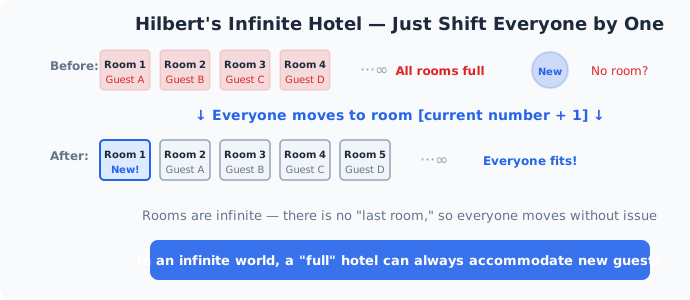
“Would all current guests please move to the room whose number is one higher than your current room.”
The guest in Room 1 moves to Room 2, the guest in Room 2 moves to Room 3, and so on indefinitely. Because the rooms are infinite there is no “last room” — so everyone can move without problem.
Room 1 is now empty. The new guest checks in.
The hotel was full, yet one shift of every guest freed a room. Something impossible in a finite hotel becomes straightforward in an infinite one.
Accommodating Infinitely Many New Guests
Now for something even more remarkable. Suppose infinitely many new guests arrive at once.
The manager makes a different announcement:
“Would all current guests please move to the room whose number is double your current room number.”
The guest in Room 1 moves to Room 2, Room 2 to Room 4, Room 3 to Room 6, Room 4 to Room 8, and so on. Every existing guest now occupies an even-numbered room. All the odd-numbered rooms — 1, 3, 5, 7, … — are now empty. Since there are infinitely many odd numbers, the infinitely many new guests can all be accommodated.
A full hotel takes on infinitely many additional guests — this is the breathtaking flexibility of infinity.
Guests Who Cannot Be Accommodated
Does the Infinite Hotel have room for any number of guests? Not quite.
Cantor’s diagonal argument proves that the number of real numbers is strictly greater than the number of natural numbers.
If guests arrived in a quantity equal to the real numbers, the hotel — whose rooms are indexed by natural numbers — could not accommodate them all.
“Infinity” comes in different sizes, and the Infinite Hotel can handle some infinities but not others. This is where the depth of infinity truly shows.
Why Infinity Defies Intuition
The reason Hilbert’s Infinite Hotel feels paradoxical is that we carry the intuitions of the finite world: “full = no more room.”
In a finite set, a part is always smaller than the whole. Remove 5 rooms from a 10-room hotel and 5 remain.
But in an infinite set, a part can be the same size as the whole. The set of even numbers is exactly as large as the set of all natural numbers. This is the decisive break from finite intuition — and the heart of the paradox.
Adding to and multiplying infinity
Set the hotel’s manoeuvres out as arithmetic between infinities.
An operation table for countable infinity
A collection with as many members as the natural numbers is called countably infinite. Its size does not change under addition or multiplication.
| Operation | What it is in the hotel | Result |
|---|---|---|
| infinity + 1 | one guest added to a full hotel | still infinity |
| infinity + finite | a hundred guests added to a full hotel | still infinity |
| infinity + infinity | one infinite coach party added to a full hotel | still infinity |
| infinity × infinity | infinitely many coaches, each carrying infinitely many | still infinity |
| infinity squared | rooms indexed by pairs of numbers | still infinity |
Nothing you add or multiply changes the size, and that is what makes infinity awkward to handle.
In the finite world, 101 people cannot stay in a 100-room hotel. In the infinite one they can. That difference is why finite common sense cannot simply be carried across.
What the guests who cannot be accommodated really are
There are, however, parties that cannot be accommodated by any means: the guests mentioned earlier who specify their room by an infinite string of digits.
That party has as many members as there are real numbers. It is an infinity strictly larger than the countable one, called uncountable.
- Countably infinite: the naturals, the integers, the rationals. They can be numbered and enumerated
- Uncountably infinite: the reals, the numbers between 0 and 1, the points on a line. They cannot be numbered through
Hilbert’s hotel can accommodate up to countable infinity. It shows, in terms of whether the rooms suffice, that even infinity has a wall it cannot cross.
Note that the real numbers between 0 and 1 alone outnumber all the natural numbers. There are more points in a segment of length one than there are integers along the entire number line — another sign that the size of an infinity does not match intuitions about counting.
Why Hilbert brought the story up
The hotel was devised by David Hilbert, one of the leading mathematicians of the early twentieth century, reportedly in a 1924 lecture. It became widely known through popular books such as George Gamow’s One Two Three… Infinity.
His aim was not to astonish an audience. Strong resistance to Cantor’s theory of infinite sets still lingered in mathematics at the time.
At the centre of that criticism was Leopold Kronecker, of the generation of Hilbert’s teachers. From the position that mathematics must not take as its objects things that cannot actually be constructed, he refused to accept arguments dealing with infinite sets at all.
Hilbert opposed him head-on. His line — “no one shall expel us from the paradise that Cantor has created for us” — is remembered as the emblem of that dispute.
The hotel was a device for showing a general audience what that paradise looked like. Infinity is strange, and it can be handled consistently by rules. The construction does not hide the strangeness; it puts it up front and then shows that the reasoning holds.
Its value as a technique for handling infinity
The idea is not confined to abstract play.
- Enumeration techniques: the procedures for numbering integers and rationals are used in designing codes and ciphers
- Designing recursion: describing an endless structure with a finite rule has the same shape as recursion in a program
- Handling limits: series and integrals with infinitely many terms are organised as operations on countable infinity
- Computability: there are only countably many programs but uncountably many functions, so uncomputable functions must exist
The last is especially potent. Because the number of programs and the number of problems worth solving are infinities of different sizes, unsolvable problems remain.
A homely question about whether the rooms will suffice turns directly into an argument about the limits of computation. Distinguishing sizes of infinity turns out to have had a practical point.
Related paradoxes of mathematical infinity
Related paradoxes about the counter-intuitive behaviour of infinite sets.
Summary
This article covered “Hilbert’s Infinite Hotel.”
The conclusion that a full hotel can take any number of additional guests is startling, but it teaches us that the concept of “infinity” operates by rules fundamentally different from everyday finite intuition. In the infinite world, the rules of the finite do not apply.
To return to the full list of paradoxes, follow the link below.
Thank you for reading. We hope to see you in the next article.
Also popular with readers
📚 Series: The World's Paradoxes (17/81)