Thank you for visiting this site. This article covers the paradox of “Gabriel’s Horn (Torricelli’s Trumpet).”
A solid with infinite surface area yet finite volume. In other words, you cannot paint its outer surface, yet you can pour paint inside and fill it completely — a figure that the more you think about it, the more it bends your mind.
What Is Gabriel’s Horn?
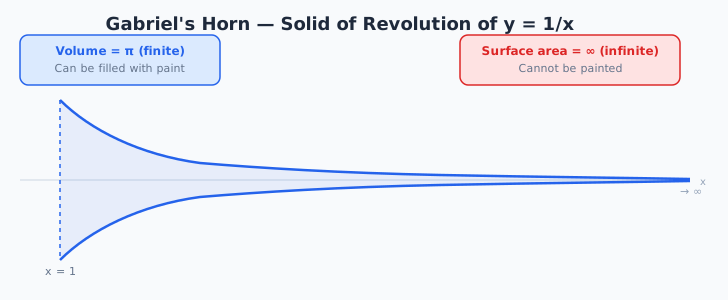
Mathematically, this solid is the solid of revolution obtained by rotating the graph of y = 1/x (for x ≥ 1) around the x-axis.
Picture its shape: it resembles a horn or trumpet. At the opening (where x = 1) there is a circular mouth, which narrows continuously as it extends to infinity. It keeps getting thinner and thinner, but never closes completely — it continues forever toward infinite distance.
Italian mathematician Evangelista Torricelli discovered this solid in 1641 and revealed its astonishing properties. Torricelli himself was stunned by the result and wrote that it was “incredible yet undeniable.” The name comes from the horn that the angel Gabriel is said to blow on Judgment Day.
Historically, this discovery predates Newton’s and Leibniz’s systematization of calculus and caused a great stir in mathematical debates about infinity. Mathematicians of the era argued intensely over how to interpret the fact that an infinitely long solid can have finite volume.
The Volume Is Finite
Integrating to find the volume of this solid yields the remarkable result of π (pi, approximately 3.14) cubic units — a finite value.
An infinitely long solid with finite volume. This defies intuition, but the horn narrows so rapidly that the contribution of each distant section to the total volume approaches zero very quickly. Summing infinitely many vanishingly small contributions still converges to a finite number.
This is the same principle of “convergence of an infinite series” that appears in the Achilles and the Tortoise paradox.

The Surface Area Is Infinite
The surface area, however, diverges to infinity.
The horn’s surface does get narrower and narrower, but the rate at which the surface area decreases is not as fast as the rate at which the volume shrinks. Summing infinitely many surface-area increments therefore does not converge — it grows without bound.
The Paint Paradox
This leads to a fascinating question.
Since the volume is π, you could pour π cubic units of paint into the horn and fill it completely.
But since the surface area is infinite, attempting to paint the outer surface of the horn would require an infinite amount of paint.
Yet if you filled the inside with paint, the inner surface would already be in contact with that paint. The inner surface area is also infinite — and yet it appears to have been coated with a finite amount of paint.
Can a finite amount of paint cover an infinite area, or can’t it? However you look at it, something seems to contradict.
Resolving the Paradox
In fact, this apparent contradiction arises from importing the physical metaphor of “paint” into a purely mathematical setting.
The mathematical operation of “filling with volume” is different from the physical operation of “applying a coat of paint.” The volume integral and the surface area integral are separate calculations, and one being finite does not imply the other is finite.
Physical paint has thickness — but as the horn narrows, it eventually becomes thinner than a molecule of paint. Beyond that point, paint cannot physically enter, so filling the interior with paint in the physical sense is itself impossible.
In short, the paradox arises from the gap between mathematical idealization and physical reality. But the mathematical fact itself — that finite volume and infinite surface area can coexist — remains genuinely astonishing.
Similar Figures
Other figures share Gabriel’s Horn’s properties. The Koch snowflake is a two-dimensional shape with finite area but infinite perimeter. The Menger sponge is a fractal with zero volume but infinite surface area — an even more extreme example.
All of these demonstrate that measurements of “size” in different dimensions can behave independently. Length can be infinite while area is finite; area can be infinite while volume is finite. In the mathematics of infinity, such coexistence is not a curiosity but rather a natural consequence of how different dimensional measures interact.
Checking the paint story against the numbers
The line “a finite amount of paint fills it, and an infinite amount is needed to coat the inside” is vivid, and it is also slightly misleading.
What the word “coat” is pointing at
The mathematical surface area comes out infinite because the horn goes on for ever while growing thinner. The balance between how fast it narrows and how fast it lengthens is what makes the volume converge and the surface area diverge.
Real paint, however, has a thickness. Suppose it is 0.1 mm; then once the horn’s diameter drops below 0.2 mm, nothing further in can be coated at all.
| View | Surface area | Paint required |
|---|---|---|
| An ideal film of zero thickness | infinite | infinite |
| Real paint with a thickness | finite (as far as it can reach) | finite |
| Filling the interior with liquid | not relevant | finite (the volume) |
In short, the claim “you can fill it but not coat it” mixes two levels: the filling is a statement about reality, the coating a mathematical idealisation of zero thickness.
Level the conditions and the contradiction disappears. Treat both ideally and the surface area is infinite and cannot be coated; treat both realistically and both are finite.
Figures with the same property
Gabriel’s horn is not the only figure where volume and surface area disagree.
- The Koch snowflake: finite area, infinite perimeter
- The Sierpiński carpet: area converging to zero, infinite perimeter
- The Menger sponge: volume converging to zero, infinite surface area
Each expresses in its own way the same fact: quantities of different dimension can behave independently.
Human intuition tends to assume that a big thing is big in every respect, whereas length, area and volume are mutually independent. Combinations where one is finite and another infinite are not unusual in mathematics.
It was found before the calculus
The figure was discovered in 1641 by the Italian mathematician Evangelista Torricelli — nearly half a century before Newton and Leibniz put the calculus in order.
Torricelli is known for inventing the barometer, and he left excellent work as a mathematician too. He called this figure the acute hyperbolic solid.
There was no notation for integration at the time, so the proof used Cavalieri’s method of indivisibles: treating a figure as a collection of infinitely thin slices to obtain its volume, a forerunner of the modern integral.
The shock on publication was considerable. The conclusion that an infinitely long object has a finite volume was hard for the mathematicians and philosophers of the day to accept.
Thomas Hobbes reacted furiously, and is reported to have said something to the effect that he would sooner give up mathematics than believe it.
The watershed over how to handle infinity
The figure matters because it was placed at the centre of the dispute over whether infinity could legitimately be brought into calculation.
- The opponents: calculations involving infinity cannot be trusted at all, and contradictory conclusions are the proof
- The defenders: the conclusion merely offends intuition, the calculation contains no error, and it is intuition that should be revised
The defenders won, and methods for handling infinity were systematised as the calculus. The judgement of whether to doubt the calculation or the intuition when a counter-intuitive result appears set the direction mathematics took from there.
The same pattern repeats later with non-Euclidean geometry and the theory of infinite sets. In each case, the side that accepted the strange conclusion rather than throwing it out ended up with a new field.
Torricelli’s trumpet is one of the earliest instances. Seeing it as the figure that marks the moment “it feels wrong, therefore it is wrong” stopped working changes how it looks.
Related paradoxes of mathematical infinity
Related paradoxes about the counter-intuitive behaviour of infinite sets.


Summary
This article covered the paradox of “Gabriel’s Horn.”
Few figures show finite and infinite coexisting so intimately, and Gabriel’s Horn vividly illustrates how different the behavior of infinity in mathematics is from everyday intuition.
To return to the full list of paradoxes, follow the link below.
Thank you for reading. We hope to see you in the next article.

Also popular with readers
📚 Series: The World's Paradoxes (18/81)