
Thank you for visiting this site. This article covers “The Easterlin Paradox (the Happiness Paradox).”
Money can buy happiness. Many people believe this, and up to a point it is true. Yet when a nation’s income multiplies several times over, the average happiness of its citizens barely changes — a strange phenomenon confirmed repeatedly by research.
What Is the Easterlin Paradox?
The paradox is based on research published in 1974 by American economist Richard Easterlin.
Easterlin identified the following apparently contradictory facts.
Cross-sectional comparison within a country: Within the same country at the same time, higher-income people tend to report higher happiness than lower-income people. This is what intuition would predict.
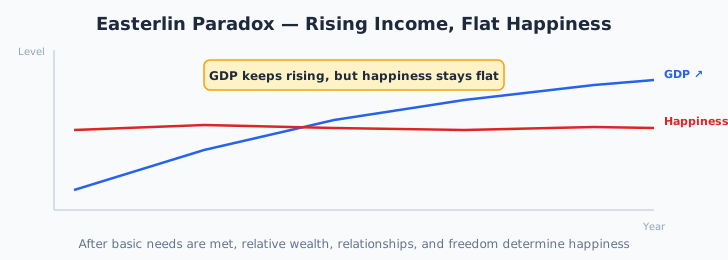
Long-term international comparison: However, as a nation’s income grows over long periods of time, average happiness barely changes.
For example, Japan’s real GDP grew approximately six-fold between 1958 and 1991, yet life satisfaction survey scores were essentially flat. The United States showed a similar pattern.
In other words, the rich are happier than the poor within a country, yet the country as a whole does not become happier as it grows richer.
Why Doesn’t Rising Income Raise Happiness?
Several explanations have been proposed.
Relative income hypothesis: People judge their happiness not by the absolute level of their income, but by comparison with others around them. If everyone’s income doubles, relative positions are unchanged, so happiness does not change.
Adaptation (hedonic treadmill): Even after income rises and living standards improve, people quickly adapt to the new level. The joy of buying a new car fades within months, replaced by the desire for something even better. Research showing that lottery winners’ happiness returns to near pre-winning levels within a year illustrates the power of this adaptation.
Rising aspirations: As income grows, so do expectations. Reaching ¥10 million a year is thrilling at first, but soon the new baseline becomes “of course I should be living like this on ¥10 million…”
Counterarguments and the Debate
The Easterlin Paradox has faced challenges.
A 2008 study by Stevenson and Wolfers, drawing on a broader international dataset, concluded that there is a logarithmic positive correlation between income and happiness: doubling income raises happiness by a fixed increment.
However, this correlation is strongest in the transition from low-income to middle-income countries. For income growth within developed nations, the relationship tends to be weaker.
In other words, “escaping poverty” reliably raises happiness, but moving from “middle class to wealthy” may contribute relatively little.
A 2010 study by Kahneman and Deaton found that in the United States, daily emotional well-being plateaus at an annual income of around $75,000 (approximately ¥6.8 million at the time). Importantly, they also found that “overall life satisfaction” continues to rise gradually beyond that threshold — a distinction between how you feel day to day and how you evaluate your life overall.
Japan as a Case Study
Japan is one of the countries that best illustrates the Easterlin Paradox.
During the high-growth era from the 1960s through the 1980s, real incomes in Japan grew several-fold. Yet the Cabinet Office’s survey on life satisfaction showed remarkably little change. Some indicators even show higher satisfaction in the 1990s after the bubble economy burst.
In the 2024 World Happiness Report, Japan ranked 51st in the world — despite being the world’s fourth-largest economy by GDP, behind not only Finland (#1) and Denmark (#2), but also many countries in Latin America and Asia with lower per-capita incomes.
What This Paradox Teaches Us
The lesson of this paradox is that happiness cannot be bought with money alone — at least not beyond a certain level.
Human relationships, health, leisure, social participation, and self-fulfillment all influence happiness independently of income. If high income comes at the cost of health and relationships, total happiness may not increase at all.
At the policy level, the growing attention given to multidimensional happiness indicators (such as Bhutan’s Gross National Happiness) — rather than pursuing GDP growth alone — reflects the influence of this paradox.
So what does move happiness?
If income does not do it, what does? Long-term panel studies give fairly consistent answers.
| Factor | Effect on happiness | How easily one adapts |
|---|---|---|
| Good relationships | large | hard to adapt away |
| Health | large | hard to adapt to (when worsening) |
| Unemployment | large decline | almost no adaptation |
| A rise in income | small | adapted to quickly |
| A long commute | continuing decline | hard to adapt to |
| An expensive purchase | a temporary lift | gone within months |
The part I find interesting is that the effect of unemployment is far larger than the loss of income can explain. Somebody who loses the same amount of income for another reason falls much less far than somebody who is made unemployed.
The leading interpretation is that losing a role and a place of belonging is doing the work.
Commuting is another good example. People adapt to noise and traffic to a degree, and they turn out not to adapt to a long daily commute. One estimate has it that a pay rise can come out negative on balance if the commute grows by an hour.
What we adapt to and what we do not
The core of the Easterlin paradox is an asymmetry: people adapt to changes in their situation, and not to the situation itself.
- Adapted to: a pay rise, a move, a new car, new appliances
- Not adapted to: chronic pain, a noisy home, loneliness, insecure employment
The first are events, the second are states. An event’s effect fades in months; a state keeps acting every day.
That has implications for how money is spent. Rather than a one-off expensive purchase, spending that changes the daily state tends to work better: shortening the commute, moving somewhere quieter.
My own experience matches it — satisfaction lasts longer from money spent on changing the surroundings than on buying things.
Comparing countries tells a different story
The Easterlin paradox was found in time-series comparison: within a single country, average happiness does not rise as the country grows richer over the decades.
Line countries up side by side, though, and the picture changes. Richer countries have higher average happiness, quite clearly.
That discrepancy is exactly why the problem has stayed contested for so long.
- Time series within a country: growing richer, happiness flat
- Comparison between countries: richer countries are happier
- Comparison between individuals within a country: higher earners are happier
Two of the three tie income to happiness, and only the time series does not. Explaining that asymmetry has been the crux.
The leading interpretation is that the baseline for comparison moves. Individual happiness turns on how one stands relative to those around one, so when everyone’s income rises together the gaps do not change and the average does not move.
Comparison between countries, meanwhile, takes in differences that relative comparison does not erase — the quality of healthcare, of public safety, of institutions. Those genuinely improve when everyone becomes richer.
Up to what point does it work?
There are numbers attached to the range over which income affects happiness.
A 2010 study by Daniel Kahneman and Angus Deaton found that day-to-day emotional wellbeing plateaus above a certain annual income, while one’s overall evaluation of one’s life keeps rising with income.
The answer changes with the question, in other words. “Was today enjoyable?” and “how do you rate your life?” turned out to be different questions.
Reanalyses from 2021 onward report no plateau, and the matter is unsettled.
At minimum, though, most studies agree on the direction: above a certain level, the effect of additional income shrinks. Not that the rise stops, but that it slows. That is the safe reading for now.
Related paradoxes of economics and happiness
Related paradoxes where an improvement measured in money or happiness fails to deliver the expected result.



Summary
This article covered “The Easterlin Paradox.”
The relationship between money and happiness is not simple. This fact is worth considering in contexts ranging from personal life planning to national economic policy.
To return to the full list of paradoxes, follow the link below.
Thank you for reading. We hope to see you in the next article.

Also popular with readers
📚 Series: The World's Paradoxes (65/81)