Thank you for visiting this site. This article covers “The Grandfather Paradox.”
A staple of time-travel science fiction, this paradox is also seriously debated by physicists. If you travel to the past and kill your own grandfather, does causality itself collapse?
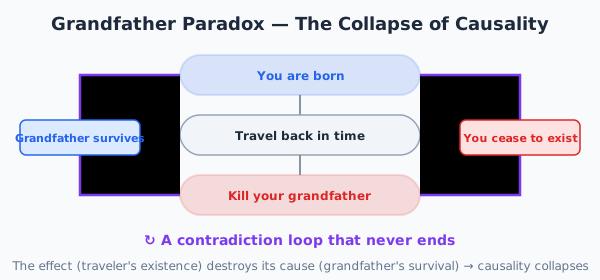
The Paradox
Suppose you board a time machine and travel back to when your grandfather was still young. You kill him. What happens?
Your grandfather’s death means his child (your mother or father) is never born. If your parent was never born, you yourself are never born.
If you were never born, you cannot board a time machine and travel to the past. If you never go to the past, your grandfather is not killed.
If your grandfather was not killed, you are born. If you are born, you board a time machine, travel to the past, and kill your grandfather. Then…
An endless loop of contradiction: kill grandfather → you disappear → grandfather survives → you are born → kill grandfather → …
Why “Grandfather” Specifically?
This paradox uses “killing your grandfather” rather than killing yourself. The reason is clear.
Killing yourself creates some complications in the timing. The grandfather version cleanly demonstrates the causal chain: “grandfather’s death → parent not born → you not born → no time travel → grandfather not killed.”
Of course the same paradox arises with your grandmother, your parents, or any ancestor whose existence is necessary for yours. The key is destroying the “cause” of your own existence by going back in time.
Why It Is a Serious Paradox
The reason this paradox is taken seriously is that it threatens causality — one of physics’ most fundamental principles.
Causality holds that: “cause precedes effect” and “effects cannot influence their causes.” All the laws of physics rest on this foundation.
If interference with the past via time travel is possible, then an effect (the time traveler’s existence) could destroy its cause (the grandfather’s survival), and causality collapses.
The problem does not even require killing anyone. Stepping on a butterfly in the past could eliminate that butterfly’s descendants, alter history in a cascade, and ultimately affect the time traveler’s own existence. Ray Bradbury’s short story A Sound of Thunder explores exactly this theme.
Physicists’ Responses
Several approaches have been proposed to address the paradox.
The Novikov Self-Consistency Principle
Russian physicist Igor Novikov argued that even if time travel is possible, events that would create a contradiction are automatically prevented by the laws of physics. Going back to the past, you would somehow — a gun misfires, you mistake someone for your grandfather, you change your mind — be unable to kill him. History is self-consistent; it cannot be changed.
This principle implies a restriction on free will. A person who returns to the past cannot change anything; they can only become part of history as it already occurred.
The Many-Worlds Interpretation
Applying quantum mechanics’ many-worlds interpretation: killing your grandfather in the past causes a “branch” into a new world where the grandfather is dead. The original world (where you were born) is unaffected, so no contradiction arises.
Under this interpretation, time travel is not really “going back in time” but “moving to a parallel universe.” The grandfather you kill is someone else’s grandfather in another branch; your own grandfather survives in your original world. However, you may not be able to return.
Hawking’s Chronology Protection Conjecture
The simplest solution: Stephen Hawking’s Chronology Protection Conjecture holds that the laws of nature work to prevent time travel.
General relativity theoretically allows spacetime structures called closed timelike curves (paths that loop into the past). Hawking argued that quantum effects would destabilize and destroy such structures before they could form. The universe is “chronologically safe,” in Hawking’s phrase.
To support this conjecture, Hawking once held a “party for time travelers.” He sent out invitations only after the event. If time travel were possible, future people who read the invitation should have attended. Nobody showed up.
Science Fiction Treatment
The Grandfather Paradox has inspired countless science fiction works.
In Back to the Future, the protagonist accidentally prevents his parents from meeting in the past and begins to fade from existence. In the Terminator franchise, a robot sent from the future tries to kill a specific person to reshape history.
All of these entertainingly depict the dangers of changing the past and the complexity of causality — with this paradox at their core. Note that there is also a separate paradox about causal loops in time travel: the Bootstrap Paradox.

Attempts to investigate it experimentally
Time travel looks absurd, and the associated physics is being examined seriously.
In 2014 an Australian research team ran an experiment simulating a closed timelike curve with photons. Nothing was sent into the past; a mathematically equivalent situation was reproduced in an optical system.
The result supported the direction in which only consistent solutions are realised and inconsistent setups are physically disallowed.
That agrees with Novikov’s self-consistency principle: even if you could go back, the only actions you could carry out are the ones that add up.
- An inconsistent act: its probability goes to zero. Coincidences pile up and it is always prevented
- A consistent act: happens normally. It was already built into history
- The upshot: the past cannot be changed, and it can be participated in
The gun misfires, you get lost, your resolve falters. Whatever the reason, the one outcome that does not occur is your grandfather being killed.
Squaring it with free will
What remains uncomfortable here is the sense that you ought to be able to do it if you tried, and somehow you cannot.
The laws of physics are not directly forbidding an individual action. What is forbidden is a history that is inconsistent as a whole.
| Position | Can the past be changed? | Treatment of free will |
|---|---|---|
| Self-consistency principle | no | only inconsistent choices are unavailable |
| Many-worlds | it creates another world | entirely free; the original world is unchanged |
| Chronology protection | you cannot go back at all | the problem never arises |
Many-worlds may be the easiest to accept psychologically. Kill your grandfather and you are not born in that world, while the world you came from remains untouched.
In that case, though, it is not travel into the past but travel to a different world. You have not changed your own past.
Whichever position you take, the structure is such that the one wish — to rewrite your own history — is the one that cannot be granted. That is rather suggestive in itself.
Related paradoxes of time travel
Related paradoxes where the premise of travelling to the past twists causation itself.

Summary
This article covered “The Grandfather Paradox.”
Whether time travel will ever be possible is unknown, but this paradox touches on the very foundations of physics — time and causality — and is as compelling a theme for science as it is for fiction.
The fact that nobody came to Hawking’s party does not prove time travel is impossible. Perhaps they came but made sure not to be noticed.
To return to the full list of paradoxes, follow the link below.
Thank you for reading. We hope to see you in the next article.

Also popular with readers
📚 Series: The World's Paradoxes (71/81)