Thank you for visiting this site. This article covers the “Bootstrap Paradox (the Causal Loop Paradox).”
It is one of the two great time-travel paradoxes alongside the Grandfather Paradox. Unlike the other, this one involves no logical contradiction — the unsettling core is that the information or object in question has no origin at all.
Because there is no contradiction, it is all the more eerie. This paradox shakes the very foundation of how humans think about causality.
A Concrete Example
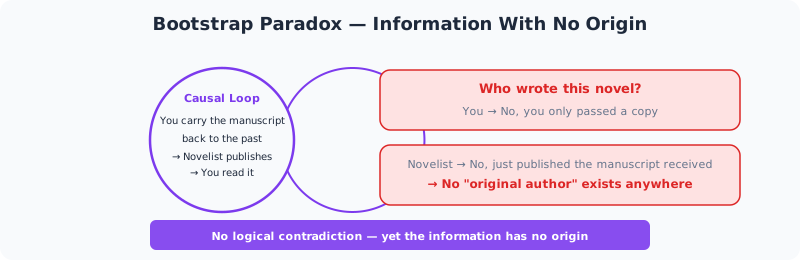
Suppose you are a huge fan of a novelist. One day you obtain a time machine and travel back to when that novelist was young and had written nothing yet.
You hand the young novelist the manuscript of their future masterpiece — a book that has already been published in your era. The novelist reads it and publishes it as their own work. The book becomes a massive hit, is read through the decades into your time, you become a devoted fan, travel back in the time machine, and the loop begins again.
Here is the question: Who wrote this novel?
The manuscript you handed over is a copy of a book published in the future. But that book was published by the young novelist based on the manuscript they received from you. There is simply no “original author” anywhere.
The novel exists inside a causal loop, present in the world yet written by nobody.
The Physical Object Bootstrap
The same paradox applies not only to information but to physical objects.
Suppose your future self travels back and hands your past self a time machine. Your past self uses it, grows older, eventually travels back in time with the machine, and hands it to your younger self. “When was this time machine built?” — the answer is “it was never built.”
A physical object bootstrap raises an even deeper problem than an information one. Physical objects deteriorate over time. The time machine should wear down with each loop, yet an object that has completed infinite loops and is still functioning is deeply unnatural.
Information — a novel’s story, a melody — is abstract and does not degrade in principle. However, the medium that carries it (paper, hard drive) is physical and still subject to decay.
The Origin of the Name
“Bootstrap” comes from the English idiom of “pulling oneself up by one’s own bootstraps” — an impossible act of lifting yourself by gripping your own shoelaces. It is a metaphor for producing yourself from yourself as your own cause.
Incidentally, the computer “boot” (startup) also comes from this word. A computer needs a program to start, but the computer must already be running to read a program. The tiny program that resolves this chicken-and-egg problem is called the “bootstrap.”
How It Differs from the Grandfather Paradox
In the Grandfather Paradox, a logical contradiction arises: kill your grandfather → you disappear → you can’t kill him → you’re born → you kill him … an irresolvable loop.
In the Bootstrap Paradox, by contrast, no logical contradiction occurs. The causal loop is self-consistent: the novel exists, the loop runs stably, and nothing breaks.
The problem is not contradiction but the philosophical discomfort of “information with no origin.” Causality holds that “every effect has a cause,” yet in the Bootstrap Paradox a causeless effect exists.
This distinction matters. The Grandfather Paradox is often used to argue that time travel is impossible. The Bootstrap Paradox does not prove impossibility. Logically permissible, yet philosophically unsettling — that is the Bootstrap Paradox’s unique position.
Depictions in Science Fiction
The Bootstrap Paradox is a theme that has appeared repeatedly in science fiction.
Robert A. Heinlein’s short story By His Bootstraps (1941) is one of the earliest SF works to treat the paradox seriously. The protagonist becomes entangled in a complex loop that connects his own past and future.
In Back to the Future, Marty performs “Johnny B. Goode” at the 1955school dance; Chuck Berry’s cousin calls Chuck and holds the phone up so he can hear it. In this case, who composed “Johnny B. Goode”? Chuck Berry heard the song from Marty and composed it; Marty remembered the song and performed it in the past — a perfect bootstrap.
What Physics Says
General relativity shows that, in theory, spacetime structures called “closed timelike curves (CTCs)” — paths that loop back into the past — can exist. In a spacetime with CTCs, causal loops like the Bootstrap Paradox are theoretically possible.
The Novikov self-consistency principle holds that even if CTCs exist, no contradiction arises, and “contradiction-free loops” such as the Bootstrap Paradox are permissible.
However, whether information arising from nothing is consistent with entropy (the second law of thermodynamics) remains an open question. The second law says the entropy (disorder) of the universe always increases. Information is order itself, so information that exists without an origin seems to violate the law of entropy.
No definitive answer has yet been found. Whether time travel itself is physically possible is also unresolved; if it is impossible, the problem never arises.
Where did the information come from?
What makes the bootstrap paradox particularly awkward is that it breaks no visible law such as the conservation of energy.
Neither the object nor the information is destroyed or multiplied inside the loop; the state is simply that the origin alone does not exist.
Ordinarily, something coming into being has a cause. A score has a composer; a design has somebody who thought of it. The information inside the loop, however, has nobody who first made it.
- Ordinary causation: a cause, then an effect. Trace it back and you arrive at a starting point
- Bootstrap: cause and effect form a ring. Trace it back and there is no starting point
- Consequence: it is indistinguishable from information arising out of nothing
Some discussions put this as the entropy of the information having decreased, because the creative process of composing has been skipped.
Which is more serious, this or the grandfather?
Set the two great time-travel paradoxes side by side and their characters turn out to be opposite.
| Aspect | Grandfather paradox | Bootstrap paradox |
|---|---|---|
| What happens | a logical contradiction arises | no contradiction arises |
| Relation to physical law | it clearly breaks down | it breaks nothing |
| Where the problem lies | it cannot be realised | the origin cannot be explained |
| The remedy | it can be excluded by self-consistency and the like | no reason to exclude it can be found |
Precisely because nothing is contradictory, there are no grounds for ruling it out — that is the difficulty of the bootstrap.
The grandfather paradox can be dismissed as something that does not happen because it is contradictory. The bootstrap adds up perfectly, so the self-consistency principle cannot stop it.
Physicists disagree over whether to treat it as a genuine problem or merely as something counter-intuitive. One position is that since causality is not violated, there is no reason to forbid it.
The most interesting thing about this thought experiment is the very idea that information can exist without an origin.
Related paradoxes of time travel
Related paradoxes where the premise of travelling to the past twists causation itself.
Summary
This article covered the “Bootstrap Paradox.”
No logical contradiction — yet intuitively something feels deeply wrong. Information or objects with no origin, perpetually existing inside a causal loop, give us an intense sense of the strangeness of time.
“Every effect has a cause” is one of the most fundamental frameworks through which humans understand the world. The Bootstrap Paradox — which confronts us with the possibility that this breaks down — is one of the most captivating problems at the intersection of philosophy and physics.
To return to the full list of paradoxes, follow the link below.
Thank you for reading. We hope to see you in the next article.
Also popular with readers
📚 Series: The World's Paradoxes (74/81)