Thank you for visiting this site. This article covers “Galileo’s Paradox.”
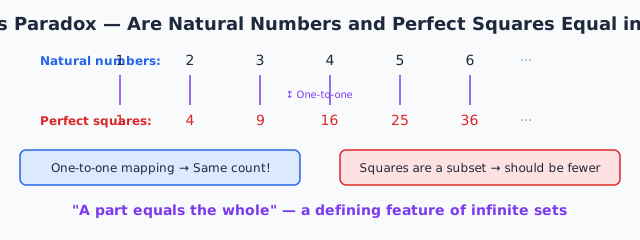
Take the natural numbers 1, 2, 3, 4, 5 … extending to infinity. Now pick out only the perfect squares: 1, 4, 9, 16, 25 … There are obviously “fewer” perfect squares — yet both sets can be shown to have the same count.
Galileo Galilei was the first to point this out clearly. His 400-year-old observation still makes us marvel at how utterly infinity confounds everyday intuition.
The Paradox
This paradox is discussed in Galileo’s 1638 work Two New Sciences, presented as a dialogue between characters Salviati and Simplicio exploring the strangeness of infinity.
List the natural numbers: 1, 2, 3, 4, 5, 6, 7, 8, 9, 10…
List the perfect squares: 1, 4, 9, 16, 25, 36, 49, 64, 81, 100…
Among the first 10 natural numbers, only 3 are perfect squares (1, 4, 9). Among the first 100, there are 10; among the first 1,000, there are 31; among the first 10,000, there are 100. The “density” of perfect squares keeps falling as we go further.
This trend continues without limit. Among natural numbers up to n there are n of them, but only about √n perfect squares. Among the first million, there are a million natural numbers but only 1,000 perfect squares — a ratio of 0.1%. Perfect squares become increasingly sparse relative to natural numbers.
This makes us want to conclude: “Perfect squares are fewer than natural numbers.”
The Shock of One-to-One Correspondence
Yet every natural number n has a corresponding perfect square n², with no gaps.
| Natural number | 1 | 2 | 3 | 4 | 5 | 6 | … | n | … |
|---|---|---|---|---|---|---|---|---|---|
| Perfect square | 1 | 4 | 9 | 16 | 25 | 36 | … | n² | … |
Every natural number has exactly one corresponding perfect square, and every perfect square has exactly one corresponding natural number. The mapping is one-to-one with nothing left over on either side. No natural number is unmatched; no perfect square is left without a partner.
If there is a one-to-one correspondence, the two sets must have “the same count.”
“By density they are obviously fewer, yet by one-to-one correspondence they are equal” — that is the paradox.
Galileo’s Conclusion — Caution About Infinity
Galileo wrestled deeply with this paradox. His final conclusion was that concepts such as “equal,” “greater,” and “lesser” can only be applied to finite quantities.
In the infinite case these concepts have no meaning, and comparing infinite quantities should not be attempted. In Galileo’s own words: “The attributes of ‘equal,’ ‘greater,’ and ‘less’ cannot be applied to infinite quantities.”
This conclusion was prudent for its time — but it was also a concession that “infinity is beyond human understanding.” More than 200 years later, a mathematician would arrive who refused to accept that concession.
Cantor’s Revolution
In the 19th century, German mathematician Georg Cantor tackled head-on the problem Galileo had avoided.
Cantor made the bold decision to define the “size” (cardinality) of a set by “whether a one-to-one correspondence exists.” Two sets that can be put into one-to-one correspondence are defined as having the same size (the same cardinality).
By this definition, the natural numbers and the perfect squares can be put into one-to-one correspondence, so they are “the same size of infinity.” Cantor named this size countably infinite (aleph-null, ℵ₀).
What Galileo had avoided — the phenomenon where “a part equals the whole” — Cantor embraced not as a contradiction but as an essential feature of infinity.
The Paradox as a Definition
More astonishing still, German mathematician Richard Dedekind turned Galileo’s paradox on its head: “Define an infinite set as one that can be put into one-to-one correspondence with one of its own proper subsets.”
In other words, “a part being equal to the whole” is not a bug of infinity but a feature. In the finite world, a part is always smaller than the whole — this intuition fails in the infinite world. And that failure is precisely what makes infinity infinite.
Under Dedekind’s definition, Galileo’s Paradox is no longer a paradox at all. It is simply a proof that the natural numbers form an infinite set.
Even Numbers, Primes, Rationals — All “The Same Size”
Galileo’s Paradox is not unique to perfect squares. The same reasoning shows that the natural numbers can be put into one-to-one correspondence with the even numbers, the odd numbers, and even the prime numbers.
Cantor further proved that the natural numbers and the rational numbers (all fractions) also correspond one-to-one. Intuitively there seem to be infinitely many rationals packed between any two natural numbers (between 1 and 2: 1/2, 1/3, 1/4… ), yet as a whole they are the same size.
On the other hand, Cantor proved by the diagonal argument that the real numbers are a “strictly larger infinity” than the natural numbers. Some infinities are bigger than others — a shocking discovery. The exploration of infinity that began with Galileo’s Paradox ultimately gave birth to an entirely new branch of mathematics: set theory.
Turning infinity into a definition
The difference between Galileo’s discomfort and Cantor’s acceptance lay in how they handled the phenomenon of a part being the same size as the whole.
What can never happen in the finite
Take three apples from ten and seven are left, always. In a finite collection, a proper subset can never have the same number of members as the whole.
The naturals and the perfect squares, however, have the same number of members while one is part of the other.
| Sets | Their relation | Size |
|---|---|---|
| Naturals and squares | the squares are part of the naturals | equal |
| Naturals and evens | the evens are part of the naturals | equal |
| Naturals and integers | the naturals are part of the integers | equal |
| Naturals and rationals | the naturals are part of the rationals | equal |
| Naturals and reals | the naturals are part of the reals | the reals are strictly larger |
The reversal Dedekind performed here was elegant. He made this property the definition of infinity.
A set that can be put into one-to-one correspondence with a part of itself is called infinite. What had been a paradox became the definition unchanged.
Promoting an awkward phenomenon to a definition
The move is a common one in mathematics.
- Negative numbers: defined as the answer to a subtraction that supposedly could not be performed
- Imaginary numbers: no number squares to a negative, so one was defined into existence
- Infinite sets: the anomaly of a part equalling the whole was adopted as the definition
In each case the solution runs not toward excluding what must not happen but toward admitting the thing in which it happens as a new object.
Galileo carefully suspended judgement. Cantor and Dedekind saw new mathematics there and went in. From the same observation, stopping and going on produced different outcomes.
Why Galileo held back
Making the same observation, Galileo suspended his conclusion and Cantor built a new theory. Where does the difference come from?
Galileo set the problem out in Two New Sciences in 1638, four years before his death — and, as quoted above, closed it by ruling the comparison out of bounds.
He gave up on comparing at all. The position is that infinity cannot be counted, so one must not speak of larger and smaller.
For his time this was a cautious and reasonable judgement. The idea of measuring size by one-to-one correspondence did not yet exist, so there was no instrument with which to measure.
What Cantor did was build precisely that instrument. He laid down the definition that things that can be put in one-to-one correspondence are the same size, and on that basis resumed the comparison.
Galileo had reason to give up comparing; Cantor had a tool for continuing to compare. The 250 years between them amounted to the presence or absence of that tool.
Related paradoxes of mathematical infinity
Related paradoxes about the counter-intuitive behaviour of infinite sets.
Summary
This article covered “Galileo’s Paradox.”
Intuitions built in the finite world do not apply to infinity — a lesson this paradox taught 400 years ago. Galileo cautiously sidestepped infinity; Cantor confronted it directly, opening new horizons for mathematics.
The fact that a part can equal the whole never stops feeling strange, no matter how many times you think about it.
To return to the full list of paradoxes, follow the link below.
Thank you for reading. We hope to see you in the next article.
Also popular with readers
📚 Series: The World's Paradoxes (75/81)