Thank you for visiting this site. This article covers “The Experience Machine.”
Suppose there were a dream machine that, once you plug in, lets you taste any wonderful experience you wish. Wealth and fame, love and adventure — you could feel supreme happiness for the rest of your life, with no suffering and no boredom. Would you choose to spend your whole life plugged into this machine?
Most people pause here with an “hmm.” Promised such perfect happiness, somehow it is hard to say “yes, plug me in right away.” Unraveling that “hesitation” is the aim of this thought experiment — and the answer leads to the fundamental question of “what is happiness?” This article digs into the setup, the reasons we refuse, the objections, and its meaning in an age of VR and social media.
The Setup
“The experience machine” is a thought experiment proposed by the American philosopher Robert Nozick in his 1974 book Anarchy, State, and Utopia.
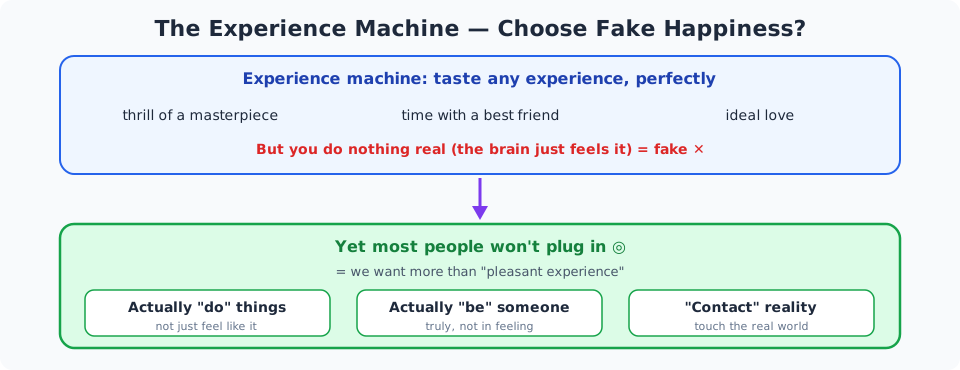
Imagine that brilliant neuroscientists have built the ultimate machine. Float in its great tank, plug electrodes into your brain, and you can taste any experience you wish, so vividly that it is indistinguishable from reality.
You choose a life-scenario from a menu in advance. The thrill of writing a masterpiece that moves the world, time spent laughing with a lifelong friend, the rush of falling in love with your ideal partner, the elation of summiting Everest — you can program any wonderful life you like. And while inside the tank, you completely forget that you are plugged into a machine, so it all feels like nothing but reality. You can schedule years at a time, and re-choose new experiences along the way.
But there is one fact never to forget. The real you is simply floating in a tank in a lab, electrodes attached. You have not written a single line of the novel, the friend does not exist, and there is no lover. Your brain is merely “feeling as if.”
“Would you choose to plug into this machine for life?”
Most People Feel “I Don’t Want to Plug In”
To this, Nozick observes that “most people would refuse to plug in.” Indeed many people, unable to fully explain why, intuitively feel “I don’t want that fake happiness.”
Yet, calmly considered, this is a very strange reaction.
If what we truly seek in life is only “pleasant experience” or “a good feeling,” then the experience machine delivers it perfectly — more reliably than reality, in fact. Real life has failure, betrayal, and illness; inside the machine there is none. If “feeling good” were all that mattered, there would be no reason at all to refuse.
And yet we hesitate, and usually decline. What does this fact mean? Nozick saw in it a crucial clue: that we refuse means we seek something more than “pleasant experience.”
Nozick’s Conclusion: Experience Is Not the Only Value
Nozick analyzed our refusal and offered three points.
-
We want not merely to experience, but actually to “do” things — we do not want the feeling of having written a masterpiece; we want truly to write one. Not the feeling of adventure, but real adventure. “Feeling as if you did it” and “actually doing it” are decisively different to us.
-
We want to “be” a certain kind of person — we do not want merely to feel brave; we want truly to be brave. Inside the machine you are no one in particular — just a drifting body, with no “content” of what kind of person you are.
-
We want to be in “contact” with reality, not an artificial world — we want to engage the real world and real others outside ourselves, not shut ourselves in a fantasy of our own making. The friend in the machine is, in the end, only a shadow your own brain produced.
In short, what truly matters to us is not only “how it feels” but also “how things actually are.”
This becomes a powerful objection to hedonism — the view that the only thing of value in life is pleasure (pleasant experience). If pleasure were everything, there would be no explaining our refusal. The very depth of our urge to decline proves that happiness is something more than mere pleasure.
A Few Objections
The argument has objections too. Here are the main ones.
One points to “status quo bias.” Perhaps we refuse not because “real life truly has value,” but merely from a psychological reluctance to give up the familiar present. To test this, philosophers devised a reversed version: “Suppose you have in fact been inside the experience machine all along. You may now return to reality (i.e., exit the machine). Would you exit?” Asked this way, some choose to stay in the machine, and the verdict wavers.
Another objection: “if the machine is perfect and you never recall reality, isn’t it simply a happy life with nothing to complain of, from the person’s own point of view?” Even if outsiders call it “fake,” if the person is fulfilled, do we have the right to deny it?
These objections push us to think harder about why, and how much, “being real” really matters.
Modern Society and the Experience Machine
The experience machine’s question is far more immediate today than when Nozick posed it 50 years ago.
Consider strikingly realistic VR worlds, games you can immerse in for hours, the easy hit of approval that social media’s “likes” provide, the endless stream of stimulation from videos and shorts. Each of these, to varying degrees, gives the “feeling of having achieved something” without going through “real achievement” — small-scale miniatures of the experience machine.
Every day we unconsciously choose how much of our time to spend on “real experience” versus “easy, pleasant pseudo-experience.” Scrolling social media to feel “connected” to others’ shining lives, versus actually meeting a friend. Becoming a hero inside a game, versus achieving something in reality. That we cannot simply shrug “if both feel good, they’re the same” is precisely because the “urge to be real” Nozick identified still runs deep in us.
Nozick’s old thought experiment quietly asks those of us surrounded by digital pleasures: “Which truly matters to you?”
Related Thought Experiments
These thought experiments ask “what is a good life?” and “what is reality?” Read alongside the experience machine, the link between happiness and reality comes into view.
See also the paradox of happiness — that rising income does not raise well-being.
Summary
This article covered “The Experience Machine.”
Even when promised perfect happiness, why do we not want to give up our “real life”? In that “hesitation,” Nozick read an important truth: “happiness is not mere pleasure.” We want not merely to feel good, but actually to accomplish something, in the real world, as our real selves.
Happiness may reside not in the pleasant feeling itself, but in achieving something in reality and truly connecting with others. Precisely because easy pleasures are everywhere available, the experience machine’s question gives us a chance to rethink “what do I want to spend my time and life on?” Would you plug in?
Thank you for reading. We hope to see you in the next article.
Also popular with readers
📚 Series: Famous Thought Experiments (30/60)