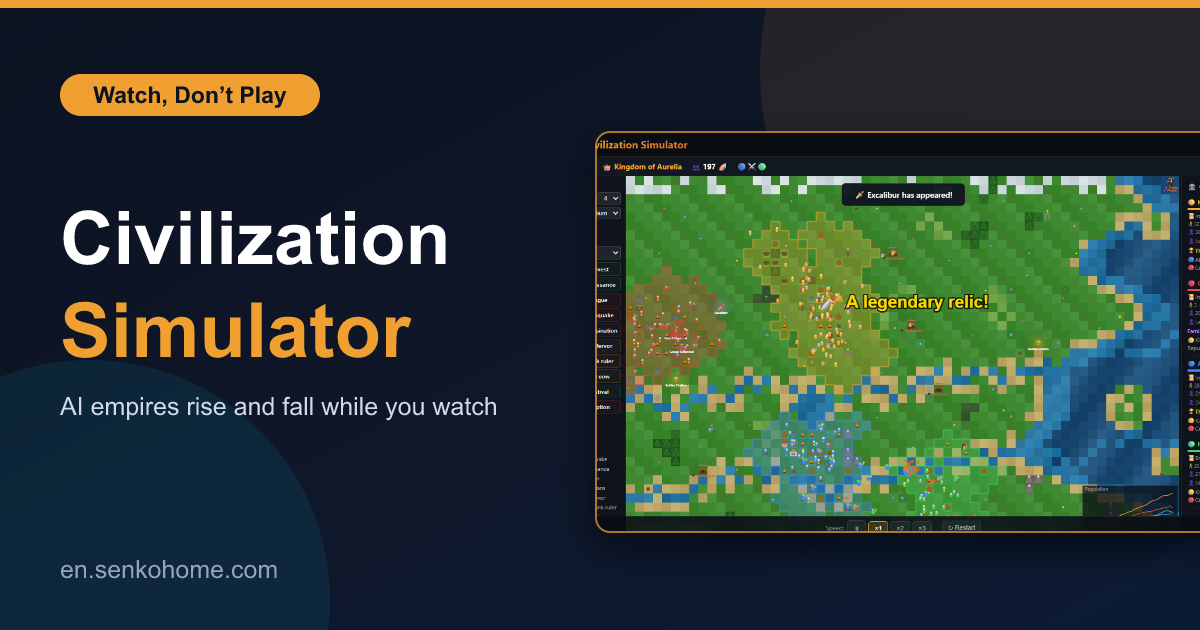
Thank you for visiting the site. This article is about the “Civilization Simulator”, a free browser app in which AI civilizations build, fight, trade and betray each other while you do nothing but watch.
I have always liked the part of strategy games where you zoom out and see the map change over centuries, and I have always been a little bored by the part where I have to click on every worker. So I made the version that keeps only the first part. There is no player civilization. You press start, and history happens.
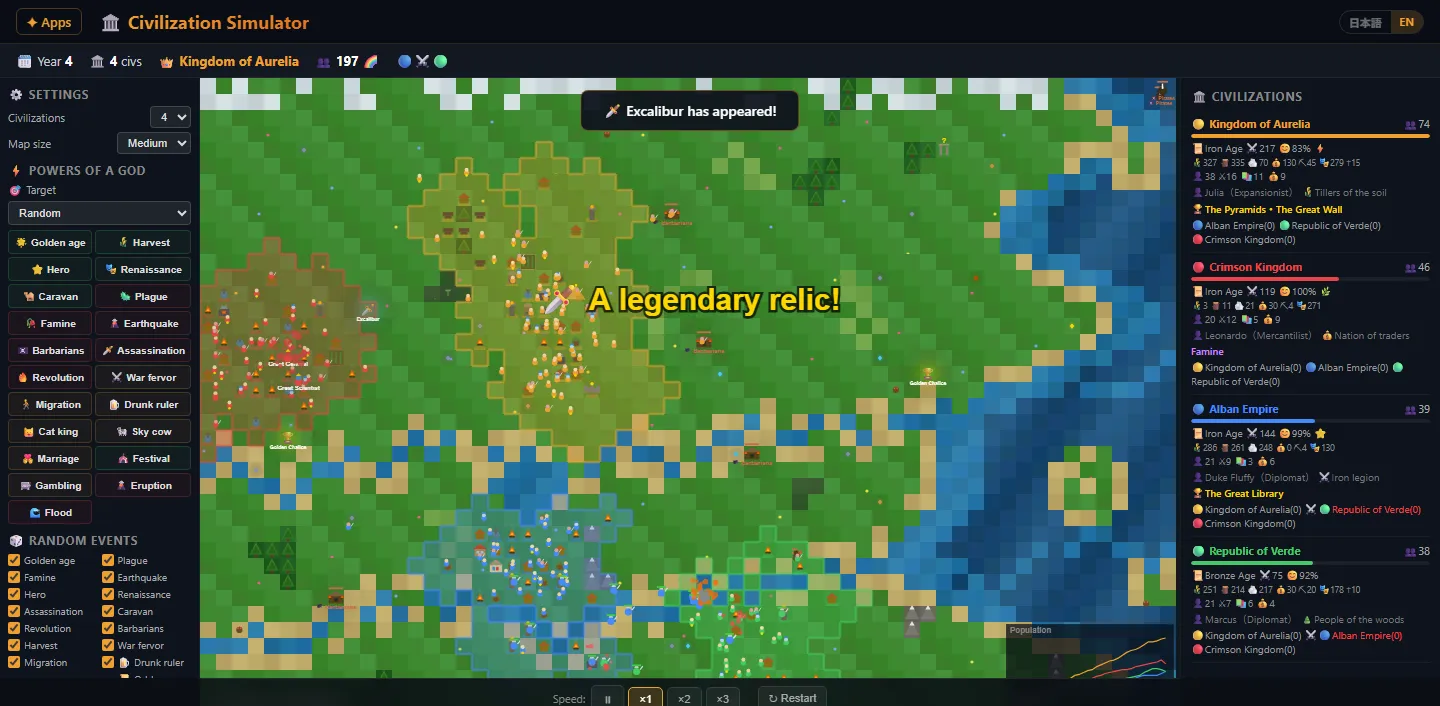
What Happens When You Press Start
Each civilization begins as a handful of citizens on a tile map. They farm, build, research and grow, and as their borders touch, the AI decides whether to trade, sign an alliance, or march. Caravans move along golden dotted lines between allies. Spies slip across borders and flicker while they work. At night the map goes dark and only the buildings stay lit, and the citizens walk home.
What makes it a “simulation” rather than a screensaver is that “each civilization has its own AI personality”, expansionist, militarist, diplomatic or mercantile, and that relations between them move with what happens. A royal marriage pushes two nations together, a betrayal pushes them apart, taking in refugees earns goodwill. From the Iron Age on, religions appear as well, from a sun cult to a storm temple, and nations sharing a faith find it easier to ally while those that differ drift into conflict. Wars are rare early on and common later, which is roughly how it went in the real thing.
The settings let you choose how many civilizations take part, up to eight, and how big the map is, and you can run the clock faster when you want to skip ahead. Clicking any tile shows the terrain, resources and who owns it; clicking a civilization’s panel shows its population, its happiness, its wars and its treaties.
The History Log Is the Real Game
The thing I check first when I come back to a running simulation is the history panel. It records the wars, the treaties, the disasters, the changes of ruler and the rest, in order. Reading it is a bit like reading a very compressed chronicle of a world that happened while you were making coffee.
The events are not all sober, either. Alongside golden ages, plagues, earthquakes and revolutions, the random event table includes a drunk ruler, a “cat king” who takes the throne, a mysterious sky cow, ducks, gambling and an odd discovery. They are rare, and I put them in because real chronicles are full of exactly this kind of thing, and because a plague that follows a gambling scandal makes for a better story than two plagues in a row.
Playing God, If You Want To
You cannot control a civilization, but you can “intervene”. The left panel has a set of powers you can drop onto a chosen civilization at any time.
| Kind | Powers |
|---|---|
| Kind to them | Golden age, harvest, hero, renaissance, caravan, festival |
| Cruel to them | Plague, famine, earthquake, barbarians, assassination, revolution, eruption, flood |
| Just interesting | War fervor, migration, drunk ruler, cat king, sky cow, marriage, gambling |
My usual routine is to let the world run untouched for a while, find the civilization that is pulling ahead, and then hand its rival a hero and a golden age to see whether the balance can be tipped. Sometimes it can. Quite often the leader absorbs the blow and wins anyway, which is its own kind of satisfying.
A civilization can win in several ways: conquer everyone, hold a long cultural lead after reaching the Renaissance, pile up enough gold, or keep every surviving nation in an alliance with a contented population. Civilizations also move through eras on their own as they grow, from the Stone Age through bronze, iron, the classical and medieval periods, the age of exploration and finally the industrial revolution, with new buildings unlocking at each step. You can turn random events off entirely if you would rather watch the pure economics play out.
Why I Think It Is Worth a Tab
It is the kind of app that is better the less you touch it. Start it, wind the speed up, and go do something else. When you come back, the map has changed, one empire has swallowed another, and the history log tells you how. A small civilization hemmed in by mountains can quietly outlast the empires around it, and another run has everyone at war before the first century is out.
Summary
This article introduced the Civilization Simulator.
What it amounts to is a strategy game with the player removed, which sounds like a joke but is actually what I wanted: the long view, the chronicle, the surprise of finding out who won. If that sounds like your kind of thing, I hope you will give it a run.
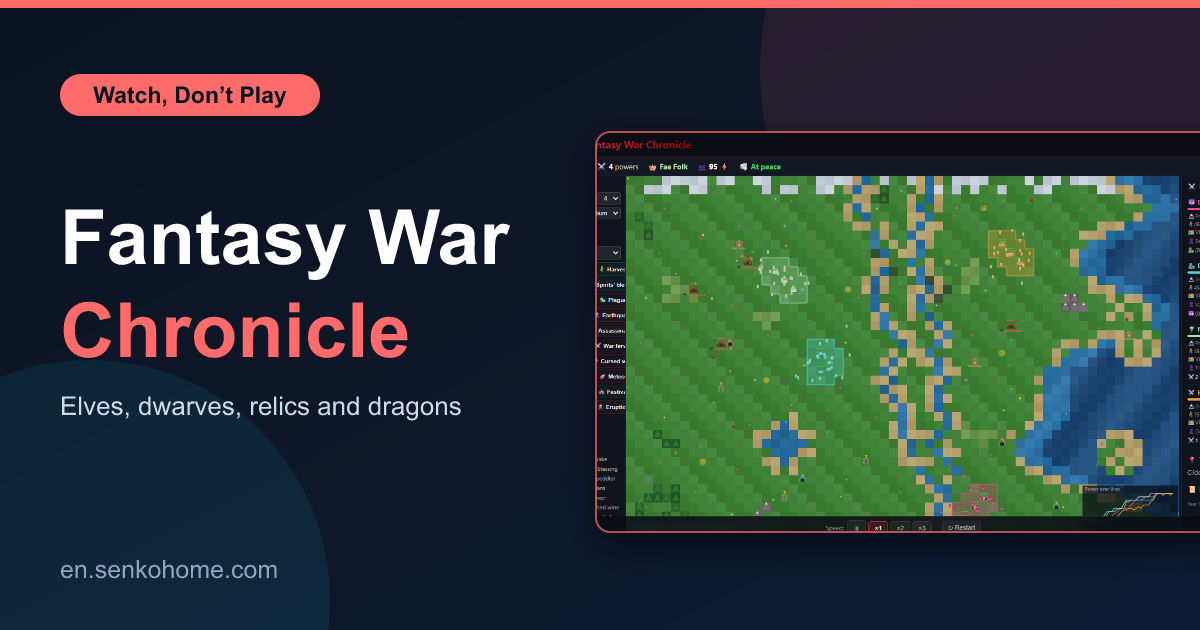
The same engine with elves, dwarves, dragons and magic is covered in this article.
I hope you will read the next article as well.
Also popular with readers
📚 Series: Free Browser Apps I Built (3/11)