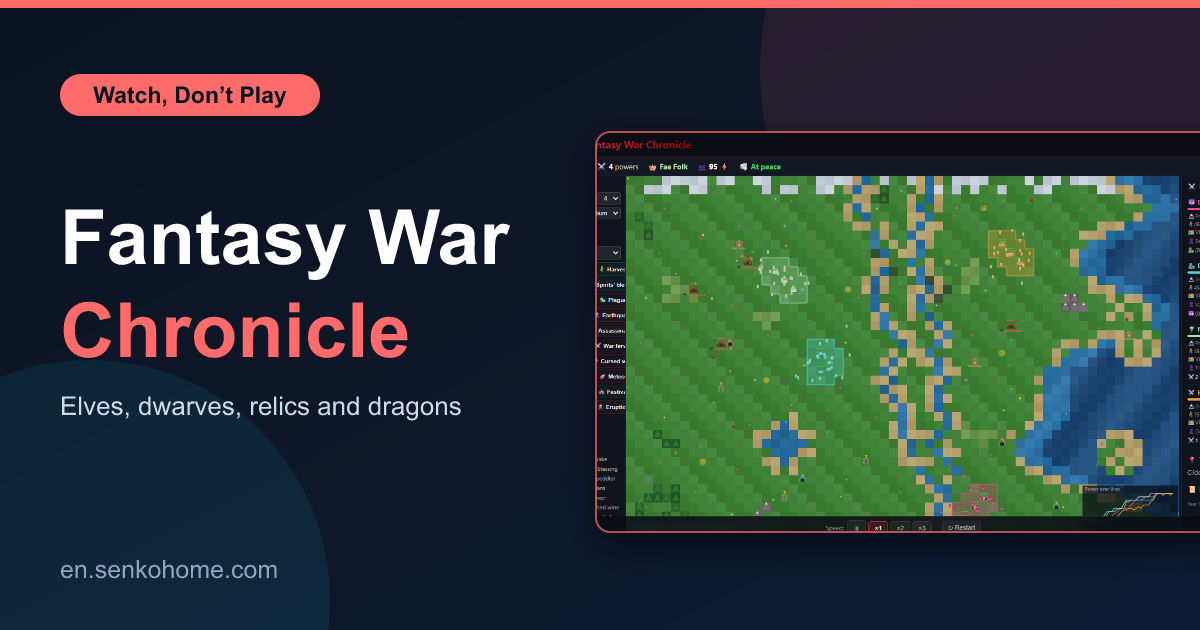
Thank you for visiting the site. This article is about the “Fantasy War Chronicle”, a free browser app in which humans, elves, dwarves, beastfolk and the rest of the usual suspects fight over a map entirely on their own, and you watch it like a war documentary from a world that does not exist.
It grew out of my Civilization Simulator. Once I had an engine that could run a few AI nations through a thousand years, the obvious next thought was: what if one of them was an undead empire, and the map had dungeons in it? So that is what this is.
Each Race Has a Bias
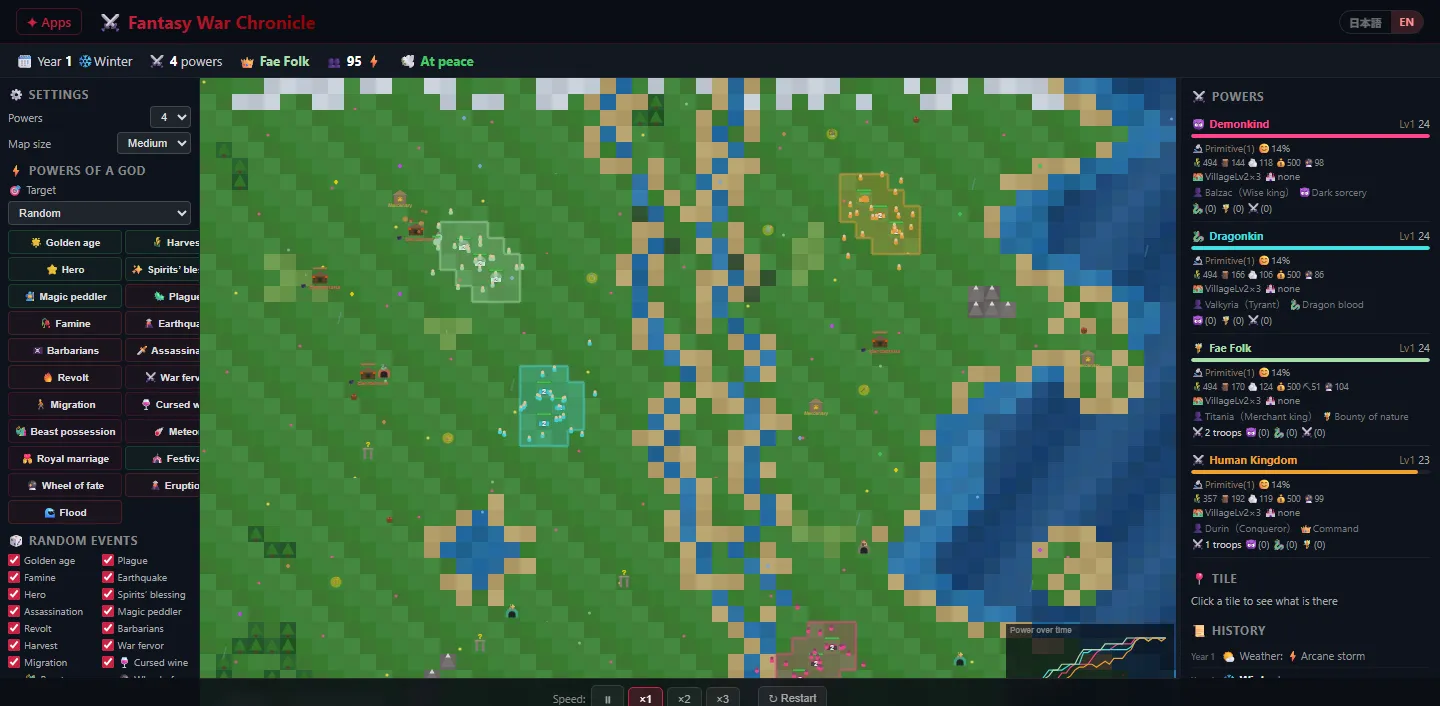
You choose how many powers take part and how big the map is, and each power is assigned a race. The races are not just skins. Each one has a trait that pushes it in a direction.
| Race | What it is good at |
|---|---|
| Human kingdom | A little of everything, better than everyone at nothing |
| Elven forest realm | Timber, so forests are worth more to them than to anyone |
| Dwarven mountain hold | Stone and iron, which means walls and weapons |
| Beastfolk tribes | Fighting, with enough food to keep an army fed |
| Undead empire | Fighting, without much else to fall back on |
| Dragonkin | Fighting, and they hit harder than their numbers suggest |
| Demons | Gold and war, a mercenary economy |
| Fairies | Food, so they grow fast and fight late |
So the dwarves build stone castles early and sit behind them, the elves expand into forests nobody else wants, and the beastfolk tend to pick the first fight. None of that is scripted. It falls out of who has what.
How a Power Grows
Each power starts with a village and builds outwards. There are several kinds of base, each upgradeable step by step: villages that become towns, cities and finally a royal capital; palisades that become forts, castles and citadels; schoolhouses that become academies and sages’ towers; stalls that become markets and trading houses; and shrines that become temples and cathedrals.
Technology rises on its own with population and village level, from a primitive tribe through the feudal, kingdom, sorcery and imperial ages, and each step unlocks troops and spells: healing, fireballs, barriers, lightning, summoning, siege engines and eventually siege cannons. A power that builds academies climbs this ladder much faster, and the AI knows it, so the late game usually belongs to whoever invested in libraries while everyone else was raising militia.
Buildings under construction are fragile, and a captured base resets to level one, which means a long war tends to leave the map poorer than it found it. I did not plan that as a moral, but I have come to like it.
The Map Has Things In It
What separates this from the civilization version is that the wilderness is not empty. Ancient ruins give resources or knowledge to the citizens who wander into them. Dungeons can give treasure, mana or a relic, or kill the explorer. Mercenary guilds sell soldiers for gold. Monster packs roam and have to be put down, and barbarian camps raid until someone clears them.
The relics are the part I watch for. They are scattered in the no-man’s-land between the powers, a dragonslayer’s sword, a ring of agelessness, a sage’s staff, a horn of plenty and so on, each a permanent buff, and no one power can hoard them all. Who finds them, and when, can decide the whole war.
On top of that, the seasons and the weather change production for everyone: autumn is harvest, winter cuts food hard and slows movement, and a magic fog or a cursed wasteland can sweep through and starve a front line.
Interfering
You cannot command a power, but you can reach in. The god powers on the left are the familiar ones, golden age, harvest, plague, famine, assassination, barbarians, alongside the fantasy set: a spirits’ blessing, a magic peddler, a cursed wine, a beast possession, a meteor, a royal marriage and a wheel of fate that does something you will not see coming.
A power wins by wiping out everyone else, by growing rich enough, or by holding most of the map. The history panel logs how it went, and wound up to full speed a whole war fits in the time it takes to eat lunch.
Summary
This article introduced the Fantasy War Chronicle.
A strategy game that plays itself, then, with enough going on under the surface, race traits, relics, seasons, technology, that the same settings rarely produce the same war twice. If you have ever wanted to know whether the undead or the dwarves would win a long siege, this will tell you, and then tell you something different the next time.
The original, historical version of the engine is covered here.
I hope you will read the next article as well.
Also popular with readers
📚 Series: Free Browser Apps I Built (4/11)