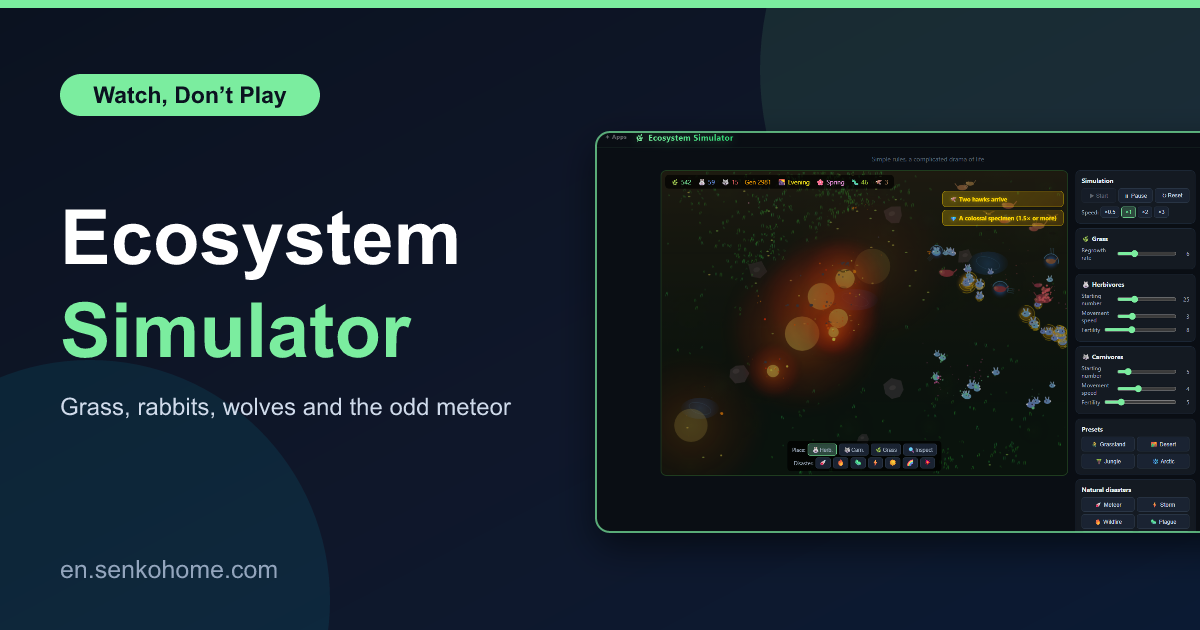
Thank you for visiting the site. This article is about the “Ecosystem Simulator”, a free browser app in which grass grows, herbivores eat it, carnivores eat the herbivores, and the whole thing either finds a balance or collapses while you watch.
It started from a textbook graph, the one with the hare and lynx populations chasing each other in waves. I wanted to see that wave happen rather than read about it, so I wrote a world with three kinds of living thing and a handful of rules, and then spent far too long dropping meteors on it.
What Is in the World
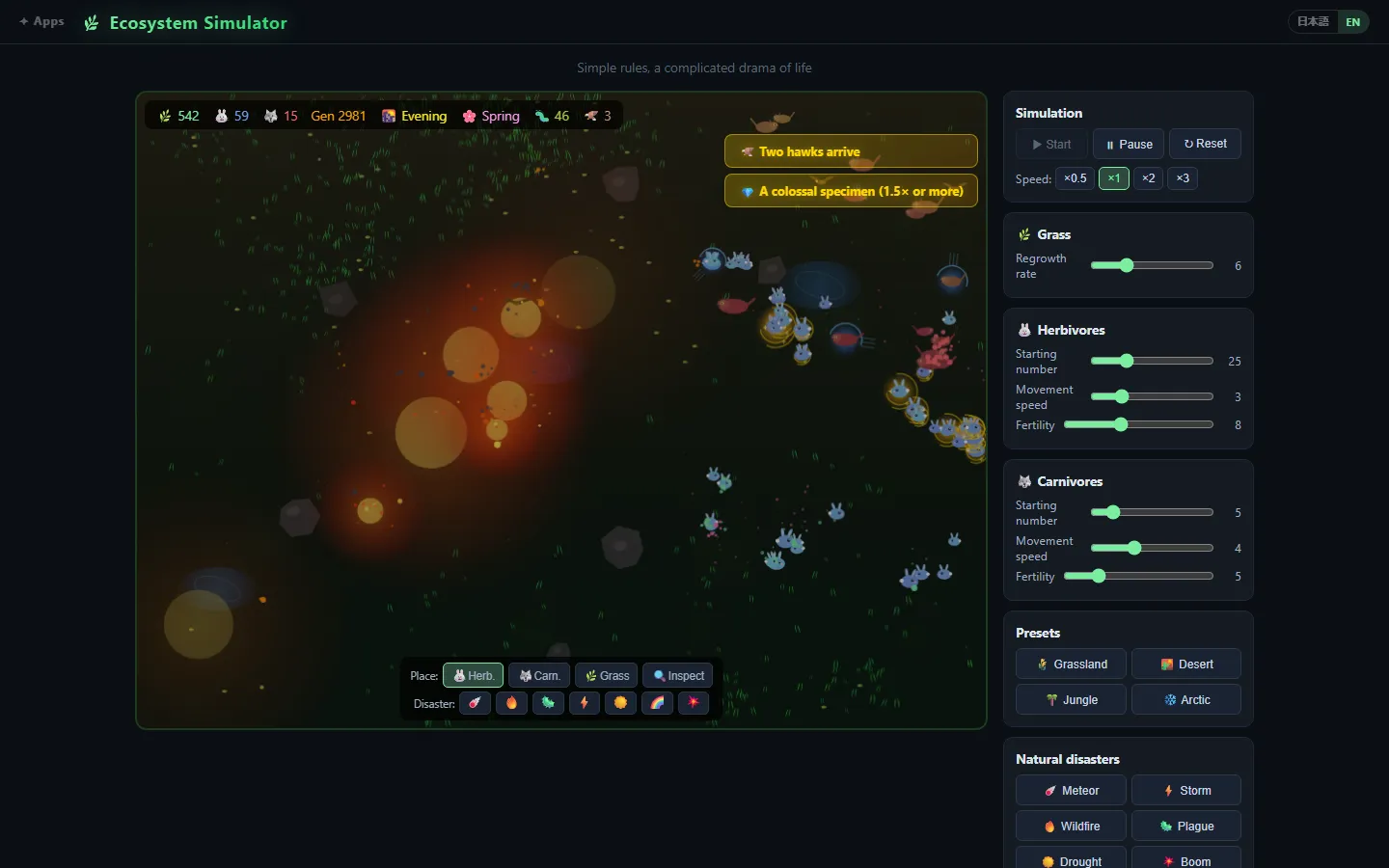
Press start and grass begins to spread across the field. Rabbits appear and eat it, wolves appear and hunt the rabbits. Each animal has energy that drains as it moves and refills when it eats, and each one breeds when it has enough to spare. That is close to the entire rule set, and yet within a few minutes you get the textbook wave: rabbits boom, wolves follow, rabbits crash, wolves starve, grass recovers, and round it goes.
A few things are layered on top to keep it from being too tidy.
- Day turns to night on its own. At night wolves see further and move faster, and rabbits slow down, so the balance tilts twice a day
- The seasons turn from spring to winter, and grass barely grows in winter. A population that looked stable in summer can find out in December that it was not
- Insects crawl over the grass and give rabbits something extra to eat, and hawks fly in from off screen, take a few rabbits, and leave
- Animals mutate. A gold aura marks a giant, a blue aura marks a sprinter, and you can click any animal to see what it is carrying
The sliders on the right let you change the numbers underneath, how fast grass grows, how much energy a meal gives, how often things breed, and the presets swap the whole environment at once if you would rather start from a desert or a paradise.
The Disasters Are the Fun Part
You can click anywhere on the field to drop in whatever is selected in the bar below it, a creature or a catastrophe. The catastrophes are the part I reach for most, and these are the ones I use.
| Disaster | What it does |
|---|---|
| Meteor | Wipes out everything at the impact point. The crater stays |
| Wildfire | Spreads outwards and burns the grass. Animals run from it |
| Plague | Passes between animals and drains their energy |
| Storm | Lightning strikes animals directly, and the world goes dark under the rain |
| Drought | Much of the grass withers |
| Eden | Grass springs up everywhere and every animal recovers |
| Boom | The herbivores multiply all at once |
What I did not expect is how often the “kind” disasters are the destructive ones. A boom of rabbits strips the field bare, the wolves feast for a while, and then both populations fall off a cliff because there is no grass left to restart from. A drought, by contrast, sometimes stabilises a run that was swinging too hard. The simulation does not know which events are supposed to be good, and it turns out that is the interesting bit.
Things to Try
The first experiment I would suggest is to do nothing. Let it run for five minutes and watch the population graph. Then restart and set grass growth very high, and watch the same three species behave completely differently. After that, try to build a world with no wolves at all and see how long the rabbits last.
If you have a child who is learning about food chains, I think this is a better half hour than the textbook page, partly because they get to drop the meteor.
Summary
This article introduced the Ecosystem Simulator.
Three species and a few rules are enough to produce boom, crash, recovery and the occasional extinction, and the disasters are a way of asking the world “what if” and getting an honest answer. If you enjoy watching systems rather than controlling them, I think it will keep you for a while.
A simulation in the same spirit, with civilizations instead of rabbits, is covered here.
I hope you will read the next article as well.
Also popular with readers
📚 Series: Free Browser Apps I Built (2/11)