
Thank you for visiting this site. This article covers the king of interview puzzles: “the bridge and torch problem.”
Night. Four people stand before an old suspension bridge. The bridge is dark and dangerous, so crossing requires the torch — and there is only one. The bridge holds at most two people at a time. The four walk at different speeds, taking 1, 2, 5, and 10 minutes respectively, and a pair moves at the slower member’s pace. So: what is the minimum time for all four to cross? Most people answer 19 minutes. The correct answer is 17 — and hidden in that 2-minute gap is a move that upends how you think about scheduling.
What Is the Bridge and Torch Problem?
The bridge and torch problem is a puzzle about optimizing a movement schedule that includes handing off a shared resource (the torch). The rules:
- Four people on the same side; all want to cross
- Crossing requires the torch; there is exactly one
- The bridge takes two at most, and a pair crosses at the slower person’s speed
- Crossing times: 1, 2, 5, 10 minutes. The torch must be walked across (no throwing)
The earliest known print appearance is in 1980s puzzle books, and in the 1990s it became world-famous as a Microsoft interview question. Interviewers reportedly posed it with the hint “it is known that 17 minutes is achievable,” and candidate after candidate agonized: “it won’t go below 19 — the problem must be wrong.” A viral internet version has the four members of U2 crossing the bridge in the 17 minutes before a concert.
The Intuitive Answer: the 1-Minute Sprinter Shuttles Everyone — 19 Minutes
First, the plan nearly everyone conceives: obviously the fastest walker should own the torch and ferry everyone.
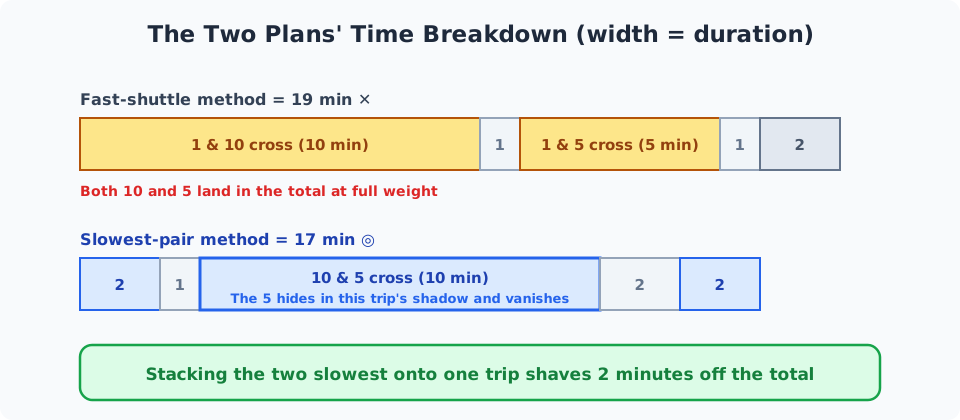
- 1 and 10 cross (10 min)
- 1 returns with the torch (1 min)
- 1 and 5 cross (5 min)
- 1 returns (1 min)
- 1 and 2 cross (2 min)
Total: 19 minutes. Fix the fastest as the shuttle, ferry the slow ones one at a time. It looks airtight — and indeed, within this plan, not one second can be shaved.
But look at the breakdown and the weakness surfaces: the two big numbers, 10 and 5, both land in the total at full weight. As long as the slow walkers travel separately, that sum is inescapable.
The Correct Answer: Send the Two Slowest Together — 17 Minutes
The winning procedure:
- 1 and 2 cross (2 min)
- 1 returns with the torch (1 min)
- 10 and 5 cross (10 min)
- 2 — waiting on the far side — returns with the torch (2 min)
- 1 and 2 cross (2 min)
Total: 2+1+10+2+2 = 17 minutes.
The key is step 3. Putting the slowest pair, 10 and 5, on the same trip hides the 5 completely in the shadow of the 10 — it never appears in the total at all. Shipped separately, the two cost 10+5 = 15 minutes; together, just 10. A full 5 minutes saved right there.
But the plan requires groundwork. After the slow pair crosses, someone must be on the far bank to bring the torch back — making the slow pair do it would ruin everything. Hence step 1: send the two fast walkers over first, pre-positioning the return driver (2). Steps 1 and 2 look like wasted shuttling, but they are the setup for step 3’s heavy freight. This construction — “deploy people early for a later move” — stands beside the river crossing’s “bring the goat back” among the master moves of scheduling puzzles.
Whether to Pair the Slowest Is Decided by Arithmetic
Is pairing the slowest always right? Actually, no. Call the four times a, b, c, d in ascending order. The two plans total:
- Slowest-pair method: a + 3b + d
- Fast-shuttle method: 2a + b + c + d
Subtracting, the slowest-pair method wins exactly when 2b is less than a + c. That is: if the second-fastest is fast enough to serve as return driver, pairing pays; if the second is slow, stick with the shuttle. With 1, 2, 5, 10: 2b = 4 versus a+c = 6 — pairing wins. But with, say, 1, 4, 5, 10: 2b = 8 versus a+c = 6, and the fast shuttle (21 minutes) beats the slowest-pair plan (23 minutes).
Which strategy is optimal flips with the parameters. That is the puzzle’s deeper flavor: memorize “this move is always right” and the problem is built to trip you. Easy to see why interviewers loved it. For larger groups, the known basic form is repeating the pattern “fix the two fastest as drivers and ship the slow ones over in pairs, slowest first” — the complete general analysis was given in a 2002 paper by the mathematician Rote.
Stack Your Bottlenecks
Translated into working language, the puzzle’s lesson reads: “overlap your slow tasks with each other — don’t hide them behind fast ones.”
Suppose a job contains two long-running steps: a server reboot and a data migration; heavy-equipment delivery and electrical work; a slow approval and a long-lead-time parts order. Run them in sequence and the times add; run them concurrently and you pay only the slower one. This is critical-path shortening in project management — or, in the kitchen, doing the prep while the stew simmers.
The easily missed part: the concurrency requires an upfront “setup move.” In the 17-minute solution, the 3 minutes of steps 1–2 are that investment. Judged in isolation, a wasted round trip; in fact, it purchases the 5-minute saving. Evaluate each move only by its immediate yield, and the setup move gets vetoed as “waste” — and the global optimum stays out of reach. The river crossing’s lesson again, resurfacing in the different arena of time optimization.
In software, picture a pair of slow test suites: run them in separate waits and you pay for both; run them in parallel and you pay only the slower — and the effort of provisioning a second execution environment is your “setup 3 minutes.” Booking the slow internet installation and the bulky furniture delivery on the same moving day is the same idea. Build the habit of asking “what is my slowest item, and what can I overlap it with?” and waiting times all over your life start shrinking.
The Proof of Minimality, and Larger Groups
Why Isn’t the Fastest-Shuttles-Everyone Plan Optimal?
The shuttle’s weakness: every slow walker’s time lands in the total at full weight. The 1-minute walker’s round trips are indeed cheapest, but the instant 10 and 5 ride separate trips, a 15-minute bill is locked in. The slowest-pair method spends an extra trip on the 2-minute return driver and, in exchange, deletes the 5 entirely. It is a comparison between “driver costs” and “separate-shipping costs for the slow,” and the answer turns on the numbers.
Can’t It Be Done in 16?
No. The trip carrying the 10-minute walker costs at least 10. At least two return trips are needed to bring the torch back — at best 1 and 2 minutes (even reusing the same returner costs 1+1). And one more outbound trip beyond the final one is required. Enumerate the necessary trips in their cheapest combination and no assignment below 17 exists. As a teaching point, the puzzle is only fully answered when both halves are in hand: the existence of a 17-minute schedule, and the impossibility of 16.
How Do You Think About 5 or More People?
Same doctrine: the candidates are the form “fix the two fastest as the outbound-and-return drivers, and ship the rest over in pairs, slowest first,” blended with fast-shuttle rounds. Each round, compare the cost of shipping the current slowest pair together (a + 2b + the slower time) against shuttling them across individually, and take the cheaper — repeating this builds the optimum. However large the group, the principle of stacking the slow together never changes. That constancy is the move’s beauty.
Related Logic Puzzles
See the original “setup move disguised as retreat,” “the river crossing problem”; shortest move-counts by recursive decomposition in “the Tower of Hanoi”; and counting the lower bound from one trial’s information in “the 12 coins and the balance scale.”


Summary
This article covered “the bridge and torch problem.”
The 19-minute plan is rational at every single step, and loses overall. The 17-minute plan contains an apparently pointless round trip, and wins overall. The contrast demonstrates a first principle of the optimization world: stacking up local efficiencies does not guarantee the global optimum.
And the move that decided the match was “put the two slowest on the same trip and hide one slowness inside the other.” Since learning it, when I build a schedule I start by writing down the slowest task and asking what can ride along with it. Suspect first that the slow items can run side by side. That two-minute shave transfers to a surprising number of jobs.
To return to the full list of logic and probability puzzles, follow the link below.
Thank you for reading. We hope to see you in the next article.

Also popular with readers
📚 Series: Logic & Probability Puzzles (8/11)