Thank you for visiting this site. This article covers one of the hardest of all logic puzzles: “the blue-eyed islanders.”
On a certain island live 100 blue-eyed inhabitants and 100 brown-eyed inhabitants. The island has no mirrors, and speaking of eye color is taboo. And there is a law: anyone who learns their own eyes are blue must leave the island at midnight that day. One day a traveler, addressing everyone at once, says: “There is at least one blue-eyed person on this island.” To islanders who can each see 99 blue-eyed neighbors, this should be a banality everyone already knows. Yet from this single remark follows a dramatic conclusion: on the 100th midnight, all 100 blue-eyed islanders leave the island together.
What Is the Blue-Eyed Islanders Puzzle?
The blue-eyed islanders puzzle confronts you with the difference between “everyone knows” and “everyone knows that everyone knows.” The rules:
- The island has 100 blue-eyed and 100 brown-eyed inhabitants
- All inhabitants are perfectly logical — and everyone knows that everyone is perfectly logical
- No mirrors or reflective water; discussing eye color is forbidden. Everyone can see everyone else’s eyes
- Anyone who becomes certain their own eyes are blue must leave at midnight that day
- One day, a traveler declares before everyone: “There is at least one blue-eyed person”
The puzzle asks: what happens after the declaration? And the deepest riddle is this: blue-eyed islanders can see 99 blue-eyed neighbors, brown-eyed ones can see 100 — “there is a blue-eyed person” was known to absolutely everyone. Why does a declaration with apparently zero new information move the island?
The Answer: a Mass Departure on Night 100
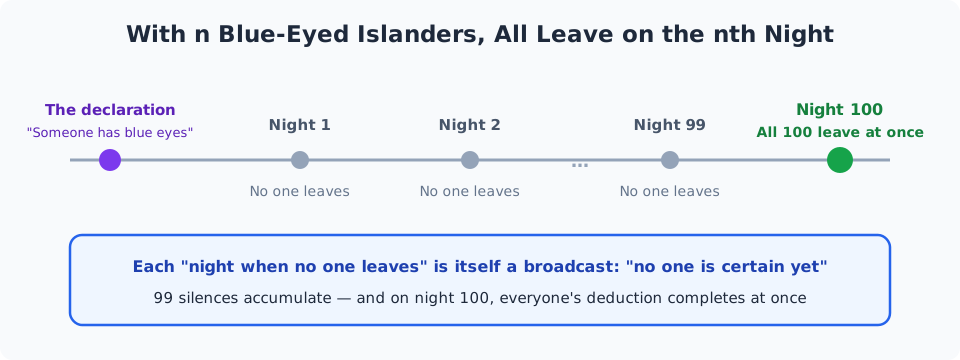
The conclusion first: on the 100th midnight after the declaration, all 100 blue-eyed islanders leave simultaneously. The 100 brown-eyed islanders remain.
The standard way in is to shrink the numbers drastically.
One blue-eyed islander. They see no blue eyes at all. The instant they hear the declaration, they conclude “the blue-eyed person must be me,” and leave on the first midnight.
Two blue-eyed islanders. Blue-eyed A sees exactly one blue-eyed person, B. A reasons: “If my eyes are not blue, B is the only blue-eyed one — so B will leave on night one.” But on night one, B does not leave (B is watching and waiting for the same reason). That fact of not leaving tells A: “B sees someone with blue eyes. That someone is me.” And so on the second midnight, both leave together.
Three blue-eyed islanders. Each thinks: “If I’m not blue-eyed, the other two will leave on night two.” When nobody leaves on night two, each one’s eye color is settled, and all three depart on night three.
Continuing likewise, induction shows that with n blue-eyed islanders, all leave together on the nth midnight. With 100, it is night 100. Every one of those 99 quiet nights was a broadcast, delivering to the whole island the information that “no one is certain yet.”
A Classic Born from Mathematicians’ Amusements
The puzzle’s prototype is old. The famous version is the “dirty faces problem” that the mathematician John E. Littlewood presented in his 1953 book “A Mathematician’s Miscellany” — people with soot-smudged faces can see everyone’s face but their own, and a burst of laughter sets off the chain of deductions. Structurally identical to the island.
The physicists George Gamow and Marvin Stern included the same form in their 1958 collection “Puzzle-Math” as the “problem of the unfaithful wives” — a rather more scandalous seasoning in which a proclamation to the town unravels each household’s infidelity by induction.
On the modern internet, the puzzle was popularized by Randall Munroe, author of the webcomic xkcd, who posted the blue-eyed islanders on his site as “the hardest logic puzzle in the world.” It stirred worldwide argument, and the mathematician Terence Tao famously organized the points of dispute on his blog. Simple rules — and even after hearing the answer, the nagging feeling won’t die: “but the declaration contained no new information, did it?” The identity of that nagging feeling is precisely the next concept: common knowledge.
What the Traveler Delivered Was Not a Fact but Common Knowledge
Precisely stated, what the traveler’s declaration introduced was not the fact “a blue-eyed person exists.” It was the state of “everyone learned it, in front of everyone, at the same moment.”
See the difference with two islanders. Blue-eyed A and B each see the other’s blue eyes, so both know “a blue-eyed person exists.” But A does not know whether B knows it. The only blue eyes A can see are B’s — so if A’s own eyes are not blue, then B sees no blue eyes at all and may not know that any blue-eyed person exists.
The moment the traveler declares it before everyone, that uncertainty dies. A knows “B heard it,” and knows “B knows that A heard it.” The nesting continues to any depth, and the infinite tower — everyone knows; everyone knows that everyone knows; and so on — snaps into existence all at once. Game theory calls this “common knowledge.” Formalized by the philosopher David Lewis in 1969 and given mathematical foundations by the economist Robert Aumann in a 1976 paper, it is a thoroughly respectable academic concept.
For the induction chain to run on an island of 100, the tower must reach the 100th story. Before the declaration, the island had only 99 stories — exactly one missing. Publishing a fact everyone knows is not an act of distributing the fact — it is an act of completing the tower of knowledge. That is the heart of the answer.
The Moment the Open Secret Is Spoken in the Meeting
The concept of common knowledge explains the pressure points of real organizations and societies with startling accuracy.
Andersen’s “The Emperor’s New Clothes” is the textbook. Everyone lining the street knew the emperor was naked. No one could act, because every person thought: “maybe everyone but me can see the clothes.” The child’s cry — “the emperor is naked!” — conveyed no unknown fact; it synchronized everyone’s awareness in front of everyone. That is why the laughter could finally break out.
The same thing happens in company meetings. Every member half-knows the project’s schedule risk, yet no one proposes countermeasures until it lands on the agenda. The value of stating a problem in an official setting and recording it in the minutes lies not in transmitting information but in converting it to common knowledge. A problem everyone knew privately becomes, the moment it is said aloud in the meeting, something “no one can pretend not to have known.” The power of whistleblowing and disclosure regimes, and the way bank runs and bubble collapses take the form of “everyone vaguely sensed it, then one news report triggers the stampede” — same structure throughout.
In engineering, the “Two Generals’ Problem” of distributed systems is famous as the impossibility of common knowledge: however many rounds of possibly-lost messengers you exchange, the nested certainty that “agreement on the attack time has been established” never completes. Message exchange alone cannot manufacture common knowledge — a theoretical result that lights, from behind, just how special a device the island’s “declaration before everyone” really was.
What Happens to the Brown-Eyed Islanders?
They stay, forever. A brown-eyed islander sees 100 blue-eyed people, so when those 100 leave on night 100, they learn “I am not blue-eyed.” But the law demands certainty about one’s own color, and knowing you are not blue cannot decide between brown and green. With no one to tell them, certainty never comes, and the obligation to leave never arises. That the same island splits into a group whose deduction completes and a group whose never does — that, too, is part of the puzzle’s charm.
Without the Declaration, Wouldn’t Waiting 100 Days Do the Same?
No. The induction chain is built on the base case: “if exactly one islander is blue-eyed, they learn it on the night of the declaration and leave.” Without the declaration, even a lone blue-eyed islander has no way to learn their color, and the night-one departure never happens. Knock out the base and the two-person deduction collapses, then the three-person one, all the way up the chain. The synchronizing signal that starts the count of days supplies both the shared clock and the shared knowledge.
Would Real Humans Actually Behave This Way?
Almost certainly not. The conclusion requires the strong premise that everyone is perfectly logical, and that this itself is common knowledge — a single miscount or broken rule shatters the chain, and no real human tracks 100 stories of nesting. But that is exactly why, in the real world, there is value in manufacturing common knowledge through institutions rather than trusting human deduction: official announcements, contracts, standards, all-hands communications. They are devices for artificially reproducing the traveler’s declaration.
Related Logic Puzzles and Paradoxes
See the entry-level craft of reasoning about others’ sightlines, “the hat puzzle”; the group that misreads everyone’s true feelings into a conclusion nobody wanted, “the Abilene paradox”; and meeting up without any communication, “Schelling points.”


Summary
This article covered “the blue-eyed islanders,” one of the hardest of all logic puzzles.
The traveler’s remark contained no fact unknown to a single islander. What changed the island’s fate was that the remark laid the final story of the tower — “everyone can be certain of everyone’s awareness.” The value of information is determined not by its content alone but by who says it, before whom, and how. I know no teaching material that displays that truth as vividly as this puzzle.
When your team’s “things everyone surely knows” refuse to move, remember this island. What’s missing may not be information — it may be the traveler who says it in front of everyone.
To return to the full list of logic and probability puzzles, follow the link below.
Thank you for reading. We hope to see you in the next article.

Also popular with readers
📚 Series: Logic & Probability Puzzles (4/11)