Thank you for visiting this site. This article explains Schelling Points (Focal Points).
There is a phenomenon where multiple people naturally choose the same option without any discussion or prior agreement. The essence of a Schelling point is the self-fulfilling expectation: “I choose this because everyone else is likely to choose it.” This concept serves as a useful lens for understanding a wide range of phenomena — the emergence of technical standards, natural monopolies in markets, reference points in negotiation, and international politics.
Thomas Schelling and “The Strategy of Conflict”
The concept of Schelling points was proposed by economist Thomas Schelling. In his 1960 book The Strategy of Conflict, he applied the framework of game theory to international security, deterrence theory, and negotiation.
Schelling received the Nobel Prize in Economics in 2005, shared with Robert Aumann. The selection committee recognized him for “having enhanced our understanding of conflict and cooperation through game-theory analysis.”
The most intuitively compelling part of Schelling’s work was his analysis of coordination problems. In game theory, a coordination problem is a situation in which players acting independently can benefit by choosing the same option. Such problems typically have multiple Nash equilibria, and theory alone cannot predict which equilibrium will be reached.

Yet Schelling demonstrated experimentally and logically that real people converge on a specific equilibrium through “salience” derived from culture, context, and convention. This convergence point is the “focal point” or “Schelling point.”
The Structure of Coordination Problems
To understand coordination problems concretely, consider the following situation.
Two people, A and B, must independently navigate to the same meeting place without any means of communication. With no prior agreement on where to meet, they must decide independently and arrive at the same conclusion.
This structure can be represented by the following game:
| A chooses place X | A chooses place Y | |
|---|---|---|
| B chooses X | Both get 1 (success) | Both get 0 (failure) |
| B chooses Y | Both get 0 (failure) | Both get 1 (success) |
This payoff matrix has two Nash equilibria: “both X” and “both Y.” Both are rational solutions, but mathematics cannot distinguish between them.
This is where culture and context enter. If there is shared knowledge that “X is obviously the more prominent place” in a given society, both A and B predict that the other will choose X, and they both converge on X. This “prominence” — a non-logical quality — is the source of the Schelling point.
The New York Experiment
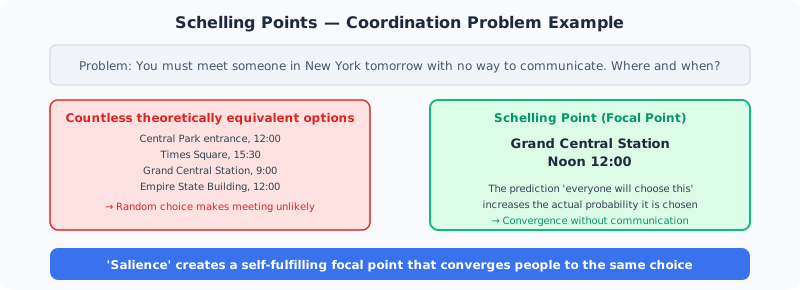
Schelling conducted an actual experiment, asking Yale University students: “Suppose you need to meet someone in New York City tomorrow and have no way to contact them. Where and at what time do you show up?”
In theory there are countless possible answers, but most students chose Grand Central Station, at noon.
Why Grand Central? As the most recognized transportation hub in New York, it serves as the cultural focal point for “where to meet.” Why noon? Because it is the most “round” time in the day.
There is no unique rational answer — the convergence arose purely from the expectation that “everyone will choose this.”
This salience is shaped by culture, context, and history. Ask the same question in London and Big Ben or Trafalgar Square might be the focal point. A different era or group would yield different answers.
Sources of Salience
Analyzing what generates “salience” reveals several recurring patterns.
Uniqueness and extremes: Firsts, zeros, maximums, minimums, and midpoints — anything that is “number one” by some criterion is salient. In games asking “pick an integer that matches your partner’s pick,” 1 is most frequently chosen for this reason.
Round numbers and thresholds: 100, 1,000, 50% — “tidy numbers” are salient. This is why proposals of “one million dollars” are common in negotiations.
Geographically or physically prominent landmarks: Rivers, mountain ranges, roads, buildings — anything visually prominent on a map is salient as a boundary or landmark.
Precedent and convention: An option that has been chosen before tends to be chosen again. Conventions, customs, and industry standards are a manifestation of the self-reinforcing property of Schelling points.
Common knowledge: It is not just that A thinks X will be chosen — B knows A thinks this, A knows B knows, and so on. This “common knowledge” structure strengthens the Schelling point. What matters is not merely “many people know” but “everyone can predict everyone else’s choice.”
Numbers, Games, and Price-Setting
Schelling point effects have also been observed in number-based experiments.
In a game saying “choose a positive integer; win a prize if you match your partner’s choice,” the most frequently chosen number is 1. The number 1 has salience as the starting point of the number line — the smallest positive integer.
In an inverse version — “choose a number; win if you differ from your partner” — many people choose 2 (reasoning: 1 is too obvious, so I’ll avoid it). This higher-order reasoning (“predict what my partner predicts”) is also related to the Schelling point concept.
Applications to price-setting: Psychological pricing (¥99, ¥999) is used to lower consumers’ price perception, but there is a separate Schelling point dynamic at work as a “reference point for negotiation.” In bidirectional negotiations involving salaries, real estate, or project budgets, round numbers naturally become focal points — used as starting points and compromise targets.
“Annual salary of ¥6 million,” “apartment at ¥30 million,” “project budget of ¥5 million” — these figures function as anchors for negotiation even when they have no inherent rational basis.
Industry Standards and Network Effects
In markets where multiple technology standards compete, Schelling point logic operates powerfully.
In standards battles — VHS vs. Betamax, HD-DVD vs. Blu-ray, JavaScript vs. alternative browser scripting languages — “which is more widely adopted” often matters more than “which is technically superior.”
Once a standard surpasses a certain adoption threshold (critical mass), it itself becomes a Schelling point. New users choose it “because everyone uses it,” which accelerates adoption further. In markets where Metcalfe’s Law operates (network value scales with the square of the user count), this convergence on a Schelling point creates a “winner-take-all” structure.

Many things that are now “de facto standards” — the USB specification, TCP/IP protocol, English as the international lingua franca, the magnetic stripe on credit cards — attained their status not through technical superiority but through convergence on a Schelling point.
Brands and Market Positioning
In brand strategy, the Schelling point concept explains the value of becoming the category representative.
When associations like “Coke means Coca-Cola,” “delivery means FedEx,” or “search means Google” become entrenched, those brands become the Schelling point in their category’s purchase context. The moment a consumer thinks “I want a cola,” their choice automatically moves toward Coca-Cola.
The concept used to capture this position is Category King. The number-one brand in a category enjoys dramatically larger market share and profits than the number-two brand. This is because the self-fulfilling expectation of the Schelling point is at work.
Marketing claims like “Number 1 in sales” or “Highest customer satisfaction” are designed to give recipients a focal point — “everyone chooses this” is itself a reason for more people to choose it.
Negotiation and BATNA
In negotiation, Schelling points determine where agreements land.
Consider a real estate negotiation. The seller opens at ¥28 million; the buyer at ¥24 million. The midpoint of ¥26 million becomes a natural Schelling point. The cultural convention of “splitting the difference” makes that point salient.
Skilled negotiators exploit this. By setting the opening price (anchoring), they can shift the midpoint in their favor. If the seller opens at ¥32 million, the midpoint becomes ¥28 million.
Conversely, to avoid being pulled by the other party’s anchor, having a clear BATNA (Best Alternative to a Negotiated Agreement) is essential. Establishing your own floor value prevents you from being pulled by focal points into irrational concessions.
Salary negotiations have the same structure. Setting the “market rate” as a Schelling point — through industry benchmarks, your previous salary, or competing offers — helps establish a favorable starting point.
International Politics and Ceasefire Lines
Schelling was particularly interested in applications to nuclear deterrence and international relations.
Setting ceasefire lines: Why are the 38th parallel, rivers, or mountain ranges chosen as ceasefire lines? Geographically clear boundaries possess salience as Schelling points. Adopting a boundary visible to everyone — rather than a precise numerical line — makes agreements easier to reach and maintain.
The 38th parallel in the Korean War, the division of Berlin, and historical borders along the Rhine and Danube possessed the character of Schelling points as “prominent boundaries,” not solely for military or political rationality.
Nuclear deterrence and the “firebreak”: What Schelling emphasized most was the “firebreak” between nuclear and conventional weapons. The clear boundary of “no nuclear use” is far more salient than subtle graduated escalation. The norm of nuclear non-use functions as a Schelling point, forming part of the deterrence that prevents nuclear escalation.
International law and conventions: The 12-nautical-mile territorial sea and 200-nautical-mile exclusive economic zone are Schelling points with both rational justification and salience as international common knowledge.
Schelling Points in the Digital Age
Schelling point logic operates in modern digital spaces as well.
Cryptocurrency: Bitcoin’s entrenchment as “the representative cryptocurrency” owes not just to technical merit but also to the first-mover advantage and Schelling point effect of “spreading first.” Ethereum’s position as the smart contract platform follows the same logic.
Social media platforms: TikTok’s short video format, Twitter’s character limit (now X), LinkedIn’s professional network — each has become the Schelling point in its context. For the coordination problem of “connecting with friends who share my interests,” the platform most people use is the natural convergence point.
Internet memes: The spread of specific words, images, and formats as “memes” online also carries the self-reinforcing Schelling point property: “everyone knows it, so I use it.”
Intentionally Designing Schelling Points
Schelling points can be deliberately created, not just emerge organically.
Commitments and announcements: Public goal declarations — “we’ll sell 1 million units,” “we’re targeting ¥1 trillion in annual revenue” — establish focal points inside and outside the organization. When everyone holds that number as common knowledge, it becomes easier to align strategy, resource allocation, and priorities.
Rules and norms: Organizational rules like “9 a.m. start” or “weekly reports submitted Monday morning” function as focal points that simplify coordination, even if optimal timing varies for each individual.
International treaties and agreements: The Paris Agreement’s targets of “1.5°C temperature rise” and “carbon neutrality by 2050” serve not only as scientific precision but as Schelling points that focus national policy, corporate investment decisions, and technology development.
Summary
This article explained Schelling Points (Focal Points). We hope it was useful.
The essence of a Schelling point — “I choose this because everyone else is likely to choose it, so I choose it too” — as a self-fulfilling expectation explains the solutions to a wide range of coordination problems: the emergence of technical standards, natural monopolies, negotiation reference points, and the formation of international agreements.
When you ask “why did this option become the default?” or “why did negotiations settle here?” the Schelling point perspective illuminates the otherwise invisible convergence mechanism.
To return to the framework list and game theory overview, see the links below.
Thank you for reading. We hope to see you in the next article.

Also popular with readers
📚 Series: Strategic Thinking Frameworks (6/16)