Thank you for visiting this site. This article explains Mechanism Design.
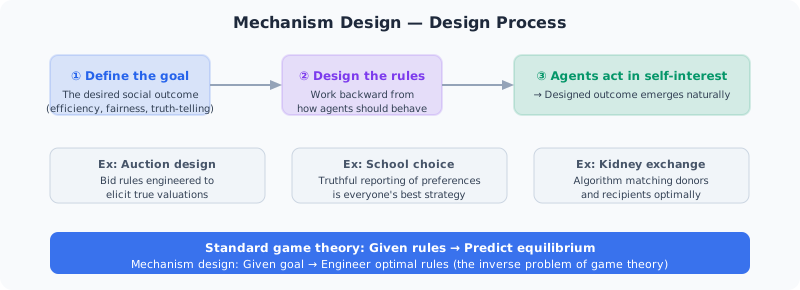
While classical game theory takes rules as given and predicts “how participants will behave,” mechanism design does the opposite. It starts from a desired outcome and works backward to design the rules that produce it. It is sometimes called the inverse problem of game theory.
The Birth of Mechanism Design
The foundations of mechanism design were laid by Leonid Hurwicz. In the 1960s he proposed the concept of “incentive-compatible mechanisms,” studying the design of systems that aggregate dispersed information to produce socially desirable outcomes.
Hurwicz’s theory was initially pure abstract mathematics, but Roger Myerson and Eric Maskin later expanded it into highly practical domains.
- Myerson: Optimal auction theory, bargaining theory, and applications to political economy
- Maskin: Established implementation theory and clarified the conditions under which socially desirable outcomes can be achieved as equilibria
All three received the Nobel Prize in Economics in 2007. The selection committee recognized them for “having laid the foundations of mechanism design theory, which allows for the construction of a theory for designing rules that allow for desired social outcomes even in situations where there is asymmetry in information and individuals act in their self-interest.”
Difference from Social Choice Theory
Mechanism design is closely related to social choice theory but differs in direction.
Social choice theory: Studies methods for aggregating individual preferences (who people like, what they want) into collective decisions. Its subjects include voting, majority rule, and the Borda count. Arrow’s Impossibility Theorem — that the only aggregation rule satisfying all reasonable axioms simultaneously is dictatorship — is a famous result in this field.
Mechanism design: Designs “rules of the game” such that socially desirable outcomes are achieved while participants have an incentive to report their private information honestly. Its emphasis is on eliciting participants’ private information (preferences or costs known only to themselves).
The key shift in thinking is not “force behavior through regulation” but “design a system where following your own interests naturally produces good outcomes.”
Incentive Compatibility and the Revelation Principle
The core concept of mechanism design is incentive compatibility.
A design is incentive-compatible when it is in each participant’s best interest to report their private information (preferences, costs, valuations) honestly.
Weak incentive compatibility (Dominant Strategy IC): Honest reporting weakly dominates every other strategy (there is no situation in which dishonest reporting is strictly advantageous).
Bayesian incentive compatibility: When each participant believes the others are reporting honestly, honest reporting is also their best response.
The Revelation Principle, proved by Myerson, is the most powerful theoretical tool in mechanism design.
Its content: “Any outcome achievable by any indirect mechanism (complex auction formats, negotiation rules, etc.) can also be achieved by a ‘direct revelation mechanism’ in which honest reporting is an equilibrium for every participant.”
The practical implication is that a designer needs only to consider mechanisms with a simple “report your information honestly” structure, without separately analyzing mechanisms with complex strategic behavior. This makes the mechanism design problem mathematically tractable.
Auction Design: Theory and Practice
The most famous application of mechanism design is auction design.
English auction (ascending-bid): Price rises from a low starting point; the last remaining bidder wins. Highly transparent, but not well suited to selling multiple goods simultaneously or goods with complementarities.
Dutch auction (descending-bid): Price falls from a high starting point; the first bidder to raise their hand wins. Used for agricultural products and financial IPOs.
First-price sealed-bid: All bidders submit bids privately; the highest bidder wins and pays their bid. Bidders have an incentive to bid below their true valuation (“strategic shading”).
Vickrey auction (second-price sealed-bid): All bidders submit bids privately; the highest bidder wins, but pays the second-highest bid.
The key insight of the Vickrey auction is that bidding one’s true valuation is a dominant strategy.
Here is why. Let v be your true valuation and m be the highest bid among all other bidders.
- If v > m (you value it most): You win regardless of how you bid at or above m. You pay m, earning profit v − m > 0. Misreporting does not change the payment m, so honest bidding and dishonest bidding give the same payment. However, bidding below v risks losing when you would have won.
- If v < m (someone else values it more): Honest bidding (v) means you don’t win. Bidding above v would win, but payment is m, yielding v − m < 0 — a loss.
Therefore, in both cases, bidding your true valuation v is optimal (dominant strategy).
The VCG Mechanism
The generalization of the Vickrey auction is the VCG Mechanism (Vickrey-Clarke-Groves Mechanism).
The VCG mechanism is designed to allocate multiple goods and resources efficiently while making honest reporting of valuations a dominant strategy.
VCG payment rule: Each winner pays “the increase in total surplus that others would have received if the winner were absent.” This is called “internalizing the externality.” Because winners pay for the value they deny others, honest reporting becomes a dominant strategy.
Applications of VCG:
Internet advertising auctions: Google’s search advertising bids and Facebook’s ad slot auctions use variants of the VCG mechanism. Advertisers bid based on the value of search clicks for their products, and the most efficient advertiser wins the slot.
Spectrum auctions: US spectrum auctions beginning in the 1990s involved spectrum bands with complementary value (holding bands A and B together is worth more than either alone), which motivated the design of Simultaneous Multiple-Round Auctions (SMRA) inspired by VCG. Economists including Paul Milgrom were central designers; the inaugural auction raised more than four times the government’s forecast.
Stable Matching Theory
An important application of mechanism design beyond auctions is matching theory.
Unlike goods transactions, when participants have mutual preferences (medical students choose hospitals, and hospitals also choose students), simple auctions don’t work.
The Gale-Shapley Algorithm (Deferred Acceptance Algorithm), proposed by David Gale and Lloyd Shapley in 1962, works as follows (student-proposing version):
- Each student applies to their first-choice school
- Each school tentatively “holds” its top applicants and “rejects” the rest
- Rejected students apply to their next preferred school
- Schools re-compare new applicants with currently held ones and hold the new top group
- Repeat until everyone is held or has exhausted their list
The result is a stable matching: a matching with no “blocking pair” (a student and school who both prefer each other over their current assignments).
The Gale-Shapley algorithm is guaranteed to always find a stable matching.
Moreover, in the student-proposing version (student-optimal stable matching), honest reporting of preferences is a dominant strategy for every student — meaning no student can gain by misreporting their preferences. The mechanism is incentive-compatible.
Real-world applications:
The NRMP (National Resident Matching Program), which manages the matching of US medical graduates with hospitals, has used stable matching since 1952 (redesigned using Gale-Shapley in 1998). Some Japanese local governments use stable matching for daycare placement decisions.
Shapley and Alvin Roth received the Nobel Prize in Economics in 2012 for this research.
Kidney Exchange Programs
A profoundly impactful application of mechanism design is the kidney exchange program.
In living-donor kidney transplantation, family members or friends often wish to donate a kidney but are incompatible with the intended recipient due to blood or tissue type mismatches. However, when two such incompatible donor-patient pairs exist and each donor is compatible with the other pair’s patient, a “paired exchange” is possible.
Alvin Roth and colleagues designed matching algorithms to conduct these exchanges at scale and efficiently. The system incorporates “kidney chains” linking multiple pairs, enabling thousands of transplants per year in the United States.
The kidney exchange program symbolizes the practical value of mechanism design as an application that directly saves lives.
School Choice Systems
Mechanism design thinking is also applied to school choice systems, a topic of growing interest worldwide.
Traditional school choice processes gather first-preference and second-preference rankings, but parents who worry their first-choice school is too competitive may behave strategically (listing a more accessible school first). This is a classic example of individually rational behavior reducing overall efficiency.
The student-proposing version (student-optimal stable matching) using the Gale-Shapley algorithm achieves an incentive-compatible rule in which listing your true first choice is never disadvantageous.
New York City, Boston, and Denver have adopted this system for school assignment. Some Japanese municipalities have adopted stable matching for daycare center allocation.
Applications to Business and Organizational Design
Mechanism design thinking extends naturally to business and organizational design.
Performance-based compensation: When a principal (management) cannot directly observe an agent’s (employee’s) actions (information asymmetry), mechanism design involves creating a compensation structure where the agent pursuing their self-interest achieves the organization’s goals. Stock options, bonus design, and commission structures are applications.
Internal markets and transfer pricing: When large corporations allocate resources (people, equipment, capital) across divisions, setting internal prices (transfer prices) so that divisions autonomously make optimal allocation decisions is also mechanism design.
Crowdfunding design: The “full refund if the target isn’t reached” rule is a mechanism that mitigates the free-rider problem in public goods games. The sense that everyone must contribute or the project fails reduces free-riding.
Ranking and review systems: Amazon’s review system, Airbnb’s mutual rating, and StackOverflow’s reputation system are all design problems involving incentives for honest feedback.
Limitations of Mechanism Design
In real institutional design, the theoretically optimal mechanism is not always feasible. Here are the main limitations.
Complexity of preferences: Theory assumes participant preferences can be expressed quantitatively, but real preferences are often more complex and non-linear. Fully quantifying factors like fairness, morality, and social norms is particularly difficult.
Computational complexity: Applying the VCG mechanism to complex allocation problems can make optimal allocation computation NP-hard. Even a theoretically optimal mechanism is unusable if it cannot be computed in practice.
Complex rules aren’t understood by participants: If a mechanism is too complex, participants cannot understand it and cannot act strategically in the intended way. The Vickrey auction is theoretically excellent but “why do I pay the second-highest bid?” is counterintuitive, and it is rarely used in commercial auctions.
Vulnerability to collusion: Protecting against participants cooperating to undermine the designer’s intent (bid-rigging, collusion) is necessary. Bid-rigging in competitive procurement is the classic example, significantly damaging mechanism efficiency.
Incomplete models: Mechanism design assumes participant rationality, but as behavioral economics shows, human decision-making is influenced by cognitive biases. Cases exist where theoretically optimal mechanisms fail in behavioral economic terms.
Practical Steps for Institutional Design
A practical procedure for applying mechanism design thinking:
Step 1 — Clarify the desired outcome: Define clearly what you want to achieve: efficiency (Pareto-efficient allocation), fairness, stability, or information elicitation. Multiple objectives often trade off, requiring prioritization.
Step 2 — Understand the information structure: Identify who holds what private information. Locating the information asymmetry (seller knows quality, buyer knows valuation, etc.) is the starting point.
Step 3 — Identify the incentive problem: Analyze what strategic behavior currently arises under existing rules (or no rules). Identify why undesirable outcomes occur (adverse selection, moral hazard, free-rider problems).
Step 4 — Design incentive-compatible rules: Design rules such that participants’ honest reporting of their true information aligns with their self-interest. Using the Revelation Principle, treat the direct revelation mechanism as the base case.
Step 5 — Assess implementability and side effects: Consider computational feasibility, ease of understanding, collusion resistance, and participation costs. Account for behavioral economics dimensions (responses to human cognitive biases).
Summary
This article explained Mechanism Design. We hope it was useful.
Mechanism design handles a wide range of institutional design problems — from auctions, matching, and resource allocation to kidney transplantation, school choice, and corporate compensation design — all through a single axis: incentive compatibility.
“Design rules that align participants’ self-interest with the interests of society as a whole” — this idea is applicable to every context of organizational, market, and policy design. Combined with nudge theory and Pareto efficiency, it yields an even more practical perspective on institutional design.
To return to the framework list and game theory overview, see the links below.
Thank you for reading. We hope to see you in the next article.
Also popular with readers
📚 Series: Strategic Thinking Frameworks (7/16)