Thank you for visiting this site. This article explains Evolutionary Game Theory.
This field analyzes biological evolution, the formation of social norms, and human cooperative behavior through the lens of game theory. The fundamental difference from classical game theory is that strategies are evaluated not by a fixed standard but by the outcome of their interactions with other strategies.
The Birth of Evolutionary Game Theory
Evolutionary game theory was proposed in the 1970s by biologist John Maynard Smith and mathematician George Price. Their goal was to explain behavioral patterns in animals — aggressive behavior, territorial disputes, cooperative acts — within the framework of natural selection, where individuals act to maximize the fitness of their genes.
In their 1973 paper “The Logic of Animal Conflict,” Maynard Smith introduced the concept of the Evolutionarily Stable Strategy (ESS), mathematically formalizing the conditions under which a strategy is stably maintained in a biological population.
Subsequently, Robert Axelrod’s research on the evolution of cooperation (1984, The Evolution of Cooperation) extended evolutionary game theory beyond biology into political science, economics, sociology, and computer science.
Differences from Classical Game Theory
Classical game theory rests on the premise that rational agents maximize their own payoffs. Evolutionary game theory differs in several key ways.
No rationality assumption: Players do not need to consciously calculate and optimize. Genetically programmed behavioral patterns (instincts, habits, imitation) are sufficient.
Population dynamics: Rather than asking what each individual’s optimal strategy is, it analyzes how the distribution of strategies across the whole population changes over time.
Fitness as the criterion: Strategies are not evaluated by “how large the payoff is” but by “whether the individuals holding that strategy increase or decrease in the population (fitness).”
Dynamic equilibrium concepts: Beyond static equilibria like Nash equilibrium, it performs dynamic analysis of what equilibrium a population converges to from any initial state.
Axelrod’s Tournament
The most famous experiment in evolutionary game theory is the computer tournament for the repeated Prisoner’s Dilemma organized by political scientist Robert Axelrod in the 1980s.
In a one-shot Prisoner’s Dilemma, mutual defection is the Nash equilibrium, but when playing the same opponent repeatedly, the situation changes. A “shadow of the future” emerges where each player considers how the other will act going forward, opening the possibility of long-term cooperation.
Axelrod invited economists, psychologists, and mathematicians worldwide to submit programs, then had all strategies compete in a round-robin repeated Prisoner’s Dilemma.
Round 1: 14 strategies competed. The simplest strategy — just two lines of code — called “Tit for Tat” won.
Round 2: After publishing the Round 1 results, 62 strategies competed. Tit for Tat again achieved the top score.
The Structure of Tit-for-Tat
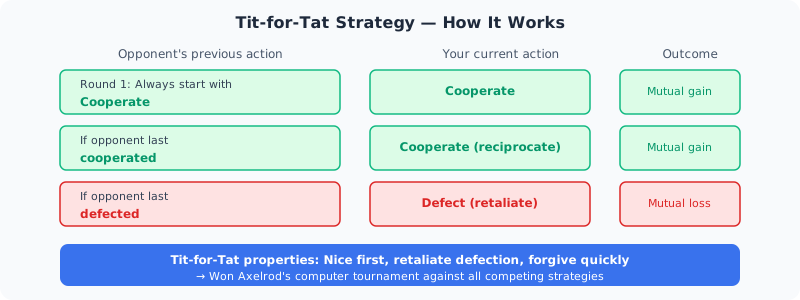
The Tit-for-Tat strategy consists of just two rules:
- Cooperate on the first move (start friendly)
- Thereafter, do whatever the opponent did last round (cooperate for cooperate, defect for defect)
That is all. Despite this simplicity, Axelrod explained why Tit-for-Tat achieved the best overall performance against a wide variety of opponents through four properties.
Niceness: Never defect first. By signaling cooperation initially, it creates opportunities for both sides to achieve high payoffs through mutual cooperation.
Retaliation: Immediately retaliate against defection. Because it never accepts exploitation at no cost, it prevents being unilaterally used.
Forgiveness: As soon as the opponent returns to cooperation, so does Tit-for-Tat. This maintains long-term relationships and prevents chains of retaliation (C→D→D→D→… endless mutual defection).
Clarity: The rule is transparent and predictable to the opponent. When the opponent understands “cooperate and I cooperate back; defect and I retaliate,” cooperation becomes easier to sustain.
This combination of properties creates robustness that holds up against both cooperative and exploitative strategies.
Limitations and Extensions of Tit-for-Tat
Tit-for-Tat is not universal. Several weaknesses are known.
Vulnerability to noise: When communication errors occur (unintended defection), two Tit-for-Tat players can fall into a chain of retaliation (defect → defect → defect →…).
The strategy that overcomes this weakness is Generous Tit-for-Tat. When the opponent defects, it forgives with some probability (e.g., 10–30%) and cooperates at random. In noisy environments, this often outperforms standard Tit-for-Tat.
A further development is Win-Stay, Lose-Shift (Pavlov strategy): if last round’s outcome was good, repeat the same action; if bad, switch. Simulations in noisy environments show Pavlov outperforming Tit-for-Tat.
Recent machine-learning research aimed at finding strategies that beat Tit-for-Tat shows that ML-designed strategies can dominate under specific conditions. But in terms of overall robustness across diverse opponents, simple Tit-for-Tat-family strategies remain powerful.
Evolutionarily Stable Strategy (ESS)
The central concept of evolutionary game theory is the Evolutionarily Stable Strategy (ESS).
Formal definition: When nearly the entire population uses strategy I, if a rare mutant using strategy J attempts to invade and strategy I has higher fitness than strategy J, so the mutant cannot spread, then strategy I is an ESS.
Mathematically, this is expressed by the following conditions:
- u(I,I) > u(J,I) — I earns a higher payoff than J in a population of I players, OR
- u(I,I) = u(J,I) AND u(I,J) > u(J,J) — even when payoffs are equal, I can resist invasion by J
Here u(A,B) is the payoff A receives in a population of B players.
ESS is a type of Nash equilibrium, but the converse does not hold. Every ESS is a Nash equilibrium, but not every Nash equilibrium is an ESS.
In a one-shot Prisoner’s Dilemma, “everyone defects” is the ESS. If one cooperative strategy enters, it gets exploited by defectors and cannot spread.
The Hawk-Dove Game and Mixed ESS
The archetypal model of evolutionary game theory is the Hawk-Dove Game.
In a contest over a resource (value V), two strategies are available:
- Hawk: Fights aggressively; if the opponent doesn’t back down, engages in combat. Combat costs C.
- Dove: Avoids conflict; backs down if the opponent plays Hawk.
Match outcomes (with V=6, C=10):
| vs. Hawk | vs. Dove | |
|---|---|---|
| Play Hawk | (V−C)/2 = −2 | V = 6 |
| Play Dove | 0 (back down) | V/2 = 3 |
In an all-Hawk population, Hawks fighting each other average −2. A Dove entering earns 0 against Hawks, which beats the average of −2, so Doves spread.
In an all-Dove population, Doves sharing the resource average 3. A Hawk entering earns 6 against Doves, beating the average of 3, so Hawks spread.
Neither pure strategy is an ESS. A mixed ESS with Hawks and Doves coexisting at proportion p = V/C emerges as the equilibrium. In this example, a mixed strategy of playing Hawk with 60% probability (V/C = 6/10) is the ESS.
This is widely used to explain the coexistence of aggressive and non-aggressive individuals in actual ecosystems (such as the evolution of “threat displays” in territorial disputes).
Replicator Dynamics
The dynamic framework of evolutionary game theory is Replicator Dynamics.
This equation describes how the proportion of each strategy in a population changes over time:
Rate of change of strategy i’s proportion = (Fitness of strategy i − Average fitness of the population) × Current proportion of strategy i
In other words, strategies with above-average fitness grow; those with below-average fitness shrink — a simple principle.
Replicator dynamics were formalized as a continuous-time model in mathematical biology, but they also play an important role in applications to economics and social science.
ESS is characterized as a stable equilibrium point of replicator dynamics. An ESS that all initial states converge to is called “globally stable”; one that is only locally stable is called “locally stable.”
Conditions for the Evolution of Cooperation
Axelrod’s experiments and evolutionary game theory have illuminated several conditions under which cooperation can evolve and be maintained.
Shadow of the Future: The higher the probability of continued interaction with the same partner, the more easily cooperation is maintained. When the discount factor δ in a repeated game is large (a long relationship is expected), cooperation can become a Nash equilibrium (Folk Theorem).
Reputation mechanisms: Even without one-on-one repetition, if reputation (a system where past behavior is known to others) exists, cooperation can evolve. This mechanism — called indirect reciprocity — is the evolutionary basis for reputation, credit, and social sanctions in human society.
Population structure: Rather than random matching, a population structure where cooperators cluster together (spatial or social clustering) makes cooperation more likely to evolve, because cooperators are less likely to be surrounded by defectors.
Punishment (costly punishment): When there is an incentive to punish non-cooperating individuals (altruistic punishment), defectors can be excluded and cooperation maintained. However, without second-order punishment (punishing those who don’t punish), the question of who bears the punishment role creates a second-order free-rider problem.
Green Beard Effect: If there is a reliable signal identifying cooperators (an identification marker like a “green beard”), cooperators can interact selectively with each other, making cooperation easier to evolve.
Evolutionary Explanations for Human Cooperation
Evolutionary game theory provides a theoretical foundation for the puzzle of why humans cooperate on such a large scale.
Unlike social insects such as ants and bees, humans cooperate extensively with genetic strangers. Evolutionary biology offers several competing hypotheses for this phenomenon.
Kin selection (Hamilton’s r×B>C rule): Altruistic acts toward relatives increase the replication of shared genes, so altruism itself can evolve “selfishly.” Difficult to apply to cooperation with distant strangers.
Reciprocal altruism (Trivers): Cooperation in anticipation of future reciprocation. Viable when repetition and reputation mechanisms exist.
Cultural group selection: Groups with cooperative norms outcompete non-cooperative groups in inter-group competition, spreading cooperative norms. The theoretical debate between individual selection and group selection continues.
The large-scale cooperation puzzle: Axelrod’s model works well for small-group repeated games, but explaining cooperation in anonymous urban societies (manners toward strangers, contributions to public goods) requires additional mechanisms (strong reciprocity, threat of punishment, institutional enforcement).
Applications to Business and Organizations
The insights of evolutionary game theory are applicable to business and organizational design.
Industry competitive dynamics: The Hawk-Dove logic can analyze how the proportion of competitive versus cooperative firms in an industry fluctuates. When price competition (Hawk strategy) intensifies and reduces industry-wide profits, cooperative behavior (Dove strategy) becomes more viable.
Organizational culture and rule design: Cooperative behavior in the workplace also follows repeated-game logic. Reputation mechanisms (360-degree reviews, internal communities) and penalties (reputation costs for non-cooperation) are mechanisms that establish cooperation as the ESS.
Open-source communities: The open-source model, where strangers collaborate to build software, is a case of evolutionarily stable cooperation enabled by reputation (GitHub contribution history), mutual dependence (using others’ code yourself), and indirect reciprocity.
Summary
This article explained Evolutionary Game Theory. We hope it was useful.
Unlike classical game theory, which starts from the rules of a game and solves for equilibria, evolutionary game theory predicts equilibria from the dynamics of “many individuals trying strategies, with successful strategies spreading.” This perspective is especially effective for analyzing biology, societies, and organizations where rationality cannot be assumed.
The properties of Tit-for-Tat — nice, retaliatory, forgiving, and clear — offer practical wisdom for building long-term trust-based relationships that remains relevant today.

To return to the framework list and game theory overview, see the links below.
Thank you for reading. We hope to see you in the next article.

Also popular with readers
📚 Series: Strategic Thinking Frameworks (5/16)