Thank you for visiting this site. This article explains Behavioral Economics.
Traditional economics treated humans as “agents who always act rationally (Homo economicus).” Behavioral economics incorporates insights from psychology to study how actual people make irrational judgments in systematic and predictable ways.
The Birth of Behavioral Economics
Behavioral economics developed rapidly from the 1970s through the 1980s. Psychologists Daniel Kahneman and Amos Tversky brought psychology’s experimental methods into economics, systematically analyzing behavioral patterns that had previously been dismissed as “irrational noise.”
Kahneman received the Nobel Prize in Economics in 2002 (the first case of a psychologist receiving it rather than an economist). Richard Thaler received the prize in 2017.
Behavioral economics differs from the “rational economic agent” model in two key respects. First, human computational and information-processing capacity is limited; people tend to choose options that are “good enough (satisficing)” rather than fully optimal — Herbert Simon’s “bounded rationality.” Second, judgment is influenced by emotions, context, and path-dependent heuristics.
The “rational economic agent” assumption that behavioral economics critiques is also the starting point for game theory and expected utility theory.
System 1 and System 2
Kahneman’s book Thinking, Fast and Slow popularized the dual-process theory, the theoretical foundation of behavioral economics.
System 1 (fast thinking): Automatic, intuitive, emotional, effortless. Like solving “2+2=?” or the immediate emotional response to seeing a photo of a dog.
System 2 (slow thinking): Deliberate, analytical, logical, effortful. Like solving “17×24=?” or comprehending a complex passage.
Typically, people make quick judgments using System 1 and activate System 2 when the decision is difficult or important. Most cognitive biases are the result of System 1’s automatic processing generating incorrect judgments in situations that actually require System 2.
Anchoring
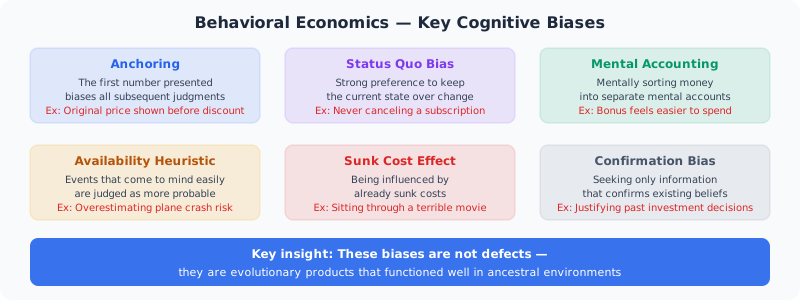
Anchoring is the phenomenon in which the first number or piece of information encountered creates a systematic bias in subsequent judgments.
Kahneman and Tversky’s famous experiment: participants were shown a random spin of a roulette wheel (set to land on either 10 or 65), then asked a completely unrelated question — “What percentage of African countries are members of the United Nations?” Those who saw 65 on the roulette answered an average of 45%; those who saw 10 answered an average of 25%.
Despite no logical connection between the roulette number and UN membership, the first number seen (the anchor) strongly influenced the judgment.
Anchoring in business:
A label showing “regular price ¥100,000, now ¥50,000” makes ¥100,000 the anchor, making ¥50,000 feel like a bargain.
In negotiations, the first figure offered becomes the anchor, which is why the party who opens first can gain an advantage. In salary negotiations, naming a high number first tends to pull subsequent discussion toward that range.
A real estate agent’s strategy of “show the expensive property first” is also an application of anchoring.
Countering anchoring: Before making a decision, consciously set aside information that might serve as an anchor and first form your own assessment — “how much would I value this without seeing any anchor?” — then reference the information.
Status Quo Bias
Status quo bias is the tendency to maintain the current state and show disproportionate resistance to change.
It is explained by loss aversion from prospect theory: the possibility of losing something by changing feels greater than the possibility of gaining something equivalent.
Samuelson and Zeckhauser’s study (1988) had participants decide how to manage a fictional inheritance. Participants showed a strong tendency to maintain whatever “current portfolio” the experimenters had arbitrarily set as the starting point — even though it was experimentally manipulated. Simply being called “the current state” was sufficient to make it preferable.
Connection to the default effect: An important application of status quo bias is the default effect (covered in detail in the nudge theory article).
Studies comparing opt-in (default: not enrolled) and opt-out (default: enrolled) approaches show that the default setting dramatically affects participation rates in many domains — organ donation, pension enrollment, and green energy subscriptions.
Mental Accounting
Mental accounting, proposed by Richard Thaler, is the phenomenon in which people mentally sort money into separate “accounts” by source, purpose, or category — treating the same amount of money differently depending on how it was obtained or labeled.
Examples:
“Spending a bonus on a vacation” is not rational: wages and a windfall are objectively the same money. But a bonus is placed in a special mental account and feels more freely spendable.
“Casino winnings of ¥50,000” are treated more loosely than “¥50,000 earned through ordinary work” — the acquisition path makes it feel like “found money.”
“Never touch the fixed deposit but spend cash in the wallet immediately” is also an effect of managing the same money in different mental accounts.
Using mental accounting to your advantage: You can apply this property in your own favor. Dividing savings accounts by purpose (retirement fund, travel fund, emergency fund) and labeling each creates a “psychological commitment” to each account, making it easier to keep saving.
Objectively the same money behaves differently based on labels — this property of mental accounting is widely applied (and misused) in personal finance, organizational budget management, and marketing.
The Sunk Cost Fallacy
A sunk cost is a cost already incurred and unrecoverable. In rational decision-making, sunk costs should not influence future choices.
Yet in practice they do influence decisions — this is the sunk cost fallacy (also called the Concorde fallacy or escalation of commitment).
Movie example: You start watching a film at the cinema and it’s terrible. The rational decision is “use the remaining time for something else,” but most people stay to the end “because I paid for the ticket.” The ticket cost is sunk and cannot be recovered by staying.
Project example: A project has consumed ¥30 billion, needs another ¥30 billion to complete, and the completed product would now be worth ¥20 billion. Additional investment is irrational. Yet companies repeatedly fail to pull out “because we’ve already invested so much” (the Concorde fallacy).
Professional sports example: The tendency to keep playing an expensive player regardless of current performance is an organizational manifestation of the sunk cost effect.
The rational criterion is “expected future return” — not “past costs.” A practical countermeasure to the sunk cost effect is asking: “If I were starting from scratch today, would I continue this?”
Confirmation Bias and Overconfidence
Confirmation bias is the tendency to actively seek information that supports your existing beliefs or hypotheses while ignoring or downplaying contradictory information.
Experiments show that people are more motivated to “confirm” (gather evidence that their hypothesis is correct) than to “actively test” (seek evidence that it might be wrong).
Confirmation bias combined with overconfidence produces serious errors.
Three forms of overconfidence:
- Overprecision: Overestimating the accuracy of your own knowledge and predictions (“I’m certain this stock will rise”)
- Overestimation: Rating your own abilities as above average (in the famous study, 90% of drivers rate themselves as above-average)
- Overplacement: Believing you will perform better than average on difficult tasks
These biases produce unfounded conviction that “I can beat the market,” underestimation of startup failure rates, and diagnostic errors.
Hyperbolic Discounting (Time Inconsistency)
Hyperbolic discounting is the phenomenon of discounting near-future rewards far more steeply than distant-future rewards — in a way that is inconsistent over time.
Example: “¥100 today” vs. “¥101 tomorrow” — most people choose today. But “¥100 in 30 days” vs. “¥101 in 31 days” — most people choose 31 days.
The time gap is one day in both cases, yet people strongly prefer “today” in the near future but can wait in the distant future. A rational exponential discounting model would apply the same discount rate to the same time interval.
Hyperbolic discounting explains:
- Difficulty saving (prioritizing current spending over future retirement)
- Difficulty with long-term behavioral change like dieting or quitting smoking (“I’ll start tomorrow” — procrastination)
- The “procrastinate → panic → all-nighter” pattern before deadlines
Commitment devices for your future self — automating savings deductions from your paycheck, setting self-imposed early deadlines — are practical countermeasures to hyperbolic discounting.
Heuristics and the Taxonomy of Cognitive Biases
Kahneman and Tversky systematized the heuristics (cognitive shortcuts) that generate biases.
Representativeness heuristic: Probability is judged by how closely a target resembles the typical image of a category. When told “someone who loves books and is introverted” and asked “librarian or farmer?”, people tend to choose librarian — despite farmers being far more numerous. The base rate is ignored in favor of stereotypic typicality.
Availability heuristic: Probability is judged based on examples that come to mind easily. Immediately after seeing many news reports of plane crashes, people overestimate the danger of flying; conversely, when earthquakes feel like “a distant concern,” insurance enrollment rates drop. Ease of recall does not necessarily match actual frequency or probability.
Affect heuristic: Emotions toward a subject (liking, dislike, fear, trust) influence judgments of its risks and benefits. People who dislike nuclear power tend to estimate its risks as higher and its benefits as lower; people who support it do the reverse.
Summary
This article explained Behavioral Economics. We hope it was useful.
The cognitive biases behavioral economics has identified are not defects — they are evolutionary products of an environment that demanded rapid judgment. The problem is that these heuristics misfire in modern complex decision-making situations.
Knowing the names and mechanisms of biases makes the motivations behind your own and others’ behavior more visible. To questions like “why am I reacting emotionally to this proposal?” or “why can’t I cut this losing position?”, behavioral economics offers concrete hypotheses.
To return to the framework list and game theory overview, see the links below.
Thank you for reading. We hope to see you in the next article.
Also popular with readers
📚 Series: Strategic Thinking Frameworks (14/16)