Thank you for visiting this site. This article explains Systems Thinking.
Rather than analyzing problems as isolated elements, systems thinking grasps the whole as interactions, structures, and loops between elements. Developed by researchers at MIT and popularized by Donella Meadows’ book Thinking in Systems, it offers a powerful lens for understanding complex, recurring problems.
The History of Systems Thinking
The foundations of systems thinking trace back to System Dynamics, developed by MIT’s Jay Forrester in the 1960s. Forrester developed computer simulation methods for industrial systems, urban systems, and world systems.
Forrester’s research group (later joined by Meadows and others) published “The Limits to Growth” in 1972 at the request of the Club of Rome, simulating the interactions of population growth, resource depletion, and environmental pollution. The report sold over one million copies and became the starting point for sustainability discussions.
In 1990, Peter Senge’s The Fifth Discipline introduced systems thinking broadly to organizational theory and management, bringing it into the business world.
Systems, Stocks, and Flows
Systems thinking describes a system using three elements: stocks, flows, and feedback loops.
Stock: The accumulated amount or state at a given point in time. A lake’s water volume, a company’s customer base, a bank account balance, organizational trust, soil fertility, and atmospheric CO₂ concentration are all stocks.
Flow: The rate of change of a stock per unit time. The tap flow rate (inflow to the lake), evaporation (outflow), new customer acquisition rate, churn rate, deposits, and withdrawals are all flows.
Stock changes only through flows. And a critical property is that stocks cannot change rapidly.
A reservoir cannot be emptied or filled in an instant. Stocks like organizational trust, soil fertility, and people’s skills all have inertia that resists sudden change.
This “stock inertia” is why systems change slowly — and simultaneously why they act as buffers against sudden shocks.
Two Types of Feedback Loops
Feedback loops are the central concept of systems thinking. They determine a system’s structure and generate its behavioral patterns.
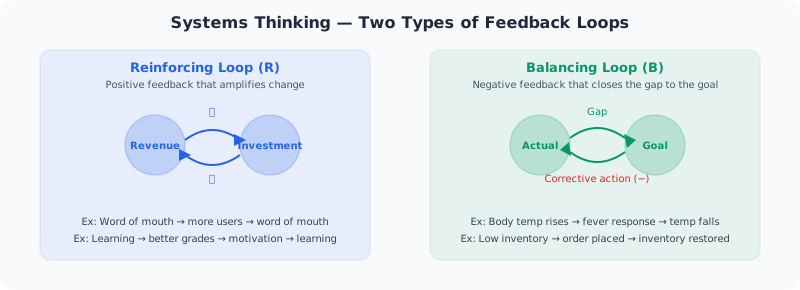
Reinforcing Loops (Positive Feedback)
Positive feedback amplifies change. An initial change generates further change in the same direction.
Examples of growth reinforcing loops:
Word of mouth → more users → more word of mouth → even more users (social network growth)
Capital investment → increased capacity → higher revenue → reinvestment → more capital investment (industrial growth)
Learning → deeper understanding → greater motivation to learn → further learning (compound knowledge)
Bank balance × interest rate → interest → larger balance → more interest (compound interest)
Reinforcing loops also create vicious cycles.
Poverty → lack of educational opportunity → low wages → poverty (poverty trap)
Stress → weakened immunity → increased disease risk → more stress
Environmental destruction → ecosystem degradation → reduced resilience → further destruction
A reinforcing loop alone causes exponential growth or collapse. In real systems, it is constrained by balancing loops.
Balancing Loops (Negative Feedback)
Negative feedback works to reduce the gap between the current state and a goal. It drives toward stability, maintenance, and goal achievement.
Examples of balancing loops:
Body temperature rises above target (36.5°C) → sweating and vasodilation cool the body → temperature returns to target
Inventory falls below target → increase orders → inventory recovers
Price rises → demand falls → price decreases (market price adjustment)
Balancing loops stabilize toward a goal, but problems arise when the “goal” is not explicit. When an organization has many balancing loops with “maintain the current state” as the implicit goal, resistance to change becomes entrenched.
The Problem of Time Delays
An important concept in systems thinking is time delay.
When time passes between a flow (action) and the resulting change in a stock (outcome), ignoring that delay causes over-intervention and oscillation.
The shower temperature metaphor: You move the lever to adjust the shower temperature, but several seconds to tens of seconds pass before the temperature actually changes. Impatient, you move the lever further — now it gets too hot. Following short-term reactions without accounting for the delay causes oscillation from over-correction.
Real-world time delay examples:
Economic policy and the business cycle: The effects of monetary policy (interest rate changes) are said to take 6 months to 2 years to appear in the real economy. Adding further interventions before the effects of the first are visible can cause the effects to accumulate later, triggering excessive inflation or economic overheating.
Medicine and disease: There is a delay of decades between smoking and lung cancer. This delay long maintained the mistaken belief that smoking wasn’t harmful to health.
Environmental policy and CO₂: Even if CO₂ emissions dropped to zero today, CO₂ already accumulated in the atmosphere would continue affecting climate for decades to centuries.
Organizational change: Building organizational culture, capabilities, and trust takes years. Changing course because results aren’t visible in the short term means changing before the outcomes have had a chance to materialize.
The principles for dealing with delays: “recognize that delays exist,” “wait for the results of actions to appear,” and “make small interventions and observe.”
System Traps and Leverage Points
Donella Meadows named structural patterns that cause systems to repeatedly generate the same problems system traps.
Tragedy of the Commons
The structure in which individually rational use of a shared resource (fisheries, pastures, the atmosphere) leads to depletion that harms everyone. Each individual reasons: “if I restrain myself alone, someone else will use it anyway” → no one restrains → resource depletion.
Solutions include mechanism design (institutional constraints on shared resource use), privatization, and community self-governance rules.
Competitive Escalation
A reinforcing loop where two parties each see the other as a threat and continue to escalate. Arms races, advertising wars, intensifying price competition.
Solutions: “one party backs down first (the logic of Axelrod’s Tit-for-Tat strategy)” or “mutually constraining rules (arms control treaties, industry agreements).”
The Trap of Wrong Solutions
A loop in which addressing the symptoms rather than the root causes of a problem delays the actual solution. Headache medicine stops the pain but does not resolve the cause (stress, poor sleep). Short-term symptom treatment delays long-term root-cause resolution.
Solution: “direct flows, rules, and structure at root causes, not symptoms.”
Leverage Points
A leverage point is a place within a system where a small change can generate large overall change.
Donella Meadows listed leverage points in 12 levels from lowest to highest effect. Key examples:
Low-effect leverage points (hard to achieve lasting change):
- Changing numbers (parameters): slightly adjusting a tax rate or tightening an emissions standard slightly
Medium-effect leverage points:
- Changing the strength of feedback loops: speeding or slowing feedback
- Changing information flows: changing who knows what (publishing pollution data, supply chain transparency)
- Controlling reinforcing loops: weakening positive feedback (antitrust regulation)
High-effect leverage points:
- Changing rules (institutions): changing the rules of the game itself
- Changing the system’s goal: changing what the system is trying to achieve
- Changing the paradigm: changing the worldview, values, and beliefs that give rise to the system
Meadows says the most powerful leverage point is the “paradigm.” When a society’s fundamental worldview shifts — from one where slavery was accepted to one that recognizes human rights, from one where only GDP growth is the goal to one that considers sustainability — the same structure produces entirely different behavior.
For practical decision-making, working at lower-level leverage points (information flows, feedback loop structure, rules) is more actionable.
Interactions and Unintended Side Effects
One of the most important lessons of systems thinking is that an intervention in one part of a system produces unexpected effects on the whole.
Induced demand: When roads are widened to relieve congestion, new drivers appear and congestion returns. Increased capacity makes latent demand visible; the increased flow maintains the stock (accumulated congestion).
The Cobra Effect: When British colonial administrators in India offered a bounty for dead cobras to reduce the cobra population, locals began breeding cobras for the reward money. The policy worsened the very problem it aimed to solve. A similar effect occurred with the rat-bounty policy in French colonial Vietnam.
Antibiotic resistance: Overuse of antibiotics drives the evolution of drug-resistant bacteria. Short-term infection control (a balancing loop) activates a reinforcing loop of resistance strengthening.
These examples illustrate the systems structural problem: “local optimization does not produce global optimization.”
Systems Thinking and Organizational Theory
Peter Senge applied systems thinking to organizational structure in The Fifth Discipline. Among his five disciplines (personal mastery, shared vision, team learning, mental models, and systems thinking), he positioned systems thinking as “the fifth discipline” that integrates the other four.
Reinforcing loops in organizations:
Hiring capable talent → productivity rises → revenue increases → better hiring conditions → even more talented people (virtuous cycle of a good organization)
Frequent quality problems → brand erosion → talented people leave → further quality problems (vicious cycle)
“Balancing process with delay” — a system trap:
When there is a delay between an organization recognizing a problem, taking action, and seeing the results, anxious management may implement additional (often excessive) measures before the first intervention has had time to work. When the first intervention’s effects finally appear — compounded by the additional measures — overcorrection results.
Summary
This article explained Systems Thinking. We hope it was useful.
The answer to “why does the same problem keep recurring?” lies, in most cases, in the structure of the system — this is the core insight of systems thinking. Seeing not individual events but patterns; and not patterns but structures, is the starting point.
The four tools of stocks-and-flows, identifying feedback loops, accounting for time delays, and searching for leverage points can help you anticipate the side effects of simple interventions in complex problems and find more fundamental solutions.
To return to the framework list and game theory overview, see the links below.
Thank you for reading. We hope to see you in the next article.
Also popular with readers
📚 Series: Strategic Thinking Frameworks (15/16)